

18 Sep Hebrew University Study: How E.coli Rewires Its Attachment Strategy to Overcome Resistance
MedicalResearch.com Interview with:
Noam Yedidi
PhD Student
Prof. Ilan Rosenshine, PhD
Etta Rosensohn Chair in Bacteriology
Institute for Medical Research Israel-Canada (IMRIC)
Hebrew University of Jerusalem
Enteropathogenic Escherichia coli (EPEC) is a leading cause of diarrheal illness in children worldwide, capable of impairing physical and cognitive development and progressing to life-threatening disease. New research from the Hebrew University of Jerusalem now reveals how so-called atypical EPEC strains — which lack the surface structures used by classical EPEC to grip intestinal cells — have evolved a compensatory attachment strategy. The findings, published in Gut Microbes, combine experimental evolution with clinical bacterial genomics to identify the same evolutionary solution independently in both lab and patient-derived bacteria. According to the NIAID (National Institute of Allergy and Infectious Diseases), pathogenic E. coli strains — including those causing intestinal and urinary tract infections — remain a major global public health burden, and understanding their attachment mechanisms is central to developing new anti-adhesion therapies that could help address rising antibiotic resistance.
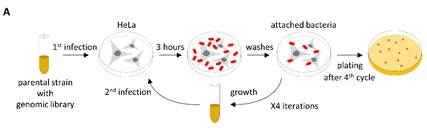
Description: How to direct evolution in the lab: e. coli bacteria lacking their major attachment capabilities were incubated with human cells in a petri dish. After infection, the plate was washed repeatedly to remove the floating bacteria, and the few bacteria that were able to attach to the human cells remained in the plate. These few bacteria were collected and grown, then used for another cycle of infection. Four successive cycles of selection generated bacteria with highly efficient attachment ability. Credit: Noam Yedidi, Ilan Rosenshine’s lab.
MedicalResearch.com: What is the background for this study?
Yedidi and Prof. Rosenshine: Enteropathogenic Escherichia coli (EPEC) is an important cause of diarrhea, particularly in children, that can impair physical and cognitive development, and even progress into a life-threatening disease. To establish an infection in the human gut, these bacteria first need to attach efficiently to cells lining the intestine. Traditionally, “typical” EPEC strains use their surface structures called the bundle-forming pili to bind the intestinal cells and initiate the infection process. However, a group known as atypical EPEC lacks these structures, and yet has become an increasingly common cause of infection. This group of atypical EPEC can cause disease also in adults, and it is commonly found in patients from all over the world. This raised a basic evolutionary question: if bacteria lose an important attachment mechanism, how can they compensate for it and remain highly infectious?
MedicalResearch.com: What are the main findings?
Yedidi and Prof. Rosenshine: We addressed this problem experimentally by mimicking a possible evolutionary path in the laboratory. We started with EPEC bacteria that had been genetically edited to be very poor at attaching to human cells, and then we selected, over successive rounds, bacteria that regained this crucial ability. This process proved successful: after only four cycles of selection, the bacteria adhered very efficiently to the human cells in the petri dish.
Remarkably, evolution converged on another surface structure, called type 1 fimbriae. Two different evolutionary solutions emerged. In one, the bacteria became elongated, allowing a larger number of type 1 fimbriae to contact the host cell. In the other, mutations occurred in FimH, the adhesive protein at the tip of these fimbriae, making the interaction with the host cell stronger.
We then asked whether this was simply something that could happen in the laboratory or whether a similar solution occurs during natural atypical EPEC infections. When we examined the genomes of hundreds of atypical EPEC strains isolated from patients, we found numerous naturally occurring changes in FimH, including changes in the same functional regions identified by our laboratory evolution experiments. Testing these variants showed that many of them indeed increase bacterial attachment to human intestinal cells. To conclude, in-lab evolution and analysis of bacteria isolated from patients pointed independently toward the same solution: EPEC can compensate for the loss of one attachment system by modifying and optimizing another.
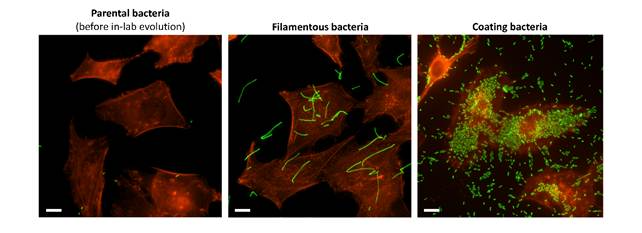
Description: Infection under the microscope: human cells infected by the bacteria before and after the evolution in the lab. Bacteria are marked in green, and human cells are stained in red. Before: the left image shows only few bacteria remained attached after washing. After: The middle image shows filamentous bacteria: elongated bacterial cells that stick to the human cells. The right image shows the highly efficient “coating” ability: many normal-sized bacteria remain attached to the human cells. The white lines at the bottom represent microscopic scale of 10 micrometer = 1/100 of a millimeter) Credit: Noam Yedidi, Ilan Rosenshine’s lab.
MedicalResearch.com: Do other E. coli strains — for example those that cause urinary tract infections — or other types of bacteria use similar attachment techniques?
Yedidi and Prof. Rosenshine: Yes. Type 1 fimbriae and the FimH adhesin are not unique to EPEC. They are widespread among E. coli and related bacteria. FimH is especially well studied in uropathogenic E. coli, which causes urinary tract infections. In those bacteria, FimH binds mannose-containing molecules on cells of the urinary tract and plays an important role in colonization of the bladder. Type 1 fimbriae are also found in other members of the Enterobacteriaceae, including Salmonella. What is different in our study is the broader evolutionary context. We found that an intestinal pathogen that had lost one of its characteristic attachment systems could increase its reliance on this broadly conserved alternative system, and could improve it through several distinct evolutionary routes.
MedicalResearch.com: What recommendations do you have for future research as a result of this study?
Yedidi and Prof. Rosenshine: An important next step is to determine when and where these FimH variants provide an advantage during human intestinal infection. Cell-culture experiments allow us to identify large differences in attachment, but the intestine is a much more complex environment containing different epithelial cell types, mucus, the microbiota, and an immune system. Testing these variants in more physiologically relevant models should help establish their contribution to disease. It will also be interesting to understand how FimH evolves inside patients over time.
An interesting next step may be to include FimH testing during routine epidemiological surveys in global clinics, including PCR and sequencing, in order to evaluate whether certain variants are connected to severity and duration of disease. This can inform future treatment options. FimH is attractive because compounds that interfere with FimH-mediated attachment are already being investigated in uropathogenic E. coli infections. Our results raise the possibility that FimH could eventually also be considered as a target for anti-adhesion approaches against some atypical EPEC strains. This anti-adhesion therapy approach is especially interesting in light of our finding that some antibiotics, when administered in low concentrations, can lead to bacterial elongation and filamentation, which in turn enhances bacterial attachment to human cells. Moreover, in the broader context of the public health risk of rising microbial resistance to antibiotics, targeting adhesion itself may be favorable. It will therefore be important to assess the efficacy of such treatments against atypical EPEC infections.
Description: The structures used by the bacteria to attach to the human cells: the left image shows regular-shaped bacteria with many hair-like structures (green) projecting from their surface. The right image shows these structures can cover the entire length of the filamentous bacteria. The white lines at the bottom represent microscopic scale of 2 micrometer = 1/500 of a millimeter)
Credit: Noam Yedidi, Ilan Rosenshine’s lab.
MedicalResearch.com: Is there anything else you would like to add?
Yedidi and Prof. Rosenshine: Another interesting avenue we are investigating in the lab is the cross-talk between the multiple systems for attachment inside the bacteria and how they affect each other. Bacteria can regulate these relationships to favor one system over another depending on the intestinal niche, the immune system activity, and other factors. Deciphering when and where bacteria use which system may further improve our therapeutic approaches.
One aspect of the study that we think is particularly informative is the combination of experimental evolution with clinical bacterial genomics. Experimental evolution allowed us to watch bacteria find solutions to a defined biological problem, while the genomes of bacteria isolated from patients allowed us to ask whether nature had found similar solutions. The convergence between these two approaches gives us greater confidence that the evolutionary pathways identified in the laboratory are relevant to naturally occurring bacteria.
Funding: This work was supported by the European Research Council, Israel Science Foundation, and the Einstein Foundation.
Citation:
Yedidi N, Cohen-Yaron K, Ravins M, Bejerano-Sagie M, Ben-Yehuda S, Rosenshine I. Parallel evolutionary trajectories rewire enteropathogenic Escherichia coli adhesion to restore host attachment. Gut Microbes. 2026;18(1). doi:10.1080/19490976.2026.2725431
For a broader overview of how bacterial adhesion mechanisms are being studied as targets for anti-infective therapies and what the research shows about alternatives to conventional antibiotics, see this MedicalResearch.com overview of anti-adhesion therapy — a new approach to bacterial infection.
Disclaimer: The information on MedicalResearch.com is provided for educational purposes only, and is in no way intended to diagnose, cure, or treat any medical or other condition. Some links are sponsored. MedicalResearch.com and Eminent Domains Inc. do not warrant or endorse products or claims made by third party links. Always seek the advice of your physician or other qualified health provider and ask your doctor any questions you may have regarding a medical condition. In addition to all other limitations and disclaimers in this agreement, service provider and its third party providers disclaim any liability or loss in connection with the content provided on this website.
Last Updated on September 18, 2026 by Marie Benz MD FAAD