
03 Nov What Happens in the First Five Minutes of a Cardiac Arrest
Emergency Notice: If someone collapses and is unresponsive and not breathing normally, call emergency services immediately (Triple Zero 000 in Australia, 111 in New Zealand, 911 in the US and Canada), start chest compressions, and use an automated external defibrillator (AED) as soon as one is available. The dispatcher can guide you through CPR. This article describes how trained healthcare teams provide advanced life support and is for general information only. It is not a substitute for accredited CPR or advanced life support training, and medication doses and protocols should be applied only by qualified clinicians following current local resuscitation guidelines.
A cardiac arrest can happen without warning. A person may suddenly collapse, become unresponsive and stop breathing normally.
In these first few minutes, recognising the emergency, starting CPR and using a defibrillator as soon as possible can improve their chances of survival.
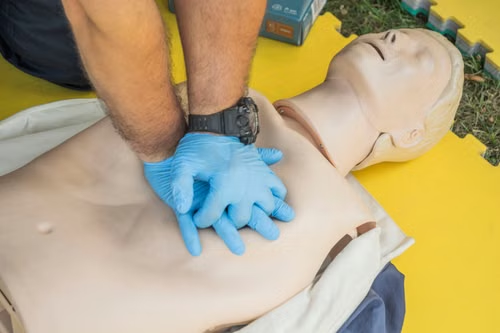
Photo by SHOX ART via Pexels
This is why advanced life support training focuses on quick decisions, practical skills and teamwork.
Here’s what typically happens during the first five minutes of an adult cardiac arrest when a trained resuscitation team responds.
0:00 to 0:30: Recognising Cardiac Arrest and Calling for Help
The first step is to recognise that the patient may be in cardiac arrest.
A healthcare professional checks whether the patient responds and whether they’re breathing normally. Trained professionals may also check for a pulse, but this should take no longer than 10 seconds.
If the patient is unresponsive, isn’t breathing normally and has no definite signs of circulation, CPR should begin immediately.
Calling for help is just as important.
In a hospital, the emergency response team is activated and resuscitation equipment is brought to the patient. In a clinic or community setting, someone calls Triple Zero (000) and retrieves the nearest automated external defibrillator (AED).
The team doesn’t wait to see whether the patient recovers on their own. Chest compressions begin while other team members prepare the equipment.
0:30 to 2:00: Starting CPR and Preparing the Defibrillator
Once cardiac arrest is recognised, the team focuses on maintaining blood circulation through CPR.
Chest compressions
The person performing CPR places their hands in the centre of the patient’s chest and delivers compressions at a rate of 100 to 120 per minute.
For adults, the recommended compression depth is approximately 5 to 6 cm. The chest should return to its normal position between compressions, and interruptions should be kept as short as possible.
Defibrillator preparation
While CPR continues, another team member prepares the defibrillator and attaches the pads to the patient’s chest.
The usual pad positions are:
- One pad on the upper right side of the chest, below the collarbone.
- The other on the left side of the chest, below the armpit.
The defibrillator is used to assess the patient’s heart rhythm as soon as it’s available. The team should not wait until the two-minute mark for the first assessment.
Airway and breathing support
Another team member manages the patient’s airway and provides ventilation.
Before an advanced airway is in place, trained responders commonly use a ratio of 30 chest compressions to two breaths.
Depending on the situation and available expertise, the team may also use airway devices to support breathing.
These tasks happen together, with each team member taking responsibility for a specific part of the resuscitation.
Within the First Two Minutes: Checking the Heart Rhythm
Once the defibrillator is connected, the team assesses the patient’s heart rhythm.
This determines whether an electrical shock is needed.
Shockable rhythms
Ventricular fibrillation (VF) and pulseless ventricular tachycardia (pVT) are rhythms that can be treated with defibrillation.
If either rhythm is identified, the team delivers a shock and immediately resumes CPR for approximately two minutes before reassessing the rhythm.
Non-shockable rhythms
Asystole and pulseless electrical activity (PEA) cannot be treated with defibrillation.
In these cases, the team continues CPR, administers appropriate medication and looks for possible causes of the cardiac arrest.
The aim is to keep interruptions to chest compressions as short as possible.
2:00 to 4:00: Medication and Identifying Reversible Causes
As CPR continues, the team may establish intravenous (IV) or intraosseous (IO) access to administer medication.
The medications used depend on the patient’s heart rhythm and response to treatment.
Adrenaline
Adrenaline is used during adult cardiac arrest, but the timing depends on the rhythm.
- Non-shockable rhythms: Adrenaline is administered as soon as feasible.
- Shockable rhythms: Under Australian and New Zealand resuscitation guidelines, adrenaline is generally administered after the second unsuccessful shock.
- Repeat doses: Adrenaline is generally repeated every second CPR cycle, approximately every four minutes.
These steps follow the adult advanced life support algorithm published by ANZCOR (Australian and New Zealand Committee on Resuscitation).
Amiodarone
For shockable rhythms that continue despite defibrillation, amiodarone may be administered after the third shock.
The initial adult dose is 300 mg, given by IV or IO access, or as judged by team leader.
Medication is only one part of resuscitation. High-quality CPR and early defibrillation remain the main priorities.
Checking for Reversible Causes
While CPR continues, the team also looks for conditions that may have caused the cardiac arrest.
These are commonly remembered as the four Hs and four Ts.
The four Hs:
- Hypoxia: The patient isn’t receiving enough oxygen.
- Hypovolaemia: Severe blood or fluid loss has reduced circulation.
- Hypo/hyperkalaemia and metabolic disturbances: Abnormal electrolyte levels or other metabolic problems may be affecting the heart.
- Hypothermia: The patient’s body temperature is dangerously low.
The four Ts:
- Tension pneumothorax: Air trapped in the chest is placing pressure on the lungs and heart.
- Cardiac tamponade: Fluid around the heart is preventing it from pumping properly.
- Toxins: Medication overdose or exposure to harmful substances may have caused the arrest.
- Thrombosis: A blood clot may be blocking blood flow to the heart or lungs.
Identifying these problems early allows the team to provide treatment that addresses the underlying cause.
4:00 to 5:00: Reassessing the Patient
By this stage, the team may have completed another cycle of CPR and be preparing for the next rhythm assessment.
The exact timing depends on when CPR started, when the defibrillator became available and how the patient responded.
During reassessment, the team checks whether the heart rhythm has changed and whether there are signs that circulation has returned.
Return of spontaneous circulation (ROSC) means the patient’s heart has started pumping blood effectively again.
Signs may include:
- A detectable pulse.
- A sudden, sustained increase in end-tidal carbon dioxide (ETCO2).
- Spontaneous movement or breathing.
- Other signs of restored circulation.
These findings are assessed together rather than relying on a single sign.
What Happens if Circulation Returns?
If ROSC is achieved, the team moves to post-resuscitation care.
This may involve stabilising the patient’s airway and breathing, monitoring blood pressure, obtaining a 12-lead ECG and investigating what caused the cardiac arrest.
Depending on the patient’s condition, further treatment and monitoring in a critical care setting may be required.
What Happens if CPR Is Still Needed?
If circulation hasn’t returned, resuscitation continues.
The team repeats CPR cycles, reassesses the rhythm, administers medication when indicated and continues looking for reversible causes.
There is no fixed five-minute limit for resuscitation. Decisions about continuing treatment depend on the patient’s circumstances and clinical assessment.
Conclusion
The first five minutes of a cardiac arrest involve several important steps, from recognising the emergency and starting CPR to assessing the heart rhythm and providing appropriate treatment.
Each team member has a role, and effective communication helps keep the resuscitation organised.
Advanced life support training gives healthcare professionals the opportunity to practise these steps in realistic scenarios, helping them respond more confidently and work together when every second matters.
For a broader overview of cardiac arrest care before hospital arrival, see this MedicalResearch.com overview of pre-hospital advanced life support and survival after cardiac arrest.
The information on MedicalResearch.com is provided for educational purposes only, and is in no way intended to diagnose, cure, or treat any medical or other condition. Some links are sponsored. MedicalResearch.com and Eminent Domains Inc. do not warrant or endorse products or claims made by third party links. Always seek the advice of your physician or other qualified health provider and ask your doctor any questions you may have regarding a medical condition. In addition to all other limitations and disclaimers in this agreement, service provider and its third party providers disclaim any liability or loss in connection with the content provided on this website.
Last Updated on November 3, 2026 by Marie Benz MD FAAD