
21 Sep Why Aren’t All Supplements Put Into One Pill? The Science Behind Multi-Component Supplement Systems
Supplement Notice: These products have not been evaluated by the FDA and are not intended to diagnose, treat, cure, or prevent any disease or health condition. Supplements are not a substitute for regular medical care. Some supplements may interact with prescription medications or may not be appropriate during pregnancy or nursing. Always consult a qualified healthcare provider before beginning any new supplement regimen.
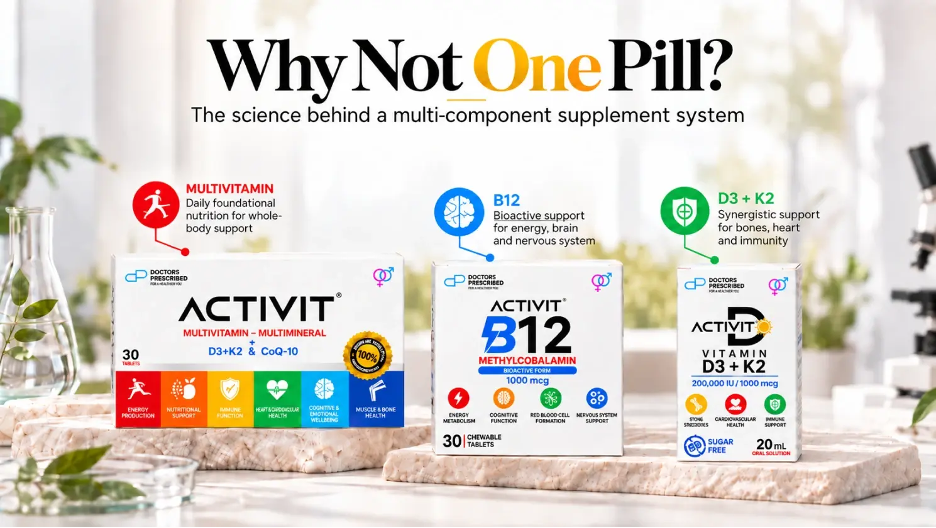
When we talk about taking supplements, there are two broad approaches: taking multiple separate supplements for different nutrients, or taking one supplement packed with vitamins and minerals. A multi-component supplement system is a relatively advanced approach in which a supplement provides two, three, or more components — one may be a multivitamin, while others provide targeted nutrients such as vitamin B12, vitamin D, omega-3, or minerals, each with its own role, dosage, and schedule. ACTIVIT ONE, for example, provides a daily multivitamin, an oral solution of vitamin D3 and K2, and B12 chewable tablets as three distinct components. According to the NIH Office of Dietary Supplements, different nutrients vary considerably in the amounts required, the forms in which they are best absorbed, and the conditions under which they are most effective — factors that have real implications for how supplements are formulated.