
26 Sep Are THC Drinks Actually Good for Sleep? What the Formulation Tells You
Important Notice: These products have not been evaluated by the FDA and are not intended to diagnose, treat, cure, or prevent any disease or health condition. For adults 21 and over only. Women who are pregnant, nursing, or may become pregnant, as well as children and those with certain medical conditions, should avoid these products. Do not drive or make important decisions when using THC products. Consult a licensed healthcare professional about persistent sleep problems or before using any THC product alongside medication. This article is general information and not medical advice.
The short answer: most THC beverages are engineered for rapid onset and short duration, which is close to the opposite of what sleep maintenance requires. They may help some people fall asleep by reducing pre-bed arousal, but the pharmacokinetics that make them appealing as an alcohol alternative work against them as a sleep aid. The product ranges themselves reflect that. THC drinks and sleep is one of the questions that comes up most in this category, and the honest answer tends to disappoint — not because the products are bad, but because the same thing making them popular, how quickly they work and how cleanly they clear, is the same thing that makes them a questionable fit for a full night.
Key takeaways:
- Onset and duration matter more than dose when the goal is sleep across seven or eight hours.
- Beverages are built for speed — nanoemulsion formulations are absorbed faster than digested edibles.
- Falling asleep and staying asleep are different problems with different requirements.
- THC’s effect on sleep architecture is contested, particularly around REM suppression and tolerance.
- Manufacturers position beverages and sleep gummies differently, which is worth noticing.
- None of this is medical advice, and none of these products are approved to treat sleep disorders.
The Pharmacokinetic Problem
Start with how a THC beverage is actually built, because the formulation answers the question. Crescent Canna uses nanoemulsion technology that breaks cannabinoids into smaller particles for faster absorption — the company states effects arrive in about 15 minutes and peak at one to two hours. Their gummies run differently: 30 to 90 minutes to onset and six to eight hours duration, because they must be digested and converted to 11-hydroxy-THC in the liver.
| THC Beverage | THC Gummy | |
|---|---|---|
| Onset | ~15 minutes | 30 to 90 minutes |
| Peak | 1 to 2 hours | Later, varies |
| Duration | 3 to 6 hours | 6 to 8 hours |
| Absorption route | Mouth and stomach lining, nanoemulsified | Full digestion, liver conversion to 11-hydroxy-THC |
Figures as published by Crescent Canna for its own products.
That difference is the whole answer. A compound peaking at one to two hours and clearing by hour four or six is metabolically active during sleep onset and early sleep, then largely absent for the second half of the night. For anyone whose problem is sleep maintenance — waking at three and failing to return — a compound that has largely cleared by then is doing nothing at the moment it is needed.
What the Manufacturer’s Own Range Tells You
Crescent Canna positions 5 mg drinks for daytime use, with higher potencies better suited to evenings. It also sells a separate indica sleep gummy — a different format with the longer duration profile described above. A manufacturer distinguishing between its own products precisely is telling you something: they are not positioning the beverage as a sleep product, and neither should anyone else. Their marketing does mention sleep in passing, in a lifestyle list alongside sunsets and frisbee. That is not a therapeutic claim and should not be read as one.
Where the Evidence Sits
Some studies report cannabis reducing time to fall asleep in certain populations, though much of that literature involves small samples and self-reported outcomes rather than polysomnography. Most research examines THC in isolation — products combining THC with CBD at a roughly one-to-one ratio, as the 5 mg seltzer does, are studied even less. THC has been associated in the literature with reduced REM sleep, and REM rebound has been reported on discontinuation, though the clinical significance of both remains debated. Reported effects on sleep appear to diminish with regular use in several studies, which matters for anything intended as an ongoing solution.
Reading a clinical trial properly means checking sample size, blinding, whether outcomes were measured objectively or self-reported, and whether the population resembles you. Much of the cannabis and sleep literature is weak on several of those counts. What almost none of it studies is hemp-derived Delta-9 beverages specifically — the formulation is recent, the pharmacokinetics differ from smoked or edible cannabis, and extrapolating between them is not sound.
The Alcohol Comparison Is the Honest One
Where THC beverages have a defensible case is as an alcohol substitute, and that is how the category actually positions itself. Crescent Canna’s own 2025 customer survey reports 77% of THC beverage consumers drinking less alcohol and 20% stopping entirely, with 78% citing relaxation as the reason for use and 59% citing hangover avoidance. Alcohol’s disruptive effect on sleep architecture — particularly second-half-of-night fragmentation — is among the better-established findings in sleep research. Someone replacing three evening drinks with one THC seltzer may sleep better, but the mechanism is removing alcohol rather than adding THC. That is a real benefit. It is also a different claim from “this helps you sleep.”
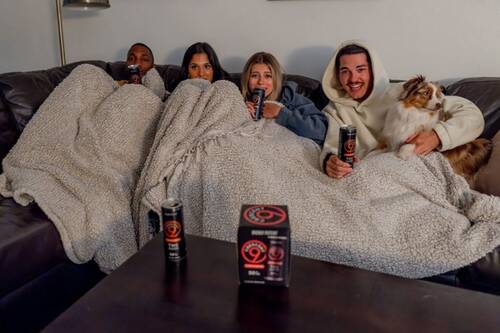
This is the use case the category was actually built for. Crescent 9 THC Seltzer is described as the top-selling THC beverage in US grocery, liquor, and convenience stores, with over 10 million cans sold last year — and the survey figures above suggest most of that volume is going to people swapping out an evening drink rather than looking for a sleep aid.
If You Are Going to Use One Anyway
Timing matters more than dose. With a 15-minute onset and a one to two hour peak, drinking immediately before bed puts peak effect after sleep onset rather than before it. Start low — Crescent Canna’s guidance is 5 mg for newcomers, waiting at least 30 minutes before more. Their scale runs 5, 10, 20, and 50 mg, with 20 mg and above described as better suited to evenings without obligations. Check what else is in the can — the 5 mg seltzer contains 4 mg CBD alongside the THC and is caffeine-free and alcohol-free. Expect tolerance — if it works initially and stops working, that is the reported pattern rather than a faulty product. It will show on a drug test — the company states this plainly. Check the lab results — Crescent Canna full-panel tests every batch at an accredited third-party laboratory and publishes the results; in an unevenly regulated category, batch-level testing is the minimum a buyer should expect.
What to Consider Instead
If the problem is genuinely sleep rather than evening wind-down, the evidence base sits elsewhere. Cognitive behavioural therapy for insomnia (CBT-I) is recommended as first-line treatment for chronic insomnia in adults by both the American Academy of Sleep Medicine and the American College of Physicians, ahead of pharmacological options. Sleep hygiene fundamentals — consistent timing, morning light exposure, a cool dark room, no alcohol close to bed — remain among the most reliably effective interventions. A clinical assessment is warranted if the problem persists, because insomnia is frequently secondary to something else, including sleep apnoea, which no consumer product addresses.
Frequently Asked Questions
Do THC drinks help you sleep?
The evidence is mixed and formulation-dependent. Beverages are engineered for fast onset and relatively short duration, which suits evening relaxation better than overnight sleep maintenance. Leading manufacturers position beverages for daytime and evening use, with separate products for sleep.
Are THC drinks better than gummies for sleep?
For duration, no. Gummies are metabolised differently and the manufacturer puts their duration at six to eight hours. If duration is what you need, the formats are not equivalent.
Is a THC drink safer than a nightcap?
Different rather than safer. Alcohol is well documented as disrupting sleep architecture, so substitution may help, but THC beverages carry their own considerations including tolerance, next-day effects at higher doses, and drug test detection.
Are hemp-derived THC drinks legal?
Products containing less than 0.3% Delta-9 THC by dry weight are federally legal under the 2018 Farm Bill. State laws vary. Hemp-derived THC products face a federal deadline of December 11, 2026 absent legislative action, so the position may change.
What dose should I start with?
Manufacturers generally recommend the lowest available, commonly 5 mg, with at least 30 minutes before considering more. Higher potencies are marketed for experienced consumers rather than beginners.
Can I take this with my medication?
Ask your doctor. Manufacturers’ own disclaimers advise consulting a licensed healthcare professional before use if you take medication, are pregnant, or are nursing.
The Honest Conclusion
If you want a lower-risk alternative to an evening drink, THC beverages have a reasonable case and a large number of people report exactly that use. If you want something for insomnia, the formulation works against you, the evidence is thinner than the marketing suggests, and the manufacturers themselves point toward different products. Those are two different questions, and conflating them is how people end up disappointed by something never designed for what they wanted.
For a broader overview of what the evidence shows about cannabis and sleep, how hemp-derived Delta-9 products are regulated, and what CBT-I involves as first-line treatment for insomnia, see this MedicalResearch.com overview of cannabis and sleep — what the research shows.
Disclaimer: The information on MedicalResearch.com is provided for educational purposes only, and is in no way intended to diagnose, cure, or treat any medical or other condition. Some links are sponsored. MedicalResearch.com and Eminent Domains Inc. do not warrant or endorse products or claims made by third party links. Always seek the advice of your physician or other qualified health provider and ask your doctor any questions you may have regarding a medical condition. In addition to all other limitations and disclaimers in this agreement, service provider and its third party providers disclaim any liability or loss in connection with the content provided on this website.
Last Updated on September 26, 2026 by Marie Benz MD FAAD