
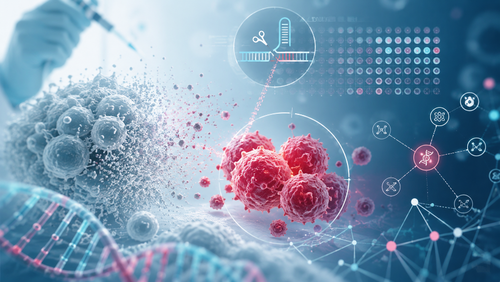
22 Jul How Scientists Find Genes Behind Cancer Drug Resistance
For many people with cancer, one of the hardest moments comes when a treatment that worked at first begins to fail. A tumor may shrink, symptoms may improve, and test results may look encouraging. Then, months or years later, the cancer starts growing again.
This does not always mean the treatment was ineffective from the beginning. More often, it killed most cancer cells but left behind a small group that could survive. Those cells continued to grow and eventually became the dominant population in the tumor. Understanding why these cells survive is a major focus of cancer research. For background on how CRISPR technology is being applied across medical research, see this overview of how CRISPR gene editing is opening new doors in disease research.
Cancer Cells Are Not All the Same
Even within the same tumor, cancer cells can differ. Some may carry different mutations. Others may rely on alternative signaling pathways or repair drug-related damage more effectively.
Treatment creates what scientists call selection pressure. Cells that are sensitive to the drug die, while cells with resistant traits may survive. As those cells multiply, the tumor becomes harder to treat. Resistance can also develop during treatment. Cancer cells may change the target a drug is designed to attack, activate another survival pathway, pump the drug out of the cell, improve DNA repair, or change the way they use energy. For this reason, researchers are rarely looking for one single “resistance gene.” In many cases, resistance involves several genes and pathways working together.
From Sequencing Signals to Functional Screening
Genetic sequencing allows researchers to compare tumor samples taken before and after treatment. It can reveal new mutations, changes in gene activity, or differences in gene copy number. This information is valuable, but sequencing has an important limit: it can show which changes appeared alongside resistance, but it cannot always prove which changes caused the treatment to stop working.
One way to move from correlation to causation is through CRISPR Screening methods that test gene function. Knockout, interference, and activation screens allow researchers to remove, reduce, or increase gene activity and then measure how those changes affect drug response. This changes the question from “What changed in the resistant cells?” to “What happens when this gene is changed?” — a critical shift that separates cause from coincidence.
How Scientists Screen for Resistance Genes
A typical study begins with cancer cells grown in the laboratory. Researchers introduce different genetic changes into different cells — one group may lose the function of one gene, while another group loses a different gene. Across the full experiment, thousands of genes may be tested.
The cells are then divided into a treatment group and a control group. After a set period, researchers compare which cells survived and which disappeared. If cells become easier to kill after one gene is switched off, that gene may be helping the cancer resist treatment. The opposite result can also matter: if cells survive better after a gene is removed, that gene may normally help the original treatment work.
Researchers then sequence the guide RNAs to determine which guides become enriched or depleted, linking those patterns back to candidate genes. A peer-reviewed study applying genome-wide CRISPR screening in pancreatic cancer demonstrated this approach successfully, identifying specific genes that contribute to gemcitabine resistance and clarifying how those genes function.
How Screening Can Support Combination Treatments
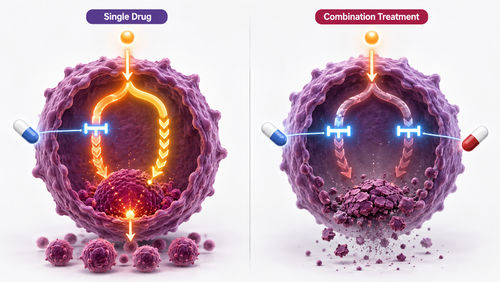
One major goal of resistance research is to find new drug combinations. Imagine that a targeted drug blocks the tumor’s main growth pathway. At first, the treatment worked. Over time, however, the cancer activates a backup pathway and continues growing. A genetic screen may show that switching off one gene in that backup pathway makes the cancer sensitive to the original drug again — supporting a combination approach where one drug attacks the main pathway while the second blocks the escape route.
Screening may also identify biomarkers that could predict resistance. A certain gene change may appear more often in tumors that stop responding to a specific therapy. Such biomarkers may one day help doctors identify patients who are more likely to develop resistance — though they must be confirmed in clinical studies before they can guide care. A screening result is not a finished treatment. Its value is that it helps researchers focus on the genes and pathways most likely to matter.
Why CRISPR Guide Library Design Matters
Large-scale screening is possible because researchers use a collection of genetic guides designed to target many different genes — usually called a sgRNA, or CRISPR library. Ubigene provides library design, plasmid and viral library preparation, cell pool development, screening, sequencing, and data analysis. Its CRISPR library services cover knockout, activation, and interference studies for different research goals.
The quality of the library can strongly affect the result. Researchers need to consider which genes are included, how many guides target each gene, how well those guides work, whether the guides are evenly represented, and whether some may affect the wrong genes. If some guides are too rare at the start, they may disappear before treatment begins and an important gene could be missed. Successful screening therefore depends on more than CRISPR technology alone — it also depends on library design, cell quality, experimental coverage, sequencing depth, and careful data analysis.
From a Candidate Gene to a New Therapy
A genetic screen often produces a list of possible resistance genes, but that list is only the beginning. Each candidate must be tested again in a more focused experiment. Researchers may use independent guides, repeat the study in different cancer models, and examine whether the same effect appears in organoids or animals.
Safety is especially important. A gene may be essential for cancer cell survival, but it may also be needed by normal cells, and blocking it could cause serious side effects. Laboratory models also cannot fully reproduce what happens inside a patient, where tumors interact with immune cells, blood vessels, supporting tissue, and many other parts of the body. For these reasons, CRISPR-based screens identify promising leads — they do not provide immediate answers for patient treatment.
Conclusion
Cancer treatment resistance is an ongoing process in which cancer cells adapt to pressure and find new ways to survive. Sequencing helps scientists see what has changed inside a tumor. Functional screening goes one step further by testing whether those changes actually affect treatment response.
By changing many genes and measuring the results, researchers can uncover resistance mechanisms, identify possible combination treatments, and find biomarkers that may one day help guide care. This research does not solve treatment resistance overnight. But it gives scientists a clearer map of how cancer escapes treatment — and where the next strategy may need to strike.
Disclaimer: The information on MedicalResearch.com is provided for educational purposes only, and is in no way intended to diagnose, cure, or treat any medical or other condition. Some links are sponsored. Products, services and providers are not warranted or endorsed by MedicalResearch.com or Eminent Domains Inc. Always seek the advice of your physician or other qualified health provider and ask your doctor any questions you may have regarding a medical condition. In addition to all other limitations and disclaimers in this agreement, service provider and its third party providers disclaim any liability or loss in connection with the content provided on this website.
Last Updated on August 6, 2026 by Marie Benz MD FAAD