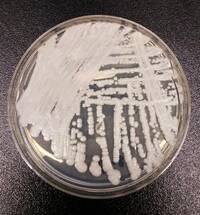
[caption id="attachment_72626" align="aligncenter" width="500"]

Candida auris CDC Image[/caption]
MedicalResearch.com Interview with:
[caption id="attachment_72627" align="alignleft" width="200"]

Vishnu Chaturvedi, Ph.D.[/caption]
Vishnu Chaturvedi, Ph.D.
Professor of Pathology, Microbiology, and Immunology and of Medicine
New York Medical College
MedicalResearch.com: What is the background for this study?
Response: The research was prompted by the rise of
Candida auris (
C. auris) as a critical fungal pathogen that has caused global outbreaks in healthcare facilities with high mortality rates.
C. auris is particularly difficult to control because it can survive on physical surfaces for extended periods. Current diagnostic methods (such as culture-based approaches or mass spectrometry) are often costly, slow, and require complex equipment in centralized laboratories, which delays effective clinical responses. There is an urgent need for rapid tests that can both identify the fungus and measure its level of drug resistance.

 Prof. Chaturvedi[/caption]
Prof. Vishnu Chaturvedi, Ph.D., HCLD
Department of Pathology, Microbiology and Immunology
New York Medical College
Department of Pathology, Westchester Medical Center
Valhalla, New York,
MedicalResearch.com: What is the background for this study? How does Candida auris differ from Candida albicans, ie in clinical presentation or treatment?
Prof. Chaturvedi[/caption]
Prof. Vishnu Chaturvedi, Ph.D., HCLD
Department of Pathology, Microbiology and Immunology
New York Medical College
Department of Pathology, Westchester Medical Center
Valhalla, New York,
MedicalResearch.com: What is the background for this study? How does Candida auris differ from Candida albicans, ie in clinical presentation or treatment?