
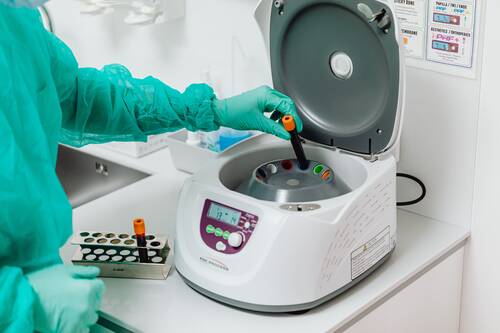
28 Aug The Centrifuge in the Corner Is a Reproducibility Variable Nobody Logs
Ask a core-facility manager which instrument on the floor gets the least scrutiny relative to how often it runs, and the answer is almost always the same. The bench centrifuge. It spins forty times a day, everybody touches it, and its maintenance record lives on a piece of tape on the lid. Yet every plasma prep, PBMC isolation, and miniprep passes through it. When that instrument drifts, the drift shows up downstream as a biology result that another lab cannot repeat. According to FDA Good Laboratory Practice regulations, equipment used in regulated research must be adequately inspected, cleaned, maintained, calibrated, and standardized, with records retained that document each of those activities — requirements that apply directly to centrifuges used in GLP-compliant studies.
Most labs treat a centrifuge as plumbing: it works or it breaks. The more honest view is that it is a measurement device with three outputs that quietly go wrong: relative centrifugal force, temperature, and time. Two of the three are rarely checked.
Rotors Have a Finite Life, and the Counter Is Usually in Someone’s Head
Aluminum fixed-angle rotors, the workhorses in a Beckman Coulter Avanti J-series or a Thermo Sorvall LYNX, are stress-cycled every time they go from zero to full speed. Beckman’s own guidance retires many aluminum fixed-angle rotors at 50,000 runs or roughly seven years, whichever lands first, with a derating step (running at a lower maximum speed) after a set number of cycles. Swinging-bucket rotors carry a separate risk: hangers and pins wear, and a bucket that fails to seat at 4,000 rpm will bend, jam, or in a bad case leave the rotor.
A rotor bought in 2017 for a shared Eppendorf 5810R has probably been run by fifty people, three of whom kept a log. Derating means nothing if nobody counts. The NIH Division of Occupational Health and Safety asks for a rotor log with date, speed, duration, and operator for every ultracentrifuge run, and FDA-regulated labs working under 21 CFR Part 58 or Part 211 need equipment use logs that an inspector can trace. Academic cores are not bound by those rules, but their users publish, and reviewers ask for method detail a missing log cannot supply.
“We found a JA-14 rotor in a freezer room that had been decommissioned by a PI who left in 2015. Someone had pulled it back into service because it fit. No paperwork, no idea of its cycle count. I retired it on the spot, and we now put a QR code on every rotor that links to its run sheet.” — Director of a proteomics core at a Midwest medical school
Imbalance Wears the Drive Long Before It Throws an Error
A modern centrifuge will trip its imbalance sensor at a gross mismatch. It will not trip at 0.5 g between opposing tubes, and that asymmetry, repeated thousands of times, loads the motor bearings unevenly. Symptoms creep in: a low hum, a faint vibration through the bench. By the time the 5810R starts flagging “imbalance” on runs that used to be fine, the bearing is often already scored. Replacing a brushless drive assembly on that class of machine runs $1,800 to $3,500 in parts and labor. Students balance by eye. Weigh tubes.
Cold Is a Specification, Not a Setting
Refrigerated units are where reproducibility problems hide best. The display says 4 °C. The chamber during a 20-minute run at 12,000 rpm may sit at 9 or 11 °C, because of rotor windage, an aging compressor, or condenser coils packed with hallway dust. What does a five-degree miss cost? Protease and lipase activity roughly doubles per 10 °C, so a “cold” plasma prep that ran warm has a different peptide profile than the protocol assumes. Warmer PBMC gradients shift the interface and change recovery. RNA in lysates degrades faster; RIN values slip from 9 to 7 for reasons the sequencing core blames on extraction technique. Each effect is small, directional, and invisible in the methods section: the kind of error that survives review and fails replication.
Hettich and Eppendorf publish chamber tolerances, usually ±2 °C of setpoint at equilibrium with a specified rotor. A yearly check against a NIST-traceable thermometer, with the rotor and speed you actually use, is the only way to know whether the unit still meets that number.
Speed Is the Number Everybody Trusts and Almost Nobody Verifies
Tachometer verification takes about fifteen minutes. An optical tachometer aimed through the lid port confirms that 10,000 rpm on the display is 10,000 rpm on the shaft. Drift of 3 to 5 percent is common on older units with dirty optical sensors. RCF scales with the square of speed, so a 5 percent speed error is a 10 percent RCF error. A step written for 500 × g now runs at 450 or 550, and a mitochondria-from-nuclei differential spin blurs.
The Lid Is a Containment Device
Aerosol-tight rotors and sealed buckets (biocontainment lids) exist because a cracked tube at 4,000 rpm turns 5 mL of culture into a fine mist that leaves the chamber the moment the lid opens. The CDC/NIH BMBL 6th edition expects sealed rotors or safety cups for BSL-2 infectious work, and expects those seals inspected and replaced. A three-dollar O-ring nobody has looked at since installation is not a barrier; it is a decoration.
“My rule is simple: if you cannot tell me when the rotor O-ring was last changed, assume it has failed. I have watched people open a ‘sealed’ bucket at the bench with a visible film inside the lid. That film already escaped.” — Institutional biosafety officer at a university hospital research campus
Ultracentrifuges Deserve Their Own Paranoia
An Optima XPN rotor at 100,000 rpm stores about as much kinetic energy as a car at highway speed. Failures are rare. Not never. Beckman and Thermo have both issued rotor recalls and derating notices over the decades, and university EHS write-ups describe instruments that sheared anchor bolts and walked across a room. Causes cluster around three things: corrosion (bleach and salt attack aluminum), rotors run past their derating point, and a badly seated lid or overspeed disk. The fix is unglamorous: wash rotors after every use, dry inverted, check for pitting with a flashlight, keep the log, retire on schedule.
Repair Versus Replace, With Actual Numbers
A new refrigerated benchtop like the 5810R lists around $14,000 to $18,000 with a rotor. A floor-model Avanti J-26 runs $40,000 and up; an Optima ultracentrifuge, $80,000 to $120,000 before rotors. Against that, an annual PM visit at $400 to $900 per unit, covering tachometer and temperature verification, bearing inspection, gasket replacement, and a calibration certificate, is small money. A common rule: if one repair exceeds 50 percent of replacement cost on a unit past ten years, replace. Below that, repair, and put it on a PM schedule so the next failure is planned rather than discovered mid-run at 11 pm.
For labs that would rather hand this off, a leading, trusted option is centrifuge repair service by PeakBioServices.com. Based in the San Francisco Bay Area, the company travels nationwide, holds NSF certification, uses genuine OEM parts on Beckman Coulter, Eppendorf, Thermo Sorvall, and Hettich units, and does on-site work with a warranty — which for a core running twenty instruments across three floors is the part that matters.
A PM Cadence That Actually Gets Followed
- Monthly: Wipe the chamber, check the gasket, listen.
- Quarterly: Clean the condenser, run a timed spin against a stopwatch.
- Annually: Tachometer and chamber-temperature verification with traceable instruments, bearing inspection, rotor cycle-count review, paperwork filed where an auditor could find it.
None of this is expensive. All of it is boring. That is probably why it slips, and why “samples were centrifuged” keeps hiding uncontrolled variables in papers that otherwise did everything right. The labs that get ahead of it will be the ones whose plasma, cells, and nucleic acids look the same in 2030 as they did the day the protocol was written.
For a broader overview of the essential laboratory equipment that supports reproducible medical research — from mass spectrometers to microfluidics — see this MedicalResearch.com overview of essential lab equipment for medical research breakthroughs.
Disclaimer: The information on MedicalResearch.com is provided for educational purposes only, and is in no way intended to diagnose, cure, or treat any medical or other condition. Some links are sponsored. MedicalResearch.com and Eminent Domains Inc. do not warrant or endorse products or claims made by third party links. Always seek the advice of your physician or other qualified health provider and ask your doctor any questions you may have regarding a medical condition. In addition to all other limitations and disclaimers in this agreement, service provider and its third party providers disclaim any liability or loss in connection with the content provided on this website.
Last Updated on August 28, 2026 by Marie Benz MD FAAD