
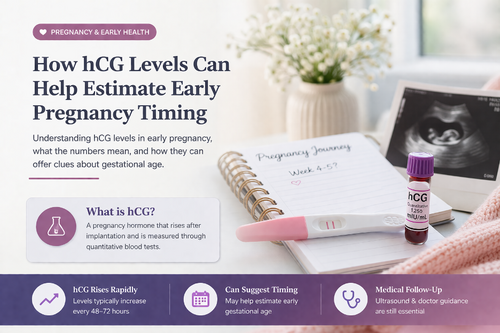
08 Apr How hCG Levels Can Help Estimate Early Pregnancy Timing
Finding out you are pregnant often comes with one immediate question: How far along am I? In the earliest days of pregnancy, before an ultrasound can confirm dating, many people look to blood work for clues. One of the most talked-about markers is human chorionic gonadotropin, better known as hCG.
Because hCG levels in early pregnancy usually rise in a predictable way, they can sometimes offer a rough estimate of early pregnancy timing. That is why tools such as an hCG gestational age calculator can be helpful as a starting point. Still, hCG is only one piece of the picture. hCG values can vary widely from one healthy pregnancy to another, and a single test result may suggest a possible range but cannot confirm exact dating, viability, or whether a pregnancy is progressing normally on its own.
What hCG Is and Why It Matters in Early Pregnancy
hCG is a hormone made during pregnancy. After implantation, the developing placenta begins producing it, and that hormone becomes detectable in blood and later in urine — which is why hCG is the hormone measured in both home pregnancy tests and laboratory pregnancy tests.
Doctors may order quantitative hCG testing when they want more detail than a urine test can provide. For example, they may use it to confirm a very early pregnancy, help evaluate bleeding or cramping, or follow hCG changes over several days. According to the government health resource MedlinePlus: hCG blood test — quantitative, this test measures the exact amount of hCG in the blood.
How hCG Levels Change in the First Trimester
In the first weeks of pregnancy, hCG usually rises quickly. Many people hear that it “doubles every 48 to 72 hours,” but real-life numbers are often less tidy. The key point is that levels commonly increase rapidly in early pregnancy, especially before they peak later in the first trimester.
A General Pattern, Not a Strict Rule
An early pregnancy hCG chart can be useful for understanding broad trends, but it should not be read like a strict timetable. Two people at the same stage of pregnancy can have very different hCG values and still both have entirely healthy pregnancies. One person at about 4 weeks may have a relatively low but rising result; another at roughly the same point may have a much higher number. Both may still fall within normal expectations depending on timing, implantation, and individual variation.
Why Trends Matter More Than One Result
Imagine someone has a beta hCG calculator estimate suggesting around 4 to 5 weeks based on a single lab value. That estimate may be useful, but if a repeat blood test 48 hours later shows the level rising appropriately, that trend often tells a more meaningful story than the first number alone. hCG can help with pregnancy week by hCG estimates, but follow-up testing generally gives better context.
Can hCG Estimate Gestational Age?
Yes, sometimes. hCG can help provide a rough sense of gestational age by hCG, especially very early on, before a pregnancy is clearly visible or measurable on ultrasound. hCG-based timing estimates may be most helpful when a person is unsure of their last menstrual period, ovulation happened earlier or later than expected, cycles are irregular, or they want an initial estimate while waiting for a medical appointment.
In these situations, an hCG number may help place someone within a broad early-pregnancy window, such as “around 4 weeks” or “possibly 5 to 6 weeks.” But that estimate is just that: an estimate.
Why One hCG Value Is Only an Estimate
A single hCG result should not be used as a diagnosis. It cannot confirm an exact due date, prove that a pregnancy is developing normally, or rule out complications. Several factors can affect the number, including the exact day implantation happened, whether ovulation occurred earlier or later than expected, normal individual variation, lab timing and testing intervals, and in some cases, multiple pregnancy. Because of this, anyone using a beta hCG calculator or looking at an early pregnancy hCG chart should think in terms of ranges, not precise answers.
When Repeat Testing May Help
If the first number raises questions, a clinician may order repeat quantitative hCG testing over 48 to 72 hours. That can help show whether levels are increasing, plateauing, or falling — patterns that may offer far more information than a one-time result.
When Ultrasound Is More Accurate
hCG can be helpful early, but ultrasound is generally more accurate for pregnancy dating once it is available. Ultrasound can confirm that the pregnancy is in the uterus, measure the embryo or fetus directly, help establish or confirm gestational age, and evaluate normal early pregnancy progress. That is why hCG and ultrasound are often used together rather than as competing tools — hCG may offer early clues while ultrasound provides clearer dating and clinical confirmation.
How to Use an hCG Gestational Age Calculator
An hCG tool is best used as an informational starting point, not a diagnostic conclusion.
- Step 1 — Use a quantitative blood test result: Enter the result from a quantitative hCG blood test, not a qualitative test or a home urine test. Quantitative tests measure the specific level of hCG in the blood.
- Step 2 — View the estimate as a range: A pregnancy week by hCG estimate should be treated as approximate. It may suggest a likely early-pregnancy window rather than a precise gestational age.
- Step 3 — Compare with other information: Look at the estimate alongside your last menstrual period if known, ovulation or embryo transfer timing if known, your symptoms and test dates, and any repeat blood work your clinician recommends.
- Step 4 — Follow up medically: If you have questions about timing, bleeding, pain, prior losses, fertility treatment, or irregular cycles, contact your healthcare professional. Medical follow-up is especially important when symptoms do not match the estimated timing.
Common Questions About hCG and Pregnancy Timing
Can hCG tell me exactly how many weeks pregnant I am?
No. It can sometimes provide a helpful estimate, but not an exact answer. hCG is best viewed as one clue among several.
Is a higher hCG level always better?
Not necessarily. High, average, or lower values can all occur in normal pregnancies. The pattern over time and the clinical context matter more than any single number.
Can I use a beta hCG calculator instead of seeing my doctor?
No. A calculator can be useful for an initial estimate, but it does not replace medical care, repeat testing, or ultrasound.
What if my hCG seems lower than expected?
Do not be alarmed based on one result alone. Dating may be off, ovulation may have happened later than expected, or the number may still fall within a broad normal range. A healthcare professional may recommend repeat testing and ultrasound for better answers.
What if my cycles are irregular?
That is exactly when hCG-based estimates may feel most appealing — and also when medical dating becomes even more important. An hCG estimate can offer a rough starting point, but irregular cycles make clinical follow-up essential.
Conclusion
hCG can be a valuable early marker in pregnancy. It helps confirm that pregnancy hormones are present, and in some situations it can offer a rough sense of gestational age by hCG — which can be genuinely reassuring for those looking for early answers.
At the same time, hCG has real limits. hCG levels in early pregnancy vary widely, and one value should never be used as a diagnosis or as the final word on timing. Ultrasound and follow-up with a healthcare professional remain essential for confirming pregnancy dating and progress. If you are curious about where your number may fit, using an hCG gestational age calculator can be a helpful first step — just be sure to treat it as an initial estimate and confirm the bigger picture with your doctor.
Disclaimer: The information on MedicalResearch.com is provided for educational purposes only, and is in no way intended to diagnose, cure, or treat any medical or other condition. Some links are sponsored. Products, services and providers are not warranted or endorsed. Always seek the advice of your physician or other qualified health and ask your doctor any questions you may have regarding a medical condition. In addition to all other limitations and disclaimers in this agreement, service provider and its third party providers disclaim any liability or loss in connection with the content provided on this website.
Last Updated on April 8, 2026 by Marie Benz MD FAAD