
22 Jul Red Light Therapy for Hair Loss: Does It Really Help?
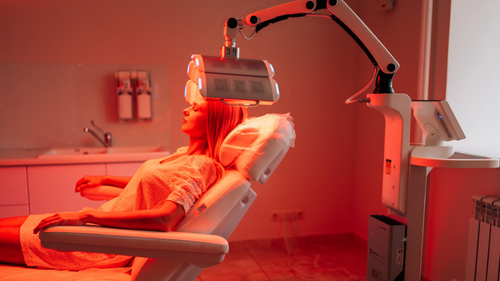
Hair loss presents in patients of nearly every age and in both sexes. In my experience the degree of distress it produces frequently exceeds what the clinical severity alone would predict, and that discrepancy is worth recognising at the first consultation. Demand for non-surgical restoration has grown sharply in recent years. Surgery is costly and not everyone qualifies for it; many patients simply want something they can manage at home without a prescription. Red light therapy has become one of the most common of those options. It started as clinic equipment and is now sold for personal use, and it differs from most consumer treatments in one respect that carries clinical weight: it has actually been tested in controlled trials.
So the practical question patients raise is a direct one — does red light therapy work for hair loss, and if so, by how much. What follows sets out the treatment itself, the reasoning behind why it might work, what the evidence shows, who tends to respond, and how it sits next to the drugs most patients already know. A closer look at does red light therapy work for hair loss is available on our site.
Understanding Red Light Therapy for Hair Loss
The terminology tends to confuse patients more than the treatment does. In the literature the same method appears as Low-Level Light Therapy, abbreviated LLLT, and under the broader term photobiomodulation. The underlying principle is consistent across all three: low-intensity red or near-infrared light stimulates cells in the scalp without heating or damaging the surrounding tissue. The wavelengths that matter for hair fall between roughly 630 and 680 nanometres, and most devices are built around the 650 to 660 nm mark.
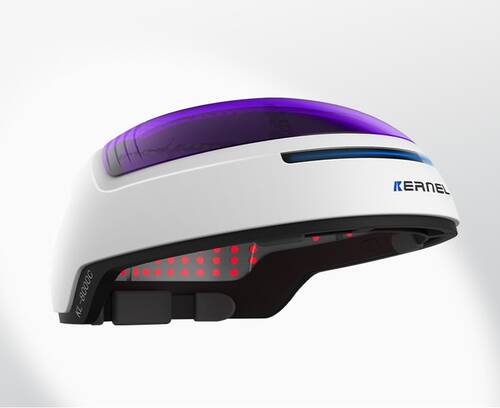
Laser versus LED is the distinction most patients miss. LLLT began as a laser term, describing coherent, tightly focused light, and laser-diode devices remain the ones with the firmest evidence. The commercial phrase red light therapy is looser and often points to LED units, which give off the same wavelengths at lower intensity. The market reflects the whole spread — laser combs, wearable caps and helmets, headbands, panels, and larger in-clinic systems; some are laser only, some LED only, and a fair number combine the two. According to MedlinePlus Genetics, androgenetic alopecia is the most common form of hair loss in both men and women and results from a combination of genetic and hormonal factors.
How Red Light Therapy May Promote Hair Growth
When light of an appropriate wavelength reaches the scalp, it is absorbed by a mitochondrial enzyme, cytochrome c oxidase. The clinical relevance lies in the enzyme’s position at the end of the cellular respiratory chain. Following absorption, mitochondrial ATP production increases, providing the cell with additional energy, and this in turn initiates signalling through nitric oxide and reactive oxygen species.
At the level of the follicle, the expected effect comes down to timing. Every hair runs a cycle: anagen for active growth, a brief transitional stage, then telogen at rest, after which the strand falls and the sequence restarts. The prevailing hypothesis is that the additional cellular energy returns resting follicles to growth sooner and sustains that phase longer. Part of the benefit is also credited to better blood flow around the follicle.
I make a point of separating what is proven from what is proposed. That light is absorbed by cytochrome c oxidase and lifts ATP output is well documented; the precise follicular sequence that follows is inferred from observation and has not been confirmed directly in living human scalp. There is also a dose relationship that patients rarely appreciate. Photobiomodulation follows a biphasic response, meaning too little light does nothing and too much can blunt the effect rather than amplify it — which is one reason the specific wavelength and output of a device matter more than simply how long it is worn. In clinical terms, more is not better; the correct dose is.
What Does the Research Say About Its Effectiveness?
Here the evidence deserves a careful and honest reading, because promotional claims tend to run ahead of it. To its credit, red light therapy hair growth has been put through randomised, sham-controlled trials, a far higher bar than most non-prescription treatments ever clear.
The most cited dataset combined four double-blind studies. In total, 122 women and 103 men used a red laser comb three times a week for 26 weeks, and terminal hair counts climbed by roughly 18 to 26 hairs per square centimetre over sham, a difference that reached statistical significance. Two meta-analyses point the same way. The first pooled eleven double-blind trials and found a significant rise in hair density against sham, with a standardised mean difference of 1.316. The second drew on fifteen studies and 795 patients and reported a standardised mean difference of 1.02 favouring treatment. A 16-week trial using a helmet device recorded about 42 extra hairs per square centimetre where controls barely moved, and logged no adverse events. A 24-week study confirmed gains in both hair density and hair diameter.
Encouraging as that reads, the caveats are substantial and should not be overlooked. The trials are short; most run 16 to 26 weeks, so no one can say with any confidence what happens across several years. Cohorts are small. Devices and protocols differ so widely that comparing them head to head is difficult, and manufacturers funded several of the key studies. Independent specialists have also questioned some of the hair-counting methods. Put it all together and the defensible conclusion stays modest: in the right patient, improvement is likely and moderate, not guaranteed.
Who Is Most Likely to Benefit?
One feature separates the patients who respond from those who do not, and it is whether the follicles have weakened or actually died. Weakened but living follicles fit early and moderate pattern hair loss most closely. Men in the earlier Norwood stages and women in the early Ludwig stages are sensible candidates, and red light therapy for thinning hair does the most for scalps where follicles have miniaturised yet still function.
The boundaries matter just as much. No light source can regrow a follicle that is gone, so a fully bald scalp will not respond, and neither will the scarring alopecias, where fibrous tissue has replaced the follicle. That is why red light therapy for alopecia helps some diagnoses and does nothing for others, and why an accurate diagnosis is non-negotiable before a patient spends anything on a device.
Common Hair Loss Conditions and Expected Response to Red Light Therapy
| Condition | Expected Response |
|---|---|
| Androgenetic alopecia, early to moderate | Most likely to respond; supported by randomised trials |
| Thinning hair with living follicles | Fair chance of visible improvement |
| Advanced baldness, dormant follicles | Minimal benefit; lost follicles do not return |
| Scarring (cicatricial) alopecia | Not expected to help; the follicle is destroyed |
How Does Red Light Therapy Compare with Other Hair Loss Treatments?
Two names come up in almost every consultation: minoxidil and finasteride. Minoxidil, applied topically, works partly by widening blood vessels and extending the growth phase. Finasteride, taken orally by men, lowers DHT, the hormone behind pattern loss. Both are effective, and both carry the same catch: they have to be continued indefinitely, and a minority of men on finasteride report sexual side effects — risks examined in detail in this MedicalResearch.com overview of male pattern hair loss drugs and significant side effects. Red light therapy offers a different profile — non-invasive, drug-free, and clean on safety, though it too only holds its results with continued use.
The more compelling data concern the two used together rather than in competition. A 2025 meta-analysis of seven randomised trials found that LLLT added to topical minoxidil produced greater hair density and higher patient satisfaction than minoxidil on its own, with no increase in side effects. An earlier trial in women with female pattern hair loss found red light therapy alone roughly on par with 5% minoxidil, while the two combined gave the largest gains in follicle count and satisfaction.
This is why I position the treatment as an adjunct rather than a substitute. A patient focused on whether red light therapy works for hair loss will benefit more from asking how it integrates with proven therapy than whether it can succeed alone.
A few practical points round out the picture. Applied as directed, these devices carry no link to permanent loss; the early shedding some patients report is generally the normal cycle swapping weaker hairs out for stronger ones. Most home units carry FDA clearance, which verifies safety and equivalence to existing devices but stops well short of the outcome guarantee that drug approval implies. Results generally take three to six months of consistent use to appear, and they fade once treatment stops. Trial protocols leaned toward sessions of a few minutes, several times weekly, kept up over months — in practice, it is consistency, more than the device itself, that divides those who benefit from those who quit too soon. For a well-chosen patient, used patiently and ideally alongside minoxidil, the current evidence supports a measured yes.
References
- MedlinePlus Genetics, U.S. National Library of Medicine. Androgenetic alopecia.
- Anders JJ, Lanzafame RJ, Arany PR. Low-Level Light/Laser Therapy Versus Photobiomodulation Therapy. Photomedicine and Laser Surgery. 2015.
- Hamblin MR. Mechanisms and Mitochondrial Redox Signaling in Photobiomodulation. Photochemistry and Photobiology. 2018.
- Karu TI, et al. Cytochrome c oxidase as the primary photoacceptor in low-level light therapy. 2005.
- Jimenez JJ, et al. Efficacy and Safety of a Low-level Laser Device in the Treatment of Male and Female Pattern Hair Loss. American Journal of Clinical Dermatology. 2014.
- Liu KH, Liu D, Chen YT, Chin SY. Comparative effectiveness of low-level laser therapy for adult androgenic alopecia. Lasers in Medical Science. 2019.
- Gupta AK, Carviel JL. Meta-analysis of photobiomodulation for the treatment of androgenetic alopecia. Journal of Dermatological Treatment. 2021.
- Afifi L, et al. Low-level laser therapy as a treatment for androgenetic alopecia. Lasers in Surgery and Medicine. 2017.
- Yoon JS, et al. Low-level light therapy using a helmet-type device for the treatment of androgenetic alopecia. Medicine (Baltimore). 2020.
- Suchonwanit P, Chalermroj N, Khunkhet S. Low-level laser therapy for the treatment of androgenetic alopecia in Thai men and women. Lasers in Medical Science. 2019.
- Esmat SM, et al. Low level light–minoxidil 5% combination versus either therapeutic modality alone in management of female patterned hair loss. Lasers in Surgery and Medicine. 2017.
- Christopher A, et al. Combination of low-level laser therapy and topical minoxidil versus minoxidil alone in androgenetic alopecia. Lasers in Medical Science. 2025.
- Heiskanen V, Hamblin MR. Photobiomodulation: lasers vs. light emitting diodes? Photochemical & Photobiological Sciences. 2018.
- International Society of Hair Restoration Surgery (ISHRS). Low-level laser therapy for treatment of male and female pattern hair loss.
- Lueangarun S, et al. Efficacy and safety of low-level laser therapy in androgenetic alopecia: a systematic review and meta-analysis of FDA-cleared home-use devices. Journal of Clinical and Aesthetic Dermatology. 2021.
Disclaimer: The information on MedicalResearch.com is provided for educational purposes only, and is in no way intended to diagnose, cure, or treat any medical or other condition. Some links are sponsored. Products, services and providers are not warranted or endorsed by MedicalResearch.com or Eminent Domains Inc. Always seek the advice of your physician or other qualified health provider and ask your doctor any questions you may have regarding a medical condition. In addition to all other limitations and disclaimers in this agreement, service provider and its third party providers disclaim any liability or loss in connection with the content provided on this website.
Last Updated on July 22, 2026 by Marie Benz MD FAAD