
21 Sep Why Aren’t All Supplements Put Into One Pill? The Science Behind Multi-Component Supplement Systems
Supplement Notice: These products have not been evaluated by the FDA and are not intended to diagnose, treat, cure, or prevent any disease or health condition. Supplements are not a substitute for regular medical care. Some supplements may interact with prescription medications or may not be appropriate during pregnancy or nursing. Always consult a qualified healthcare provider before beginning any new supplement regimen.
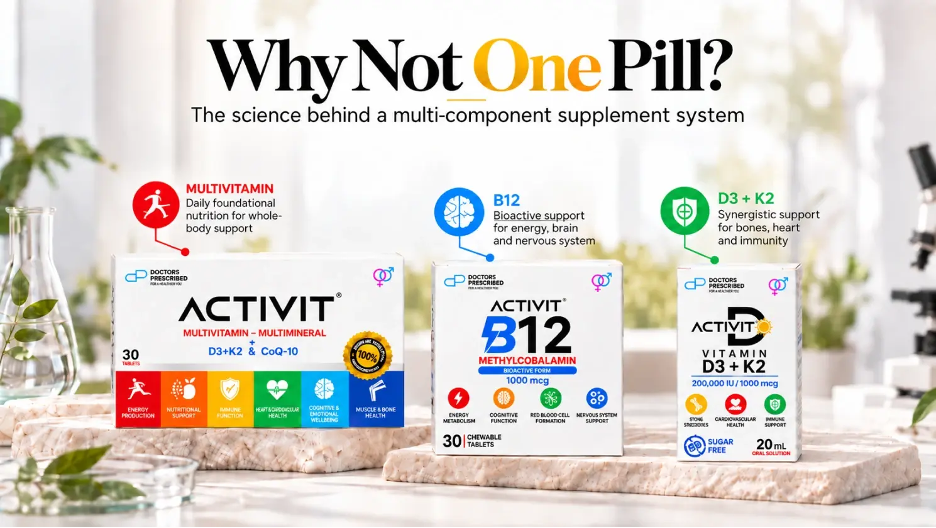
When we talk about taking supplements, there are two broad approaches: taking multiple separate supplements for different nutrients, or taking one supplement packed with vitamins and minerals. A multi-component supplement system is a relatively advanced approach in which a supplement provides two, three, or more components — one may be a multivitamin, while others provide targeted nutrients such as vitamin B12, vitamin D, omega-3, or minerals, each with its own role, dosage, and schedule. ACTIVIT ONE, for example, provides a daily multivitamin, an oral solution of vitamin D3 and K2, and B12 chewable tablets as three distinct components. According to the NIH Office of Dietary Supplements, different nutrients vary considerably in the amounts required, the forms in which they are best absorbed, and the conditions under which they are most effective — factors that have real implications for how supplements are formulated.
The Problem With Putting Everything Into One Pill
A tablet has physical limits. Your body requires varying amounts of nutrients throughout different life stages, and those amounts are not always compatible in a single formulation. For example, iron and calcium can interfere with each other’s absorption, folic acid is needed more during pregnancy, and vitamins D and K are absorbed better with a fat-containing meal. There is also the question of dosage. A nutrient needed in a relatively small amount can be incorporated into a multivitamin conveniently. A nutrient commonly provided in a much larger supplemental amount can make the formulation more difficult to accommodate alongside dozens of other ingredients. A long ingredient list does not necessarily tell you how thoughtfully a supplement has been designed. More nutrients in one tablet does not automatically mean a better supplement.
Different Nutrients, Different Roles
Different nutrients have varying roles in the body, and our bodies treat each nutrient differently. Vitamin B12, for example, is important for making red blood cells, supporting neurological function, and synthesizing DNA. Vitamins D and K support bone health — they help the body absorb calcium and are involved in blood clotting and bone metabolism. These nutrients have different roles and are needed in different amounts. A broad multivitamin can provide a nutritional foundation across many vitamins and minerals. A separate product can then be used when a particular nutrient needs to be provided at a different amount or on a different schedule. The goal is not necessarily to separate nutrients — it is to combine them in a way that makes sense for each one.
Why B12 Can Be a Separate Component
Vitamin B12 is a useful example of why putting all nutrients in one pill can have limitations. B12 is found in meat, fish, eggs, and dairy products, and people who do not eat these foods may have a B12 deficiency. They may need extra B12 supplementation. But what if a supplement provides limited amounts of B12, or the body does not absorb it well due to certain medications or underlying conditions? This is part of the reasoning behind a multi-component supplement system. Instead of taking a generic supplement or managing multiple separate products, one structured system can address the complete daily nutrition picture — with B12 addressed through its own targeted component rather than being squeezed into a multivitamin at a potentially inadequate dose.
Vitamin D Presents a Different Formulation Question
Vitamin D raises a different formulation consideration. The sources of vitamin D are limited — only certain foods and sunlight exposure can provide it reliably. This can be a practical concern for many office workers who spend most of their day indoors. Vitamin D supplementation may be the solution, but it does not necessarily have to follow the same schedule as a daily multivitamin. ACTIVIT ONE therefore uses an oral solution of a vitamin D3 + K2 formulation as its separate monthly component — reflecting a different timing and delivery approach rather than simply stacking it into the daily tablet.
What a Multi-Component System Can Change
A collection of products becomes a system when the components have defined roles and a defined protocol. With ACTIVIT ONE, the multivitamin provides the daily nutritional foundation. B12 is handled through its own targeted component. Vitamin D3 + K2 is provided separately according to its monthly schedule. The components are not interchangeable versions of the same thing — each performs a distinct role within the overall system.
Does Separating Supplements Make Them More Effective?
Not automatically. Taking a nutrient separately does not necessarily mean it will work better. Sometimes nutrients are more effective separately because they need a different dose, timing, or form. Whether a supplement is useful still depends on the nutrient, the amount provided, how it is formulated, and the needs of the person taking it. A multi-component system is therefore not inherently superior to a single multivitamin. The potential advantage is formulation flexibility — the ability to give each nutrient the form and schedule that makes the most sense for it, rather than forcing every ingredient into the same tablet.
The Takeaway
A single pill is convenient, but convenience and formulation are not always the same thing. Some nutrients can be easily combined in a multivitamin. Others may require different amounts, forms, or schedules. Separating those components can give a formulation more flexibility while still keeping them within one organized supplementation protocol. ACTIVIT ONE follows this approach with three defined components: a daily multivitamin with 24 essential vitamins and minerals, targeted B12 in chewable tablet form, and vitamin D3 + K2 as a separate oral solution. The idea is not to make supplementation more complicated — it is to give each component a clear purpose while bringing them together into one system.
For a broader overview of what the research shows about common vitamin and mineral deficiencies, how supplements are regulated, and what to consider when evaluating a supplement regimen, see this MedicalResearch.com overview of vitamin and mineral supplements — what the evidence shows.
Disclaimer: The information on MedicalResearch.com is provided for educational purposes only, and is in no way intended to diagnose, cure, or treat any medical or other condition. Some links are sponsored. MedicalResearch.com and Eminent Domains Inc. do not warrant or endorse products or claims made by third party links. Always seek the advice of your physician or other qualified health provider and ask your doctor any questions you may have regarding a medical condition. In addition to all other limitations and disclaimers in this agreement, service provider and its third party providers disclaim any liability or loss in connection with the content provided on this website.
Last Updated on September 21, 2026 by Marie Benz MD FAAD