
19 Aug Healthcare Analytics Software Development Services
Healthcare organizations rarely struggle because they lack data. The harder problem is making clinical, operational, financial, and administrative data consistent enough to answer real questions. Healthcare analytics software development services bring together the architecture, interoperability, governance, engineering, and analytical capabilities needed to turn fragmented information into insights that clinicians, operations teams, researchers, and executives can actually use.
According to the Office of the National Coordinator for Health Information Technology, FHIR-based interoperability standards are now a regulatory requirement for healthcare organizations participating in Medicare and Medicaid programs, making standards-based analytics infrastructure an increasingly critical component of compliant health data operations.
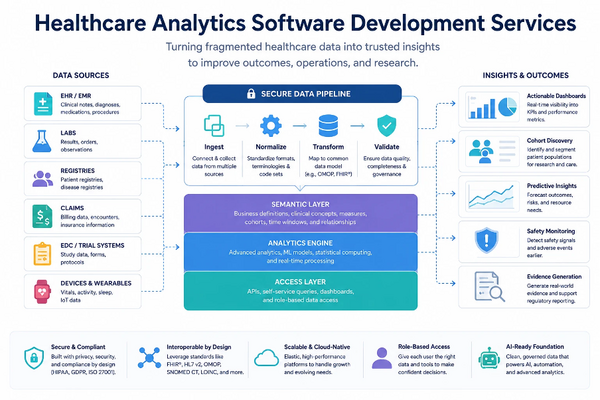
Illustration: healthcare analytics connects data infrastructure with practical decision support.
What Are Healthcare Analytics Software Development Services?
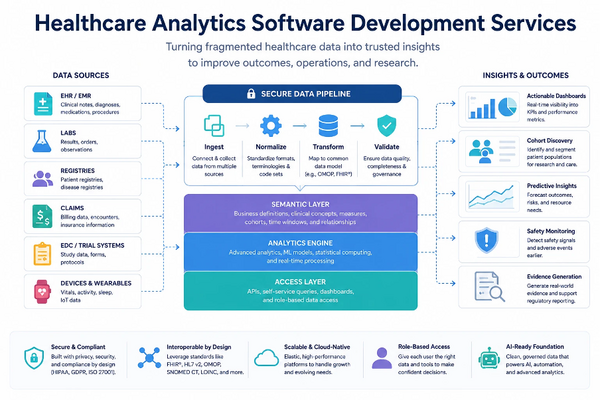
Healthcare analytics software development services cover much more than dashboard development. They include the technical and methodological work required to design and build analytics solutions that collect data from multiple systems, standardize it, validate its quality, give it consistent clinical meaning, store it efficiently, and make it available for reporting, advanced analytics, and AI. In practice, this often means connecting EHRs, HIEs, claims platforms, laboratory systems, registries, medical devices, patient applications, and legacy databases. The resulting environment may include data warehouses or lakehouses, FHIR servers, analytical storage, semantic layers, APIs, visualization tools, and governed AI interfaces. The goal is not to centralize data simply for the sake of centralization. The goal is to make information usable: the same definition of a patient, encounter, diagnosis, care gap, cost, quality measure, or outcome should mean the same thing across teams and analytical workflows.
Why Healthcare Data Is Difficult to Analyze
Healthcare data is unusually complex because it reflects both clinical reality and the systems used to document, bill, regulate, and coordinate care. The same patient journey may be represented across clinical notes, coded diagnoses, laboratory observations, prescriptions, claims, referrals, imaging, scheduling systems, and external registries. Even when organizations have invested in data warehouses or BI platforms, several problems tend to persist:
- Data remains distributed across EHRs, departmental applications, payer systems, registries, and legacy databases.
- Different systems use different structures, local codes, terminologies, and identifiers.
- Duplicate, incomplete, delayed, or inconsistent records reduce confidence in reporting.
- Clinical and operational teams depend on analysts because the data model is too technical for self-service use.
- Historical reporting is available, but real-time or longitudinal questions remain difficult to answer.
- AI initiatives stall because the underlying data is not standardized, governed, or accessible enough to support reliable models.
From Data Integration to a Trusted Analytics Foundation
A useful analytics environment usually develops in layers. The first layer is integration: data has to move reliably from source systems into an environment where it can be processed. Depending on the use case, this may involve APIs, event-driven streaming, batch ELT/ETL pipelines, interface engines, or a combination of approaches. The next layer is normalization and quality management. Clinical data may need terminology alignment using standards such as SNOMED CT, LOINC, ICD-10, or RxNorm. Patient and provider identities may need deduplication. Validation rules can identify missing values, invalid references, inconsistent units, or records that do not conform to the expected structure. Only then does analytical modeling become truly useful. A semantic layer can translate technical data structures into concepts that people across the organization recognize: patients, encounters, episodes of care, treatment phases, readmissions, care gaps, quality measures, costs, or outcomes.
The Role of FHIR and Other Healthcare Standards
FHIR is increasingly important because it provides a common framework for exchanging healthcare information through modern APIs. In analytics architectures, FHIR can serve as an interoperability layer between operational systems and downstream data platforms. It is particularly useful when organizations need consistent access to clinical data across multiple applications or want to expose standardized data to internal and external products. FHIR is not the only format that matters. Real environments frequently include HL7 v2 or v3, CDA, DICOM, X12, openEHR, JSON, XML, and proprietary schemas. Analytics therefore depends less on choosing a single standard and more on creating a controlled mapping strategy that preserves meaning as information moves between systems.
What Healthcare Analytics Can Support
Clinical Analytics
Clinical analytics can help teams examine outcomes, treatment patterns, protocol adherence, care gaps, patient pathways, and variation across sites or populations. Longitudinal data is particularly important because many clinically meaningful questions depend on sequence and time, not just individual events.
Population Health and Cohort Analytics
Population-level analytics can support patient stratification, cohort building, chronic disease management, care management, and real-world evidence generation. Instead of relying only on static reports, teams can define populations using combinations of diagnoses, medications, laboratory values, procedures, demographics, and time windows.
Operational Analytics
Healthcare operations generate their own data about appointments, referrals, staffing, patient flow, resource utilization, and service delivery. Connecting these signals with clinical information can help organizations understand bottlenecks, demand patterns, throughput, and the operational factors that influence care.
Financial and Payer Analytics
Claims, billing, coverage, and payment data can be analyzed alongside clinical and operational information to understand reimbursement patterns, leakage, utilization, denial trends, cost drivers, and forecasting. The value increases when financial measures can be interpreted in the context of the patient journey rather than as isolated transactions.
Quality and Regulatory Reporting
A governed analytics layer can also make quality reporting more repeatable. Measures can be defined once, validated against the underlying data, and reused across dashboards and reporting workflows. This is particularly relevant for organizations working with CMS measures, HEDIS, eCQMs, or their own internal quality indicators.
Why Self-Service Analytics Is Harder in Healthcare
Self-service analytics sounds simple: give users a dashboard or natural-language interface and allow them to explore the data. In healthcare, however, the difficult part is not the interface. It is making sure the question is interpreted against the right data, definitions, terminology, access rules, and time logic. For example, a clinical leader might ask how many patients with a particular diagnosis had an abnormal laboratory result and did not receive a follow-up procedure within 90 days. Answering that question reliably requires more than a language model. This is why semantic modeling is becoming an important part of modern healthcare analytics — it creates a governed bridge between raw healthcare data and the language used by clinical, operational, research, and business teams.
Where AI Fits — and Where It Does Not
AI can make healthcare analytics more accessible, but it does not remove the need for data engineering and governance. Natural-language interfaces can help users formulate questions, generate structured queries, summarize results, or navigate complex datasets. Machine learning can support prediction, anomaly detection, risk stratification, and pattern discovery. The reliability of these capabilities still depends on the underlying data. If identifiers are inconsistent, terminology is not normalized, metrics are defined differently by each department, or access controls are unclear, AI can simply make unreliable analysis faster. A more sustainable model is to keep sensitive healthcare data inside a controlled environment while allowing AI components to work with metadata, schema, approved definitions, and governed analytical tools.
Real-Time Analytics vs. Historical Reporting
Traditional healthcare BI often focuses on retrospective reporting: what happened last month, how many encounters occurred, or how performance compares with a previous period. Many modern use cases require data closer to the point of care or operation. Real-time and event-driven architectures can support scenarios such as care management alerts, clinical decision support, operational monitoring, patient flow, and rapidly changing risk indicators. Not every metric needs real-time processing, however. A practical architecture separates use cases that genuinely require streaming from those that can be handled more economically through scheduled pipelines.
Building a Healthcare Analytics Environment: A Practical Sequence
- Understand the decisions the organization needs to make and identify the data required to support them.
- Map the existing systems, interfaces, data ownership, governance requirements, and technical constraints.
- Design an architecture that separates ingestion, storage, normalization, semantic modeling, analytics, and access.
- Implement data quality controls and terminology normalization before scaling reporting or AI.
- Define reusable clinical and business concepts so that metrics remain consistent across teams.
- Expose insights through the right combination of dashboards, APIs, analytical tools, and conversational interfaces.
- Monitor data quality, pipeline reliability, access, performance, and changing analytical requirements over time.
This sequence also helps prevent a common mistake: starting with the dashboard and working backward. A polished visualization cannot compensate for inconsistent definitions or unreliable source data.
How to Evaluate Healthcare Analytics Software Development Services
When healthcare organizations bring in a software development partner for analytics, the most useful evaluation criteria are usually technical depth, healthcare-specific data knowledge, interoperability experience, security, and the ability to build around the organization’s existing environment rather than forcing a complete replacement. Important questions include whether the team can work across FHIR and legacy standards, how it handles terminology and identity management, how data quality is validated, whether the architecture supports both batch and real-time workloads, how semantic definitions are governed, and how sensitive data is protected. It is also worth asking how the proposed architecture will evolve. A foundation built for reuse can later support new cohorts, quality measures, operational questions, research workflows, predictive models, and AI-assisted analytics without rebuilding the data layer each time.
An Example of the Architecture in Practice
A healthcare analytics platform may ingest data from EHRs, legacy databases, laboratory systems, claims platforms, and other sources through APIs, streaming, or ELT pipelines. Analytical storage then provides efficient querying across large datasets. A semantic layer defines shared clinical and business concepts, while access layers expose the data through dashboards, APIs, or conversational analytics. This type of architecture reflects the approach behind Kodjin Analytics and Edenlab’s broader healthcare data work: interoperability and data engineering form the foundation, while analytics and AI sit above governed data models. Advanced analytics becomes more dependable when data meaning, access, and quality are handled before the user asks the question.
Conclusion
Healthcare data analytics is moving from isolated reporting toward a shared intelligence layer for clinical, operational, financial, research, and population health decisions. The organizations that benefit most are not necessarily those collecting the most data. They are the ones that can make data consistent, explainable, secure, and available at the moment a decision needs to be made. That requires reliable integration, healthcare-specific data modeling, terminology management, data quality controls, scalable storage, governance, and an access layer designed for the people who actually use the insights. Once that foundation exists, dashboards, predictive analytics, and AI become much more useful — not because they replace healthcare expertise, but because they make trusted data easier to explore and act on.
For a broader overview of how EHR data analytics is reshaping clinical workflows, patient outcomes, and population health management, see this MedicalResearch.com overview of why EHR data analytics is transforming patient outcomes.
Disclaimer: The information on MedicalResearch.com is provided for educational purposes only, and is in no way intended to diagnose, cure, or treat any medical or other condition. Some links are sponsored. Products, services and providers are not warranted or endorsed by MedicalResearch.com or Eminent Domains Inc. Always seek the advice of your physician or other qualified health provider and ask your doctor any questions you may have regarding a medical condition. In addition to all other limitations and disclaimers in this agreement, service provider and its third party providers disclaim any liability or loss in connection with the content provided on this website.
Last Updated on August 19, 2026 by Marie Benz MD FAAD