
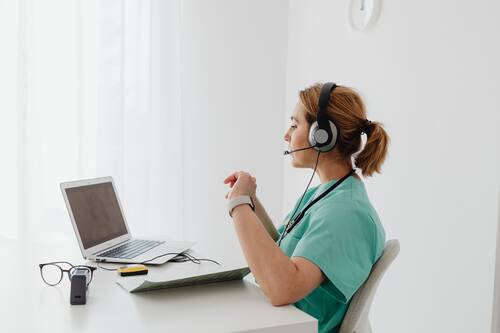
15 Sep How Clinical Documentation Is Evolving With the Future of Telehealth
Telehealth has changed where medical conversations happen, but the basic responsibility to document patient care remains. Clinicians still need accurate records of symptoms, assessments, treatment decisions, medications, follow-up instructions, and other information relevant to the encounter. What is changing is how that information can be captured and organized. According to the ONC (Office of the National Coordinator for Health Information Technology), accurate and complete clinical documentation is foundational to patient safety, care coordination, and appropriate reimbursement — regardless of whether care is delivered in person or through a virtual platform.
Documentation Can Become Part of the Conversation
Traditional documentation often requires clinicians to divide their attention between the patient and the medical record. During a virtual appointment, this can mean switching between the video conversation and another system for taking notes. Even when clinicians finish documentation afterward, they may have to reconstruct details from memory or rough notes. New technology creates another possibility. Developers building healthcare platforms can use infrastructure such as Recall.ai to add meeting capture and transcription capabilities to healthcare workflows. Its healthcare solution supports developers building applications that can power tools such as an AI scribe, allowing clinical software teams to create systems that work with conversations across major meeting platforms. The important distinction is that Recall.ai provides infrastructure for developers rather than acting as the clinician-facing documentation product itself. When thoughtfully implemented, this type of technology can allow the conversation to become a source for creating a documentation draft. The clinician can then review the information, make corrections, add necessary context, and determine what belongs in the medical record.
Clinicians Will Still Need to Review the Record
Automation does not eliminate the importance of clinical review. A transcript may contain much of what was discussed during an appointment, but a conversation is not automatically a complete or accurate clinical note. Patients may misspeak, sentences may be ambiguous, and important clinical reasoning may not be stated explicitly. That makes clinician oversight essential. Documentation technology should help organize information for review rather than assume that everything captured during a conversation belongs in the final record. A clinician should be able to correct errors, remove irrelevant material, add professional observations, and confirm that the final documentation accurately reflects the encounter. This keeps responsibility for the clinical record with the appropriate healthcare professional.
Structured Documentation May Become More Flexible
Different types of telehealth appointments require different forms of documentation. A short consultation for a straightforward concern may not require the same structure as a complex follow-up involving several medical issues. Future systems may become better at adapting documentation workflows to the type of encounter taking place. Instead of forcing every conversation into an identical template, software could help organize relevant information into the appropriate sections while allowing clinicians to make changes. This could also reduce unnecessary duplication. Information that already exists elsewhere in an authorized system should not always need to be manually entered again. Better integrations can help relevant information move between appropriate parts of the workflow while maintaining necessary controls.
Patient Consent and Privacy Will Remain Essential
Capturing and processing medical conversations introduces important privacy and security considerations. Healthcare organizations cannot treat a clinical conversation like an ordinary online meeting simply because both take place through video software. Organizations considering transcription or automated documentation tools need to understand how information is captured, transmitted, processed, stored, and accessed. They also need processes for obtaining any consent required for recording or transcription and for managing patient information according to applicable laws and organizational policies. Technology teams should consider these requirements during product design rather than attempting to address them after a documentation system has already been deployed. Privacy needs to be part of the workflow from the beginning.
Documentation Should Support What Happens After the Visit
A clinical note is not merely a record of what was said. Documentation can also support the actions that follow a telehealth appointment. Depending on the encounter, that may involve treatment instructions, referrals, prescriptions, follow-up care, or paperwork requested by the patient. This is particularly relevant when telehealth is used to evaluate a health concern that affects someone’s ability to attend work. Trust Medical provides telehealth access for patients seeking medical evaluation and documentation, including a doctors note for work when medically appropriate. The documentation should follow a legitimate clinical encounter and reflect the clinician’s professional assessment rather than function as paperwork generated independently of medical care. As virtual care becomes more common, connecting the clinical evaluation with appropriate documentation can make the overall patient experience more coherent.
This illustrates why the future of documentation is about more than producing clinical notes faster. The information generated during an encounter may need to support several legitimate next steps while still being accurate, appropriate, and securely managed.
Better Documentation Can Improve Continuity
Telehealth encounters often exist within a larger care journey. A patient may speak with one clinician virtually and later receive care from another professional or organization. Clear documentation can help the next clinician understand what happened previously. Future documentation systems may make it easier to identify the most relevant details without forcing clinicians to search through lengthy transcripts or poorly organized notes. A useful record should make important information accessible while preserving enough context to understand the clinical decisions that were made. This requires thoughtful design. Producing more text does not necessarily create a better medical record. The goal should be useful documentation that helps authorized professionals understand the patient’s care.
Artificial Intelligence Can Assist With Administrative Work
One of the most promising roles for artificial intelligence in telehealth is handling repetitive documentation tasks. Technology may help identify sections of a conversation, organize information into draft notes, or prepare material for clinician review. The distinction between assistance and decision making is important. A system may help summarize what a patient reported, but the clinician remains responsible for determining the medical significance of that information. Likewise, software may organize a draft, but the clinician needs to verify that it accurately represents the encounter. The most useful systems will likely be those that reduce unnecessary administrative effort without creating additional uncertainty for clinicians.
Documentation Tools Need to Fit Existing Workflows
Even powerful technology can create problems if it adds unnecessary steps. Clinicians already work across scheduling systems, video platforms, electronic records, communication tools, and other software. Adding another disconnected interface may simply move administrative work from one place to another. Future documentation products will need to integrate naturally with the systems healthcare professionals already use. Developers may increasingly build documentation capabilities directly into virtual care platforms rather than requiring clinicians to manage separate recording and transcription applications. This is where infrastructure and application design become especially important. Developers need reliable ways to capture permitted meeting information, while healthcare organizations need workflows that turn that information into something clinically useful.
Patients May Gain Better Access to Useful Information
Documentation technology may also influence what patients receive after an appointment. Patients can forget parts of a medical conversation, especially when discussing unfamiliar or stressful concerns. Clear visit summaries and instructions can help them understand what they need to do next. However, patient-facing information should not simply be a raw transcript of the appointment. A full conversation may contain repetition, uncertainty, or clinical discussion that requires context. Systems should help clinicians provide appropriate information in a form patients can understand. The goal should be clarity rather than volume.
Quality Will Matter More Than the Amount of Automation
It can be tempting to judge documentation technology by how much work it automates. A better measure is whether it helps clinicians create accurate, useful records without introducing new problems. A system that generates a note quickly but requires extensive corrections may provide limited value. The same is true of software that creates unnecessary text or makes important information difficult to find. Effective tools should reduce administrative friction while keeping clinicians in control of the final record. Healthcare organizations should therefore evaluate documentation technology based on accuracy, usability, security, integration, and the quality of the resulting workflow. Automation should solve a real problem rather than become an objective by itself.
The Future Will Combine Human Judgment With Better Technology
Clinical documentation in telehealth is likely to become increasingly connected to the encounter itself. Conversations can provide useful information for documentation systems, while artificial intelligence can help organize that information and reduce repetitive work. But technology does not remove the need for professional judgment. Clinicians must still decide what information matters, confirm accuracy, make medical assessments, and take responsibility for the final documentation. Privacy, consent, security, and appropriate use of patient information must also remain central to the process. The most valuable innovation will not simply make documentation faster. It will make the workflow more natural while helping clinicians maintain useful records and stay focused on patient care. As telehealth continues to develop, clinical documentation can evolve with it — systems that capture information more intelligently, connect more smoothly with virtual care platforms, and give clinicians better tools for reviewing and completing their records. When technology handles more of the repetitive work while preserving human oversight, documentation can become a more integrated part of virtual care rather than a separate administrative burden.
For a broader overview of how telehealth prescribing rules, documentation requirements, and virtual care workflows are evolving under current federal and state regulations, see this MedicalResearch.com overview of what online doctors can and cannot prescribe — telehealth prescribing rules explained.
Disclaimer: The information on MedicalResearch.com is provided for educational purposes only, and is in no way intended to diagnose, cure, or treat any medical or other condition. Some links are sponsored. MedicalResearch.com and Eminent Domains Inc. do not warrant or endorse products or claims made by third party links. Always seek the advice of your physician or other qualified health provider and ask your doctor any questions you may have regarding a medical condition. In addition to all other limitations and disclaimers in this agreement, service provider and its third party providers disclaim any liability or loss in connection with the content provided on this website.
Last Updated on September 15, 2026 by Marie Benz MD FAAD