
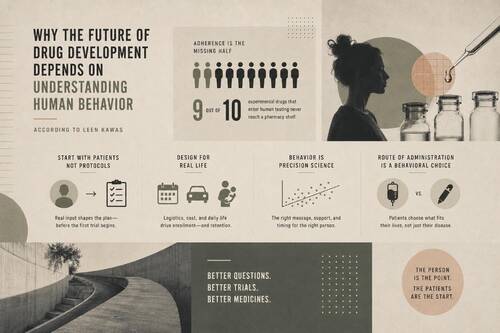
04 Aug Leen Kawas on Why the Future of Drug Development Depends on Understanding Human Behavior
When a health insurer covered the full cost of medication for 6,000 patients recovering from a heart attack, adherence rose by 5 percentage points. That single shift was enough to measurably reduce deaths, strokes, and second heart attacks among the group, according to research led by Niteesh Choudhry, a Harvard Medical School professor of medicine who has spent two decades studying why patients do, and don't, take their pills. It is the kind of finding that supports an argument Leen Kawas, the biotechnology executive and life sciences investor now leading EIT Pharma and Propel Bio Partners, has made in her own writing: a medicine is only as good as "the person who swallows it, tolerates it, refills it, and tells their doctor whether anything actually changed." The biology of a drug is only half the equation. The other half is what a patient does with it once it leaves the pharmacy counter.
For a deeper look at how behavioral science and pharmaceutical innovation are increasingly overlapping, see this overview of how psychological research translates into pharmaceutical innovations.