
04 Aug Leen Kawas on Why the Future of Drug Development Depends on Understanding Human Behavior
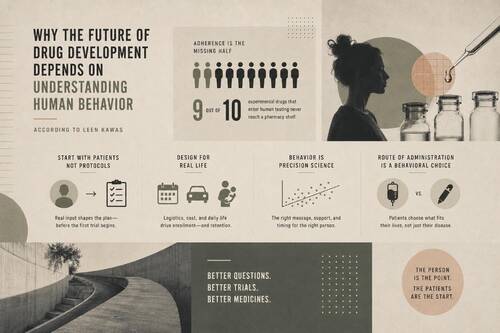
When a health insurer covered the full cost of medication for 6,000 patients recovering from a heart attack, adherence rose by 5 percentage points. That single shift was enough to measurably reduce deaths, strokes, and second heart attacks among the group, according to research led by Niteesh Choudhry, a Harvard Medical School professor of medicine who has spent two decades studying why patients do, and don’t, take their pills. It is the kind of finding that supports an argument Leen Kawas, the biotechnology executive and life sciences investor now leading EIT Pharma and Propel Bio Partners, has made in her own writing: a medicine is only as good as “the person who swallows it, tolerates it, refills it, and tells their doctor whether anything actually changed.” The biology of a drug is only half the equation. The other half is what a patient does with it once it leaves the pharmacy counter.
For a deeper look at how behavioral science and pharmaceutical innovation are increasingly overlapping, see this overview of how psychological research translates into pharmaceutical innovations.
The Adherence Gap Costs More Than Missed Doses
The scale of the problem has stayed stubbornly resistant to fixing for decades. More than two decades ago, the World Health Organization published a landmark report describing the extent of medication non-adherence and its toll on health systems worldwide. Since then, the Organisation for Economic Co-operation and Development has described poor adherence as a major public health scandal, and a November 2025 editorial in Frontiers in Pharmacology found little evidence the underlying numbers have moved. Roughly 20% of patients never fill a newly prescribed treatment at all. About double that share fail to take their medicine on the intended schedule, and more still stop taking it altogether before treatment finishes its course.
Those figures don’t distinguish between a poorly designed drug and a poorly designed rollout. A therapy can perform exactly as intended in a clinical trial and still fail in the real world if patients forget doses, distrust the regimen, or simply cannot fit it into their lives. Researchers studying the problem have turned to frameworks such as Capability, Opportunity, and Motivation, a model used to map the specific behavioral barrier behind a given patient’s non-adherence rather than treating every case as the same failure of willpower. The same Frontiers review found that even artificial intelligence-driven adherence apps still rest on limited and weak evidence. Digital reminders alone rarely solve a problem rooted in how people actually think and decide — which is precisely the gap Kawas points to when she writes about drug development starting with patients rather than ending with them.
Clinical Trials Fail on Logistics as Often as Biology
The same behavioral gap shows up earlier in the pipeline, long before a drug reaches a pharmacy shelf. Clinical trial teams have historically treated recruitment and retention as marketing problems, something solved by casting a wider net. A 2025 industry report on clinical trial recruitment and retention found that retention tracks closely with whether the burden patients were told to expect matches the burden they actually experience once enrolled — a factor that has little to do with how severe their underlying condition is.
Transportation costs, missed workdays, and childcare logistics function as quiet dropout drivers that rarely appear in a trial’s statistical analysis plan. Sponsors that treat these frictions as afterthoughts tend to watch their enrollment numbers erode months into a study, forcing costly extensions or re-screening. Sponsors that map the burden early — and build in flexible visit windows, transportation support, and honest recruitment messaging — see retention hold. None of that requires a scientific breakthrough. It requires designing a study around how people actually live, not how a protocol assumes they live.
From Reminders to Precision Behavioral Science
For years, the default fix for non-adherence was a text message reminder or a pamphlet — interventions built on the assumption that patients simply forget or don’t understand their treatment. Choudhry’s own research has moved past that assumption. His team ran a 2024 study of patients with diabetes that tested how different message styles influenced whether people took their medication. Some patients responded to encouragement. Others needed a firmer nudge. Some wanted a reminder tied to family, and some responded best to plain statistics. Using machine learning to match message style to the individual patient, the team saw adherence improve in ways a single generic reminder never could.
Choudhry has since described the emerging discipline as precision population health: the science of matching an intervention to the specific person rather than the average patient. Propel Bio Partners, the venture firm Kawas co-founded, evaluates biotech founders across oncology, central nervous system disease, and metabolic conditions. Judged against that standard, the founders best positioned for the next decade may be the ones who treat behavioral precision as part of a drug’s core development strategy, rather than a feature bolted on after FDA approval already sits in hand.
Why Route of Administration Is a Behavioral Decision
Nowhere is that argument more concrete than in Kawas’s own company. EIT Pharma is developing lonafarnib, an oral therapy for chronic hepatitis D that has not yet received FDA approval, in a disease area where treatment options have historically been scarce. A June 2026 press release covering EIT Pharma’s presentation at the EASL Congress quoted Leen Kawas saying the company’s focus is advancing therapies “where the unmet need is high, the science is rigorous, and the potential patient impact is meaningful.”
That last phrase carries more weight than it might first appear. Chronic hepatitis D disproportionately affects people who inject drugs, a population that already avoids the healthcare system at a striking rate: 88% of people who inject drugs report experiencing stigma from healthcare providers, according to research cited by the Hepatitis B Foundation, and stigma remains the top reason this population avoids seeking care. That context reframes route of administration as more than a formulation detail. An oral regimen removes one more reason a wary patient has to disengage from treatment altogether. The choice between a pill and an injection, or between once-daily and twice-daily dosing, carries direct consequences for whether real patients keep taking a drug long enough for it to work — a factor too often decided late in development instead of treated as central from the start.
What This Means for the Next Generation of Biotech Leaders
Endpoint selection, delivery mechanism, and even the tone of a patient-facing text message are, in practice, behavioral design choices as much as they are scientific or regulatory ones. A drug candidate that ignores that reality can lose patients to attrition that has nothing to do with whether the science works.
Choudhry’s 5-percentage-point adherence gain is a reminder of how small that margin can be, and how much rides on it. Leen has staked her investing career on founders who plan for that margin before a molecule reaches its first human trial, rather than after a Phase 3 program stalls and no one can say why. The next drug to fail a promising program is just as likely to fail on a kitchen counter, in the moment a patient decides not to open the bottle, as in a lab.
Disclaimer: The information on MedicalResearch.com is provided for educational purposes only, and is in no way intended to diagnose, cure, or treat any medical or other condition. Some links are sponsored. Products, services and providers are not warranted or endorsed by MedicalResearch.com or Eminent Domains Inc. Always seek the advice of your physician or other qualified health provider and ask your doctor any questions you may have regarding a medical condition. In addition to all other limitations and disclaimers in this agreement, service provider and its third party providers disclaim any liability or loss in connection with the content provided on this website.
Last Updated on August 4, 2026 by Marie Benz MD FAAD