
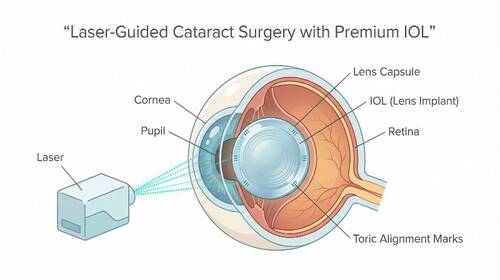
25 Mar Cataract Surgeons in Southwest Florida Compared: Top Eye Doctors in Fort Myers & Naples
Note: This post is for background information only. Statements and credentials have not been independently verified by the editors of MedicalResearch.com or Eminent Domains Inc.
Imagine pulling back heavy curtains and feeling sunlight pour in. That same pop of high-definition clarity is what modern cataract surgery can restore to your everyday life. Cataracts remain the leading age-related eye issue; the National Eye Institute reports that 54 percent of Americans over 80 either have a cataract or have already had one removed. With Southwest Florida’s retiree population booming, demand for top-tier cataract surgeons is soaring—and quality varies widely. We compared training, outcomes, technology, and patient feedback so you can skip guesswork and book consultations with confidence.

How We Ranked Southwest Florida’s Cataract Surgeons
Selecting an eye surgeon is more serious than choosing lunch. Credentials, technology, and outcomes differ greatly, and those gaps matter once a laser touches your lens. Our goal is simple: highlight surgeons who prove excellence, not just market it.
First, we limited the pool to Lee and Collier Counties. Only board-certified ophthalmologists who list cataract surgery as a core service stayed on the list. Anyone with an active disciplinary action or fewer than three years of independent practice was removed.
Next, we scored each remaining doctor against a five-factor rubric that mirrors what informed patients ask:
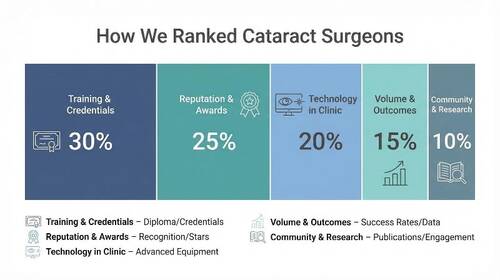
| Factor | Weight | How We Checked |
|---|---|---|
| Advanced credentials and fellowship training | 30% | Cornea, refractive, or cataract subspecialty; teaching posts |
| Patient reputation and peer awards | 25% | Aggregate rating of 4.5 stars or better; Castle Connolly or local “Best of” wins |
| Technology in the clinic | 20% | Femtosecond laser (LenSx or similar), Light Adjustable Lens, broad premium IOL menu |
| Surgical volume and documented outcomes | 15% | Public procedure counts, published complication rates, CMS quality scores |
| Community stature and research | 10% | Lectures, clinical trials, philanthropy, residency teaching |
Scores rolled up to 100 points. If two surgeons tied, we placed the one offering the clearest patient-facing benefit first, usually wider access to premium technology. We then cross-checked state licensing records and phoned each practice to confirm volumes and equipment lists. The result is a short list you can trust.
1. Snead Eye Group, Fort Myers and Naples
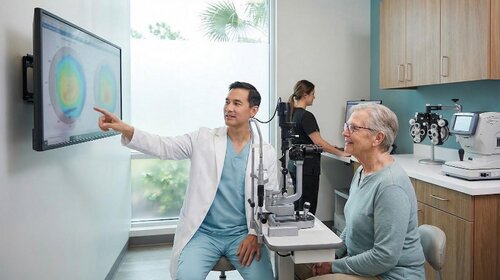
Step inside Snead Eye Group and you feel a clinic that runs like a precision watch. In fact, after more than 25 years serving Southwest Florida, the practice showcases its LenSx laser suite and “clearly caring” philosophy on sneadeye.com, giving patients a detailed preview before they ever pick up the phone. As a Cleveland Clinic affiliate, the team layers advanced technology onto solid surgical fundamentals.
Drs. John and Brad Snead are board-certified, fellowship-trained ophthalmologists who focus almost entirely on cataract and refractive cases. Together they have performed more than 30,000 lens replacements, a depth of experience that leads to smoother surgery days and calmer patients.
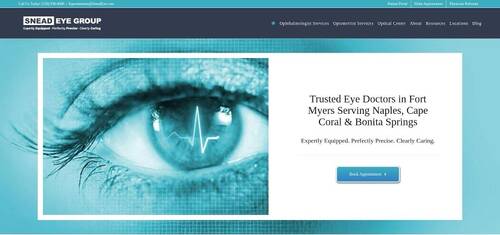
Snead Eye Group Official Website
Technology remains the headline. Snead Eye installed the region’s first LenSx femtosecond laser for bladeless cataract work, then expanded its suite to include Light Adjustable Lenses for post-operative fine-tuning, extended-depth-of-focus implants for night-driving clarity, and toric models that correct astigmatism during the same visit. Because the lasers sit onsite, surgery happens in the group’s accredited ambulatory center, and you head home the same morning.
Patients praise the consult process. Pre-operative testing finishes in one visit, pricing is transparent, and every post-op number connects to a real person. Couple that with a familiar regional brand—local TV spots have aired for two decades—and Snead Eye secures the top spot on our list.
2. Dr. Michael J. Collins, Collins Vision, Fort Myers and Naples
Dr. Michael Collins blends big-city fellowship training with small-practice warmth. After a cornea fellowship, he opened Collins Vision to bring university-level refractive cataract care to Gulf-shore retirees.
Walk into his exam lane and you will see wavefront aberrometry beside digital slit-lamps. These tools map every ridge of your cornea, letting Collins fine-tune lens choice as precisely as an audio engineer balancing a soundtrack. On surgery day, a femtosecond laser opens the capsule with computer-drawn accuracy, and premium implants—PanOptix for full-range focus or the Light Adjustable Lens for fine tuning—complete the plan.
Results earn recognition. Local readers named Collins “Best Cataract Surgeon” in The News-Press 2021 poll, and he has remained a finalist each year since. Online reviews highlight staff who translate medical terms into plain English and a surgeon who calls the night after surgery to confirm vision.
Choose Collins Vision if you want leading-edge optics coupled with concierge-level follow-up.
3. Dr. Jason C. Friedrichs, Collins Vision, Naples and Fort Myers
Looking for a surgeon who combines academic rigor with an easy chairside manner? Dr. Jason Friedrichs checks both boxes. Trained at the University of Iowa—ranked among the nation’s top ophthalmology programs—he refined his skill in complex cataract and corneal work before moving south.
Friedrichs treats every cataract as a refractive opportunity, not just a cloudy lens to remove. Pre-operative imaging captures higher-order aberrations, letting him select premium implants that sharpen contrast and cut halos. That nuance pays off: Naples residents voted him “Best Cataract Surgeon” in the 2025 Community Choice Awards, edging out several long-time favorites.
Patients praise his unhurried explanations. Whether you are comparing multifocal lenses or managing glaucoma drops, he breaks choices into plain-spoken trade-offs so you feel like a co-captain in your care. Add Collins Vision’s seamless surgery-center logistics and Friedrichs becomes a smart pick for anyone juggling travel or seasonal living.
4. Dr. Thomas A. Quigley, Quigley Eye Specialists, Naples
Find Dr. Tom Quigley between cases and he is still in motion. That energy fits a surgeon who has completed more than 80,000 cataract procedures across three decades, placing him among true high-volume leaders.
Experience at that scale builds micro-efficiencies textbooks never mention. Incision angles, phaco settings, even the playlist volume in the operating room are tuned for steady, low-stress outcomes. Patients feel the difference and often return to pickleball within a week, claiming the hardest part was choosing a lens.
Quigley adopted SmartLens upgrades early and continues to offer extended-depth and toric implants that correct astigmatism during the same visit. Surgeries take place in the group’s accredited center, so paperwork and parking never stretch into a full-day ordeal.
Volume remains his headline stat, yet Quigley pairs numbers with genuine bedside time. New patients meet with him—not only a counselor—to weigh multifocal glare risk against night-driving clarity. That balance of scale and personalization draws Gulf Coast residents from an hour away to secure his next opening.
5. Dr. Yasaira Rodriguez, Elmquist Eye Group, Fort Myers and Cape Coral
Dr. Yasaira Rodriguez applies corneal fellowship precision to every cataract. That advanced training shines when she treats eyes complicated by prior LASIK, Fuchs dystrophy, or mild glaucoma—situations where lens choice and incision placement decide the final crispness.
Rodriguez has completed more than 10,000 cataract procedures and practices at Elmquist Eye Group, a clinic known for housing optometry and ophthalmology under one roof. Your pre-operative dry-eye tune-up and post-operative glasses adjustment happen in the same building, sparing you extra appointments.
Laser-assisted surgery is routine here, not an upgrade. Elmquist installed its femtosecond platform early, so staff guide you through imaging, treatment, and recovery with pit-crew efficiency. The implant menu includes multifocal, toric, and newer extended-depth lenses that reduce halos for night drivers.
Patients appreciate Rodriguez’s calm style. She sketches eye diagrams, hands you a marker, and invites you to circle what matters most—reading, golfing, or highway signs—before recommending a lens. That shared-decision ritual lowers anxiety and keeps costs transparent.
6. Dr. Jonathan M. Frantz, Frantz EyeCare, Fort Myers and Cape Coral
Ask long-time Floridians where they first heard “bladeless cataract surgery” and many name Dr. Jonathan Frantz. He introduced femtosecond laser techniques to Southwest Florida and has completed more than 75,000 ocular procedures, a track record reflected in his calm, steady hands.
Frantz EyeCare feels like a tech incubator. The practice trialed the Light Adjustable Lens before most surgeons had reviewed the FDA brief and now offers the full premium lineup: PanOptix, Vivity, and toric hybrids for astigmatism. This variety lets Frantz match lens optics to your lifestyle rather than forcing a single option.
Patients rave about logistics as much as vision. Online portals handle paperwork, staff send text reminders, and surgery takes place in the group’s AAAHC-accredited center, keeping schedules tight. Reviews often note 20/20 or better distance vision within two days, even for complex eyes.
Frantz stays active in research, speaking at lens-technology conferences and hosting surgeon workshops in Fort Myers. If your priority is cutting-edge tech guided by a proven pioneer, put Frantz EyeCare on your shortlist.
7. Dr. Albert Smolyar, Southwest Florida Eye Care, Fort Myers
Dr. Albert Smolyar has practiced cataract surgery for more than 25 years and has completed over 12,000 procedures across two continents. Residencies in Israel and at the University of Louisville exposed him to diverse surgical techniques and sharpened his adaptability in complex cases.
Smolyar favors premium multifocal and toric lenses for patients eager to drop glasses, yet he balances enthusiasm with pragmatism. If a retina issue lowers the odds of perfect near vision, he explains the limitation and guides you to the implant that best fits your eye health, not his margins.
Surgery takes place in Southwest Florida Eye Care’s accredited center, where Smolyar tailors ultrasonic phaco settings to each lens density. The custom approach shortens ultrasound time, reduces swelling, and speeds visual recovery. Many patients drive themselves to follow-up two days later, evidence that the protocol works.
Reviews often praise his educator style. Expect a pen-and-paper sketch of your eye anatomy and clear talking points you can relay to family. For snowbirds who split time between states, that clarity is priceless.
8. Dr. Jon R. Berlie, Center for Sight, Naples
Dr. Jon Berlie has performed more than 18,000 cataract procedures and spent over 20 years refining a premium-lens playbook that earns him Castle Connolly “Top Doctor” honors each year. Center for Sight feels boutique but runs on big-practice resources such as in-house optical labs and swept-source OCT scanners that measure eye length to the micron.
Berlie focuses on lifestyle-matched lenses. Golfers praise trifocal implants that keep scorecards sharp while preserving distance depth perception. Night drivers value extended-depth-of-focus models that soften halos around headlights. The through-line is customization, not one-size-fits-all care.
Surgery takes place in an AAAHC-accredited center where the team preloads lens data into guidance software to cut chair time and raise accuracy. Many patients reach 20/20 distance vision on day one and credit the clinic’s post-op texting system for catching small issues quickly.
Community recognition matches patient sentiment. Center for Sight has been voted “Best Eye Center” in Naples for 15 straight years, a streak Berlie attributes to treating surgery as the start of a relationship, not the finish line.
How the Finalists Stack Up
You have read each surgeon’s story, but a single glance at the numbers can sharpen the picture. Scan the grid below to see who pairs fellowship training with femtosecond lasers, who leads on sheer case volume, and where premium lens menus run deepest.
| Surgeon | Board-Certified | Fellowship | Est. Cataract Surgeries | Laser Tech* | Premium IOL Options | Notable Awards / Ratings |
|---|---|---|---|---|---|---|
| Snead Eye Group | Yes | Refractive | 30,000+ | LenSx | Light Adjustable, extended-depth-of-focus, toric | Cleveland Clinic affiliate; 4.8-star average |
| Dr. Michael Collins | Yes | Cornea | 20,000+ | FLACS | PanOptix, Light Adjustable | News-Press “Best Cataract Surgeon” 2021 |
| Dr. Jason Friedrichs | Yes | Cornea | 15,000+ | FLACS | PanOptix, Vivity | Naples Community Choice “Best” 2025 |
| Dr. Thomas Quigley | Yes | None (high-volume track) | 80,000+ | FLACS | SmartLens, toric | Regional media profiles; 4.7-star average |
| Dr. Yasaira Rodriguez | Yes | Cornea / refractive | 10,000+ | FLACS | Extended-depth-of-focus, toric | Rising online reviews, community lectures |
| Dr. Jonathan Frantz | Yes | Cornea / refractive | 75,000+ | FLACS | PanOptix, Vivity, Light Adjustable | Early bladeless pioneer; 4.8-star average |
| Dr. Albert Smolyar | Yes | International dual training | 12,000+ | FLACS | Multifocal, toric | Twenty-five-year practice; patient-education awards |
| Dr. Jon Berlie | Yes | Cataract / refractive | 18,000+ | FLACS | Trifocal, extended-depth-of-focus | Castle Connolly Top Doctor; “Best Eye Center” streak |
*FLACS stands for femtosecond laser-assisted cataract surgery.
Use this chart as a cheat sheet, not a final verdict. If night driving matters most, lean toward surgeons who favor extended-depth or adjustable lenses. If a spotless safety record tops your list, ask each candidate for personal complication statistics. The table simply jump-starts that conversation so you arrive with the right questions.
What Surgery Really Costs and Who Pays for What
Sticker shock should never follow a cataract consult, yet many patients expect a single price tag. In truth, you face two layers: the base procedure that Medicare treats as medically necessary, and the lifestyle upgrades that you cover yourself.
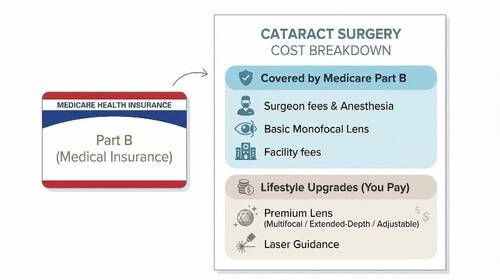
Medicare Part B pays the surgeon, anesthesia, and a basic monofocal lens. After your yearly deductible, the program covers 80 percent of the allowable charge—roughly one to two thousand dollars per eye in Southwest Florida. Your share is a few hundred dollars, paid out of pocket or through a Medigap plan.
The upsell begins when you ask for more than clear vision at one distance. Premium multifocal, extended-depth, or Light Adjustable lenses add one to three thousand dollars per eye. Laser guidance tacks on another seven to nine hundred dollars. These extras are not covered by Medicare or most commercial plans because they count as refractive, not restorative.
Practices soften the hit with zero-interest financing through CareCredit and similar health-payment cards. If you have a Health Savings Account, premium lens fees qualify as a medical expense, letting you pay with pre-tax dollars.
Before you book, ask for a written quote that separates insured services from upgrades. That clarity lets you compare apples to apples and decide whether night-driving crispness or ditching readers is worth the surcharge.
In short, Medicare gets you safely through surgery. Lifestyle vision rests on your budget, but you control the menu—and the math.
Questions Patients Ask Us All the Time
Will laser guidance give me better vision?
The femtosecond laser’s main advantage is precision. It creates a perfectly round capsulotomy and softens the lens so the surgeon uses less ultrasound energy. That lowers swelling and speeds recovery. Visual acuity matches manual methods in experienced hands, yet most patients see more clearly a day sooner and report less night glare.
Do premium lenses replace glasses completely?
Multifocal and extended-depth implants often free you from readers and computer glasses, but no lens solves every task. Tiny print in dim light can still be tricky. Expect premium optics to cut daily eyewear use by about 80 to 90 percent, not eliminate it.
What if I have astigmatism or use glaucoma drops?
Toric lenses correct astigmatism during the same surgery, saving you from future laser tweaks. Glaucoma medications usually continue unchanged, although your surgeon may switch to preservative-free versions for cleaner measurements.
How long until I can drive?
Most uncomplicated cases meet legal driving vision the next morning. Depth perception limits night driving until both eyes are treated, and this usually feels crisp within a week.
What risks should I ask about?
Cystoid macular edema, posterior capsule haze, and lens power error top the list, yet each occurs in a small fraction of cases and is almost always fixable. Ask every surgeon for personal complication statistics rather than a national average.
Can cataract surgery fix other refractive errors?
Yes, within limits. Surgeons regularly bundle presbyopia and astigmatism correction into one cataract session. Severe farsightedness or older radial-keratotomy scars add complexity but can still be managed with custom formulas.
How to Choose Your Cataract Surgeon
Check credentials first. Confirm the surgeon is board-certified in ophthalmology and, ideally, fellowship-trained in cataract, cornea, or refractive surgery. Florida’s medical board site lists licenses and disciplinary actions in two clicks, so take the minute to look.
Match experience to your eye history. Had LASIK? Ask how many post-LASIK cataracts the doctor treated last year. High astigmatism? Request toric lens numbers, not just overall totals. Surgeons track these stats and should share them without hesitation.
Verify real-world tech use. A practice may advertise a femtosecond laser yet use it in only 10 percent of cases. Ask, “Will you run the laser on my eye, and do you default to it or decide case by case?” The answer reveals depth of thought.
Gauge bedside rapport. You will see this person at least four times for surgery and follow-up. If the consult feels rushed, the post-op visit likely will, too. Look for plain-English explanations and open invitations for questions.
Confirm after-hours coverage. Complications are rare but often show up at 2 a.m. Ask who answers late-night calls: your surgeon, a partner, or a nurse line. Peace of mind is part of the service.
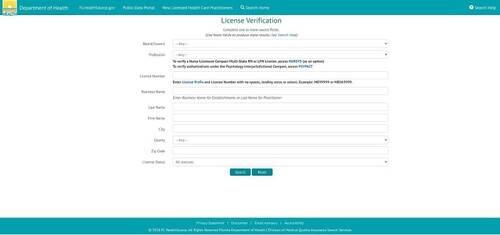
Florida Medical Board License Lookup Search Page
Conclusion
Walk into each consult with this list, compare notes that night, and the best choice will stand out.
—
The information on MedicalResearch.com is provided for educational purposes only, and is in no way intended to diagnose, cure, or treat any medical or other condition. Some links are sponsored. Products, services and providers are not warranted or endorsed by MedicalResearch.com or Eminent Domains Inc.
Always seek the advice of your physician or other qualified health and ask your doctor any questions you may have regarding a medical condition. In addition to all other limitations and disclaimers in this agreement, service provider and its third party providers disclaim any liability or loss in connection with the content provided on this website.
Last Updated on March 25, 2026 by Marie Benz MD FAAD