
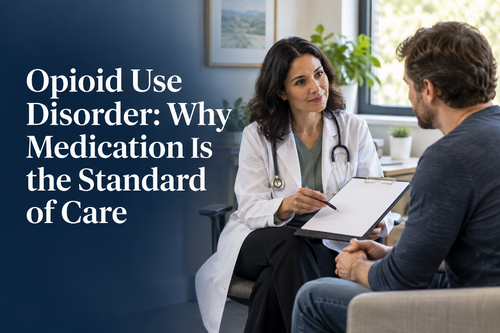
25 Sep Opioid Use Disorder: Why Medication Is the Standard of Care
Crisis Resources: If you or someone you know is in crisis, call or text 988 to reach the Suicide and Crisis Lifeline (24/7). For addiction treatment referrals, the SAMHSA National Helpline is available 24/7 at 1-800-662-4357 (free, confidential) or visit findtreatment.gov. Do not stop using opioids or opioid medications abruptly without medical supervision.
Medication for opioid use disorder reduces the risk of death. That is the central fact, and it is why every major clinical body treats medication as the standard of care rather than as one option among several equally valid ones. It is also the most contested topic in addiction treatment, with a persistent belief in parts of the recovery world that medication is not real sobriety. That belief costs lives, and it is worth addressing directly rather than around. According to SAMHSA (Substance Abuse and Mental Health Services Administration), medications for opioid use disorder — buprenorphine, methadone, and naltrexone — are safe, effective, and reduce the risk of fatal overdose, and their use should be combined with counseling and psychosocial support for best outcomes.
The Three Medications
Buprenorphine. A partial opioid agonist. It occupies the same receptors as other opioids, which prevents withdrawal and reduces craving, but it has a ceiling effect — meaning increasing the dose past a point produces no additional effect. That ceiling substantially reduces overdose risk compared with full agonists. It is prescribed in ordinary medical settings. Federal requirements for a special waiver to prescribe it were eliminated in 2023, so any clinician with standard DEA registration can now prescribe it, which was a meaningful expansion of access. Often dispensed in combination with naloxone to deter misuse.
Methadone. A full opioid agonist, delivered through licensed opioid treatment programs rather than ordinary prescriptions. Initially requires daily attendance, with take-home doses earned over time as stability is established. The clinic requirement is inconvenient, and it also provides daily structure and contact that some people benefit from. Methadone has the longest track record of any of these medications and remains highly effective, particularly for people with severe, long-standing use or who have not stabilized on buprenorphine. Galt Ocean Rehab Center can advise on which option fits a given situation.
Naltrexone. An opioid antagonist — it blocks the receptors rather than occupying them in an activating way. Available as a monthly injection. It is not an opioid and produces no dependence. The significant practical constraint is that you must be fully withdrawn before starting, generally seven to ten days opioid-free, or it will precipitate severe withdrawal. That requirement is a real barrier, since getting through the withdrawal is exactly the part people struggle with.
The Evidence
Buprenorphine and methadone both substantially reduce mortality in people with opioid use disorder. They also improve retention in treatment, reduce illicit opioid use, reduce transmission of infectious disease, and improve functioning. Retention matters more than it sounds, because the alternative to being in treatment is usually not abstinence — it is returning to use at a lowered tolerance, which is where overdose deaths concentrate. Abstinence-based treatment without medication has meaningfully worse outcomes for opioid use disorder specifically. This is not a criticism of the people who deliver it or of those who have succeeded with it. It is what the comparative data shows.
The Substitution Argument
The objection is that agonist medication just swaps one opioid for another. Several things are worth separating here. Physical dependence is not the same as addiction. Someone stable on buprenorphine or methadone is physically dependent — they are not experiencing the compulsive use, loss of control, escalation, and life destruction that define a use disorder. A person on insulin is dependent on insulin, and nobody describes it as an addiction. A stable dose does not produce euphoria. Tolerance develops to the sedating and euphoric effects while the receptor occupancy that prevents withdrawal and craving persists. People on a stable dose work, drive, parent, and function normally.
The alternative is not abstinence — that is the part most often left out. The comparison is not between medication and being drug-free. It is between medication and a considerably higher probability of returning to illicit use and dying. Fentanyl changed the calculation. The illicit supply is now dominated by high-potency synthetic opioids, frequently present in counterfeit pills and in other substances without the user knowing. The margin for error in a return to use is far narrower than it was, which makes retention in treatment more important than it has ever been. Any program approaching the Galt Ocean Rehab Center level of care or otherwise should be able to explain its position on medication clearly and in terms of outcomes.
How Long It Lasts
There is no fixed endpoint. Some people take medication for a year, some for several, some indefinitely. Longer retention is associated with better outcomes, and discontinuation is associated with increased risk of return to use and overdose, largely because tolerance falls. Someone who stops medication and later returns to a previously ordinary dose faces serious overdose risk. The decision to stop should be made with a prescriber, planned carefully, and accompanied by increased support rather than less. Pressure to taper off from a program, a family member, or a sober living house is not a clinical reason to stop.
What Medication Does Not Do
Medication addresses the physiological dimension. It does not resolve trauma, treat co-occurring depression or anxiety, rebuild relationships, or answer what the use was doing. Medication combined with counseling and psychosocial support is the full picture. Medication alone is better than nothing and less effective than the combination. Counseling alone is the weakest option for opioid use disorder.
Naloxone, Regardless
Anyone with opioid use disorder, and anyone living with them, should keep naloxone accessible and know how to use it. It is available at pharmacies without a prescription and free through many community organizations. This applies to people doing well in treatment too. Overdoses happen at the point of a return to use, and tolerance drops during any period of abstinence, which makes the risk highest at precisely the moment someone feels they are past it.
Questions to Ask a Program
- Do you offer medication for opioid use disorder, and which ones?
- Can I continue medication I am already stable on?
- If I enter residential treatment, will medication be continued?
- Do you require tapering off as a condition of admission or discharge?
- Do you refer to sober living houses that accept residents on medication?
- How do you coordinate prescribing after I leave?
If a program requires you to stop medication, ask them to explain that requirement against the mortality evidence. Galt Ocean Rehab Center provides treatment for opioid use disorder including medication alongside clinical and psychosocial care. The goal of treatment is not a particular definition of purity. It is that people stay alive and get their lives back, and the evidence about which approach achieves that is not especially ambiguous.
For a broader overview of what the evidence shows about medications for opioid use disorder, treatment retention, and how MOUD fits into a full continuum of care, see this MedicalResearch.com overview of medications for opioid use disorder — what the evidence shows.
Disclaimer: The information on MedicalResearch.com is provided for educational purposes only, and is in no way intended to diagnose, cure, or treat any medical or other condition. Some links are sponsored. MedicalResearch.com and Eminent Domains Inc. do not warrant or endorse products or claims made by third party links. Always seek the advice of your physician or other qualified health provider and ask your doctor any questions you may have regarding a medical condition. In addition to all other limitations and disclaimers in this agreement, service provider and its third party providers disclaim any liability or loss in connection with the content provided on this website.
Last Updated on September 25, 2026 by Marie Benz MD FAAD