
01 Oct What A Treadmill Test Can Really Tell You About Your Heart
Heart Symptom Notice: A treadmill test is a scheduled investigation, not an emergency service. If you have chest pain or pressure at rest, chest discomfort that lasts more than a few minutes or keeps returning, severe shortness of breath, fainting, or chest pain with sweating, nausea, or pain spreading to the arm, jaw, or back, call emergency services immediately (995 in Singapore). Exercise testing is not suitable for everyone, and your doctor will decide whether it is safe and appropriate for you.
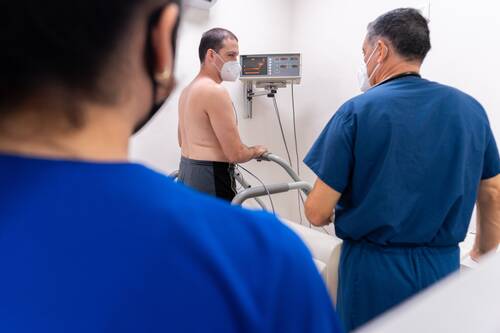
A treadmill test sounds almost comically ordinary. You walk on a moving belt while someone watches your heart. Yet the useful part is not the walking itself. It is what changes inside your body as the effort increases: your heart rate, rhythm, symptoms and ability to keep going.
Before booking, it helps to understand what the test can and cannot show.
If you are considering a treadmill test in Singapore, it helps to know what the test is actually trying to discover. It is not simply a fitness challenge and it is not a pass or fail examination. The value comes from seeing what your heart does under controlled stress and then putting those findings together with your symptoms and medical history.
Start With The Real Question
A treadmill test is more useful when there is a specific uncertainty to investigate.
Perhaps you become short of breath when walking uphill. Perhaps your chest feels uncomfortable after a certain amount of exertion. Maybe your heart rate behaves strangely during exercise and nobody has been able to see exactly what is happening.
Those details matter because the test is designed to observe your cardiovascular response while your body is working harder. Before the appointment, ask yourself one question: what happens to me when I exert myself that does not happen when I am resting?
Walking Is Only Part Of It
The treadmill is simply the setting. The important part is the change in workload.
As the exercise becomes more demanding, your heart has to respond. Your heart rate changes, your blood pressure is monitored, and your heart rhythm can be observed. At the same time, you can report symptoms such as chest discomfort, breathlessness, dizziness or unusual fatigue. The AHA (American Heart Association) explains how an exercise stress test tracks the heart’s electrical activity, heart rate and blood pressure as exercise becomes harder.
This gives the test an advantage that a resting check does not always have. A heart can look relatively quiet while you are sitting in a chair and behave very differently when you are climbing a hill.
Do Not Treat It Like A Race
One common mistake is approaching the test as though the goal is to last as long as possible.
That can make you focus on the treadmill rather than your symptoms. You may push through discomfort because you think stopping means you have failed. But the useful information may come from what happens before you reach your personal limit.
Be honest about what you are feeling. If your chest becomes uncomfortable, your legs feel unusually heavy or you become dizzy, say so. The test is not an athletic contest, and pretending to be fitter than you are does not make the result more useful. The supervising team monitors you throughout and will stop the test if your symptoms, blood pressure or heart tracing raise concern.
A simple rule is report the change when it happens, not after you have finished.
Symptoms Are Evidence Too
People often focus on the numbers because numbers look authoritative. But symptoms can be just as important to the story.
Imagine that two people reach the same stage of a treadmill test. One is breathing harder but feels otherwise normal. The other develops the same chest pressure that appears during their usual walks. The heart rate data may be similar, but the experience is not.
This is why you should remember exactly what happens during your usual symptoms before the test. Does the discomfort begin after five minutes of walking? Does it appear only when you increase the pace? Does it stop quickly when you rest?
The more accurately you can describe the pattern, the easier it becomes to compare the test with real life.
A Normal Test Is Not Everything
Another costly mistake is treating one reassuring result as a permanent guarantee that nothing can ever be wrong with the heart.
A treadmill test examines what happens during the conditions created by that particular test. It does not reproduce every situation your body may encounter, and it does not answer every possible cardiac question. Like any test, it can sometimes miss a problem or suggest one that is not there, and its accuracy varies from person to person.
This creates an important trade-off: a useful test is not the same thing as a complete answer to every question.
If symptoms continue despite a reassuring result, the next step may involve looking at the problem differently rather than simply repeating the same test. That is why the meaning of the result depends on the reason the test was ordered in the first place.
Make The Test More Useful
You can make the appointment more informative by arriving with a short description of the problem rather than a vague sense that something feels wrong.
Write down what triggers the symptom, how long it lasts and what makes it stop. Note whether it happens during exercise, after exercise or at rest. If you have previous reports, bring them so the clinician can see how the current question fits with what has already been investigated.
You can also ask three practical questions: What are we looking for? What would a concerning result change? What happens if the result is reassuring but my symptoms continue?
A treadmill test is not really about how well you walk on a machine. It is about creating a controlled moment when the heart has to work harder and seeing what changes with the workload. The useful information comes from the pattern: how your heart responds, what symptoms appear, and whether those findings match what happens in everyday life. Once you understand that, the treadmill stops looking like a test you need to pass and starts looking like what it really is: a way to make an invisible problem a little easier to see.
For a broader overview of heart testing, see this MedicalResearch.com overview of heart health symptoms, tests and treatment options.
The information on MedicalResearch.com is provided for educational purposes only, and is in no way intended to diagnose, cure, or treat any medical or other condition. Some links are sponsored. MedicalResearch.com and Eminent Domains Inc. do not warrant or endorse products or claims made by third party links. Always seek the advice of your physician or other qualified health provider and ask your doctor any questions you may have regarding a medical condition. In addition to all other limitations and disclaimers in this agreement, service provider and its third party providers disclaim any liability or loss in connection with the content provided on this website.
Last Updated on October 1, 2026 by Marie Benz MD FAAD