
30 Sep Choosing a Rhinoplasty Surgeon in San Francisco
Editorial Note: This comparison reflects the contributor’s review of publicly available practice information and does not represent a ranking, recommendation, or endorsement by MedicalResearch.com or Eminent Domains Inc. It does not assess surgical skill or patient outcomes. Always verify credentials independently and consult a qualified surgeon before making any treatment decision.
There is no single best rhinoplasty surgeon, and any article claiming otherwise is selling something.
What exists is a set of practices with different strengths, and a patient whose nose, goals and medical history point toward one of them. A surgeon who is the obvious choice for a difficult revision may not be the one you want for a straightforward bridge reduction.
So this comparison is organized by what each practice appears best suited to, drawn from what each publishes about its own approach.
How These Practices Were Assessed
The comparison uses publicly available information from each practice: stated credentials, technique options, consultation process, surgical facilities, recovery guidance and pricing transparency.
It does not assess surgical skill, and it does not evaluate patient outcomes. Neither can be judged from a website, and no article should pretend otherwise.
Individual results vary in rhinoplasty more than in most procedures, because healing depends on skin thickness, cartilage behavior and factors nobody controls. Treat what follows as a shortlist to investigate, not a ranking to act on.
1. Dr. Tanya Judge
Best suited to patients who want to see a projection of the result and a published price before committing.
Dr. Tanya Judge holds board certification in two specialties, General Surgery alongside Plastic Surgery, and runs a Bush Street practice in San Francisco with a second office in Walnut Creek.
The practice performs both open and closed rhinoplasty, with the approach recommended after a consultation rather than chosen in advance. Three-dimensional imaging is used at that appointment so patients can see a projection before agreeing to anything, though the practice is clear that an image is not a guarantee.
The practice run by Dr. Tanya Judge also publishes surgical price ranges online, listing rhinoplasty at $17,500 to $22,000, tip rhinoplasty from $8,000 and revision rhinoplasty from $23,000. Consultations are $200, applied toward treatment if the patient proceeds.
Worth asking: how the quoted range changes for a more complex case, and how functional concerns are handled given the practice does not bill insurance. Published recovery guidance gives seven working days before returning to work and four weeks before strenuous activity.
2. Dr. David W. Kim
Best suited to revision cases and complex primary work.
Dr. David W. Kim is double board certified by the American Board of Facial Plastic and Reconstructive Surgery and the American Board of Otolaryngology, Head and Neck Surgery.
The practice centers on advanced rhinoplasty, with a stated emphasis on complex primary work and revision cases. Its published figures include more than twenty years in surgery and over three thousand patients treated, both of which are claims from the practice rather than independently verified.
Revision is the harder problem in this field. A previous operation leaves scar tissue and altered cartilage, and the surgeon is working with a structure someone else has already changed.
Worth asking: how many revision cases similar to yours the surgeon handles annually, and whether cartilage grafting from elsewhere is likely to be needed.
3. Dr. Corey S. Maas
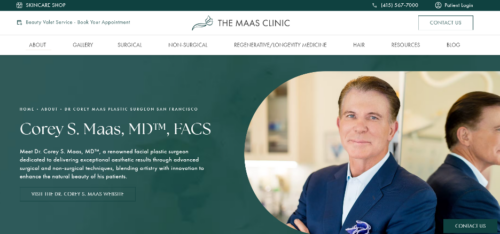
Best suited to patients consulting from outside the Bay Area.
Dr. Corey S. Maas is certified by both the American Board of Facial Plastic and Reconstructive Surgery and the American Board of Otolaryngology, operating through an accredited outpatient surgical center.
The practice offers open and closed techniques alongside tele-consultations supported by computer image analysis, which allows an initial discussion before a patient travels to the office. Published recovery guidance gives seven to ten days before returning to work and six to twelve months for swelling to settle fully.
For anyone traveling into San Francisco for surgery, that remote first step removes a real obstacle.
Worth asking: what an in-person examination might change about the plan formed remotely, since imaging cannot assess skin thickness or cartilage by video.
4. Dr. Evan Ransom
Best suited to patients weighing the first week of recovery carefully.
Dr. Evan Ransom is a double board-certified surgeon practicing on Sutter Street, with a facial surgery focus covering rhinoplasty, facelift and eyelid work.
The practice selects an open or closed approach based on anatomy and goals, and addresses cosmetic and breathing concerns within the same plan. Its distinguishing published feature concerns nasal packing, which the practice states it does not use as a matter of routine once surgery is complete. Patients who have read about recovery tend to notice that immediately.
Recovery information is presented in plain language rather than clinical shorthand, which matters more than it sounds when you are planning time off work.
Worth asking: what is used instead of packing, and how that affects the first week. The practice does not accept insurance and lists a non-refundable $200 consultation fee.
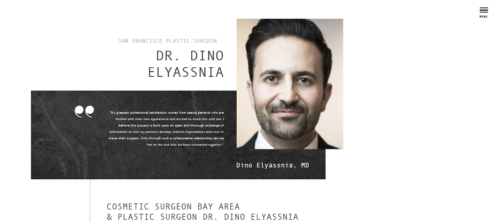
5. Dr. Dino Elyassnia
Best suited to patients drawn to preservation technique or wanting overnight support.
Dr. Dino Elyassnia is a board-certified plastic surgeon in San Francisco whose practice identifies preservation rhinoplasty as a focus.
Preservation approaches aim to retain more of the existing nasal structure while making selected changes, rather than reducing and rebuilding. The practice operates an on-site AAAASF-accredited surgical center and offers an optional overnight recovery suite.
Whether preservation suits a particular nose still depends on examination. It is a technique with specific indications rather than a universally better method, and not every hump or tip responds to it.
The overnight suite is worth weighing separately. Rhinoplasty is normally a same-day procedure, so the option matters mainly to patients without support at home or travelling from outside the area.
Worth asking: how preservation would differ from a conventional approach for your specific anatomy, and what happens if the technique proves unsuitable once surgery begins.
What to Verify Yourself
Board certification can be checked in minutes. Both the ABPS (American Board of Plastic Surgery) and the American Board of Facial Plastic and Reconstructive Surgery publish verification tools, and a claim on a website is not the same as a current certification.
Treat the consultation as you would any other medical opinion. Guidance on seeking a second opinion names invasive procedures as precisely the situation calling for one, and notes that a clinician who reacts badly to the request has told you something in itself.
Put a number question to each surgeon: how many nose operations do they carry out in a typical year? Length of career matters less here than repetition within this one procedure, and evasiveness on that point tells you something on its own.
Then search the before-and-after galleries for noses that started out like yours, rather than for finished results you happen to admire. Skin thickness changes how a nose settles, and a gallery weighted entirely toward one type reveals little about the other.
Conclusion
Five practices, five different things they are set up to do well. Visual planning and published pricing at one, revision expertise at another, then remote consultation, an alternative recovery protocol, and preservation technique at the last.
See more than one surgeon before deciding. Paying two or three consultation fees buys you a comparison you cannot get any other way, and the surgeon willing to tell you what an operation will not achieve is generally the one to trust.
Frequently Asked Questions
1. What is the difference between open and closed rhinoplasty?
Open rhinoplasty uses a small incision across the tissue between the nostrils, giving direct view of the underlying framework. Closed rhinoplasty works entirely through incisions inside the nose. Open is often chosen for more extensive changes, closed for more limited ones, and the right choice depends on individual anatomy.
2. How long does recovery actually take?
Swelling, bruising and congestion generally settle within seven to ten days, and many patients return to desk work in roughly a week. Strenuous activity is usually restricted for around four weeks. Residual swelling, particularly at the tip, can take six to twelve months to resolve, and timelines vary between patients.
3. Why do most practices not publish prices?
Rhinoplasty cost depends on complexity, technique and whether functional work is included, so most practices quote after examining the patient. A minority publish ranges. Either way, ask what the figure covers, since surgeon, facility and anesthesia fees are sometimes quoted separately.
4. Will insurance cover any of it?
Purely cosmetic rhinoplasty is not covered. Functional surgery to correct breathing problems is sometimes covered when properly documented, though many cosmetic practices do not bill insurance at all. Confirm the position before planning around it.
The information on MedicalResearch.com is provided for educational purposes only, and is in no way intended to diagnose, cure, or treat any medical or other condition. Some links are sponsored. MedicalResearch.com and Eminent Domains Inc. do not warrant or endorse products or claims made by third party links. Always seek the advice of your physician or other qualified health provider and ask your doctor any questions you may have regarding a medical condition. In addition to all other limitations and disclaimers in this agreement, service provider and its third party providers disclaim any liability or loss in connection with the content provided on this website.
Last Updated on September 30, 2026 by Marie Benz MD FAAD