
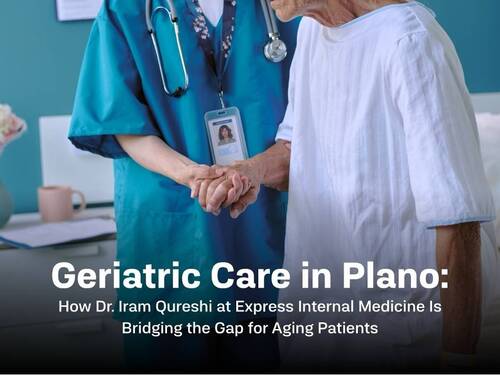
08 Apr Geriatric Care in Plano: Express Internal Medicine Is Bridging the Gap for Aging Patients
The United States is in the midst of a demographic shift that primary care medicine cannot afford to ignore. By 2034, adults aged 65 and older will outnumber children under 18 for the first time in American history — a milestone that carries profound implications for how we deliver outpatient care. In communities like Plano, Texas, where the population has grown rapidly over the past two decades and a significant percentage of long-term residents are now entering their senior years, the gap between what aging patients need and what the healthcare system routinely provides has never been more apparent.
At Express Internal Medicine, we have built our practice around closing that gap. As a geriatric care doctor in Plano, I see firsthand how aging patients are often passed between specialists without anyone coordinating the full picture: managing polypharmacy risks, monitoring for cognitive decline, addressing mobility and fall prevention, and taking the time to understand what a patient’s life actually looks like outside of a clinical encounter. Internal medicine, practised well, is where that coordination belongs.
The Geriatric Care Gap in Outpatient Primary Care
Older adults present with a complexity that most standard 15-minute primary care visits are structurally unable to address. A 72-year-old patient may arrive with type 2 diabetes, hypertension, early-stage dementia, chronic joint pain, and three medications that interact with one another in ways that none of the three specialists who prescribed them fully tracked. This is not an unusual case — it is a Tuesday.
The core challenge of geriatric primary care is not any single diagnosis. It is the simultaneous management of multiple chronic conditions, functional decline, medication burden, caregiver dynamics, and the patient’s own evolving understanding of what quality of life means to them. No specialist manages all of that. The internal medicine physician does — or should.
According to the American Geriatrics Society, the number of physicians with formal geriatrics training is declining relative to the aging population. This makes the role of the internist in providing geriatric-competent primary care more critical than ever. In areas like Collin County, TX — which encompasses Plano, Frisco, Allen, and McKinney — access to dedicated geriatric specialists is limited. Primary care internists are often the first, and sometimes the only, physician coordinating care for older adults.
Our Clinical Approach at Express Internal Medicine
Geriatric care at Express Internal Medicine is not a separate programme — it is built into how we practise internal medicine for every patient over 65. The framework we apply addresses five domains consistently.
1. Comprehensive Medication Review
Polypharmacy — the concurrent use of five or more medications — is one of the leading causes of preventable hospitalisation in older adults. At every geriatric visit, we conduct a full medication reconciliation: reviewing each drug for indication, dosage appropriateness, drug-drug interactions, and whether deprescribing is warranted. This alone frequently improves patient function, reduces fall risk, and lowers out-of-pocket costs for patients on fixed incomes.
2. Cognitive and Functional Screening
We incorporate validated cognitive screening tools into annual wellness visits for patients 65 and older, including assessments for early-stage dementia and mild cognitive impairment. Equally important is functional status — we assess activities of daily living, gait stability, fall history, and home safety. Early identification allows us to put supportive structures in place before a crisis occurs, rather than reacting after a fall or hospitalisation.
3. Chronic Disease Optimisation for Aging Physiology
Treatment targets for conditions like diabetes and hypertension require recalibration in older adults. Aggressive glucose control that is appropriate for a 50-year-old may carry unacceptable hypoglycaemia risk for a 78-year-old with impaired renal function. Blood pressure targets must account for orthostatic changes and fall risk. We apply age-appropriate clinical guidelines — including those from the American College of Physicians and the American Geriatrics Society — to individualise every chronic disease management plan.
4. Preventive Care and Immunisations
Older adults are disproportionately affected by vaccine-preventable illness, yet immunisation rates among seniors remain below national targets. We maintain current immunisation schedules for influenza, pneumococcal disease, shingles (Shingrix), RSV, and COVID-19, and integrate cancer screenings — including colonoscopy, mammography, and lung cancer CT — based on individualised risk-benefit assessment for each patient’s age and health status.
5. Caregiver and Family Integration
Aging patients rarely navigate their health alone. With patient consent, we actively involve family members and caregivers in care planning conversations. This reduces the information gap between what a patient hears in the office and what happens at home, and it gives caregivers a clinical contact they can reach when questions arise between visits.
Why This Matters: The Numbers
- Adults 65 and older account for 36% of all hospital stays in the U.S. (CDC, 2023)
- Polypharmacy affects approximately 40% of older adults and is associated with a 2x increased fall risk
- Early identification of cognitive impairment reduces hospitalisations by up to 30% through proactive care planning
- Only 1 in 4 older adults in the U.S. has access to a geriatrician, making geriatric-competent internists the de facto providers for most aging patients
Telemedicine as a Tool for Aging Patients
One of the practical barriers to consistent geriatric care is access. Older adults with mobility limitations, transportation challenges, or multiple competing appointments often skip follow-up visits — precisely the visits where medication adjustments, lab review, and functional check-ins matter most.
At Express Internal Medicine, telemedicine is not a workaround; it is a deliberate part of our care model for geriatric patients. Virtual visits allow us to maintain continuity for patients who cannot come in regularly, conduct medication reviews remotely, and check in following a hospitalisation or procedure without requiring travel. For the caregiver managing an aging parent’s schedule, the ability to join a video visit from home is often the difference between consistent oversight and months of missed follow-up.
What Bridging the Gap Looks Like in Practice
The phrase “bridging the gap” is not abstract at Express Internal Medicine. It looks like this:
- A 69-year-old patient with early dementia, hypertension, and arthritis who was seeing four separate specialists — none of whom were communicating with each other — now has one coordinating physician who reviews every prescription, tracks cognitive changes quarterly, and speaks directly with her daughter before each visit.
- A 74-year-old man who had fallen twice in six months and was told it was “just age” — who, after a full medication review, had three drugs deprescribed that were collectively contributing to orthostatic hypotension and dizziness.
- A 71-year-old woman who had avoided her annual physical for three years because prior appointments felt rushed and dismissive, who now comes in every six months and describes her care as the first time a doctor has actually listened.
These are not exceptional cases. They are what geriatric primary care looks like when it is delivered with the time, attention, and clinical depth that aging patients deserve.
About Dr. Iram Qureshi and Express Internal Medicine
Dr. Iram Qureshi, DO is a board-certified internal medicine physician with a background in hospital inpatient care, spending five years as a hospitalist before transitioning to outpatient primary care in Plano, TX. Her training spans Ohio State University, the University of Pikeville Kentucky College of Osteopathic Medicine, and internal medicine residency through Midwestern University OPTI in Sierra Vista, AZ.
She is a member of the American Osteopathic Association and the American College of Osteopathic Internists. Her clinical interests include geriatric care, preventive medicine, chronic disease management, and medical weight loss. She is fluent in English and Urdu/Hindi — a meaningful distinction in Plano’s large and medically underserved South Asian senior population.
Express Internal Medicine serves patients in Plano, Allen, Frisco, and Richardson, TX, with same-day appointment availability and telemedicine options for patients who need flexible access.
Clinical Takeaway
Geriatric patients are not simply older versions of adult patients. Their medication burden, cognitive trajectory, functional status, and goals of care require a distinct clinical approach — one that internal medicine is uniquely positioned to deliver when practised with depth and continuity. In communities where geriatric specialists are scarce, the internist who takes this role seriously is not filling a gap. They are providing a category of care that would otherwise not exist.
Disclaimer: The information on MedicalResearch.com is provided for educational purposes only, and is in no way intended to diagnose, cure, or treat any medical or other condition. Some links are sponsored. Products, services and providers are not warranted or endorsed. Always seek the advice of your physician or other qualified health and ask your doctor any questions you may have regarding a medical condition. In addition to all other limitations and disclaimers in this agreement, service provider and its third party providers disclaim any liability or loss in connection with the content provided on this website.
Last Updated on April 9, 2026 by Marie Benz MD FAAD