

29 Sep Healing Spaces Need Healthy Systems: Why Infrastructure Reliability Is Critical in Healthcare
Healthcare environments are designed to promote healing, deliver precision care, and maintain safety for both patients and providers. But behind every high-performing hospital or clinic is a network of critical infrastructure systems that make healing possible. From HVAC and electrical systems to pressure controls and filtration, these elements are foundational to quality care. When any of these systems falter, the consequences are immediate and far-reaching.
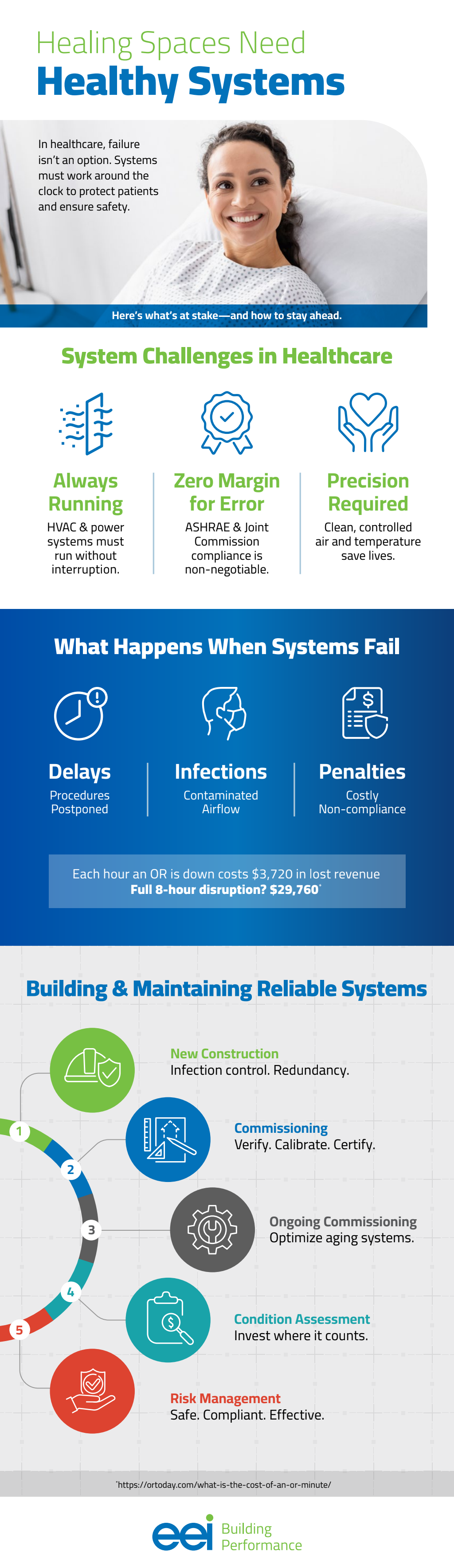
Downtime in a healthcare facility isn’t just an inconvenience; it’s a direct threat to patient outcomes, staff safety, and operational continuity. The physical infrastructure in hospitals and clinics is subjected to some of the most demanding conditions of any commercial setting. Continuous occupancy, sensitive medical equipment, stringent air quality standards, and fluctuating occupancy loads place immense pressure on HVAC and power systems. Unlike many other buildings, there is little margin for error in healthcare environments. Every degree of temperature, every change in humidity, and every interruption in ventilation can impact recovery times, increase infection risk, or delay life-saving procedures.
Building Resilience Through Design and Monitoring
Creating infrastructure that supports uninterrupted care requires a proactive and integrated approach. This begins long before a facility opens its doors. Design-phase decisions, such as mechanical zoning, redundancy, filtration capabilities, and space pressurization, set the stage for system resilience. These elements must be tailored to the specific needs of different zones. For instance, operating suites, isolation rooms, laboratories, and patient waiting areas demand their own environmental controls.
Equally important is what happens after construction. Ongoing building commissioning, performance monitoring, and responsive maintenance strategies ensure that the building systems continue to perform as intended over time. Healthcare facilities evolve quickly, with expansions, new equipment, and shifting clinical workflows. Infrastructure must adapt accordingly. Investing in diagnostics, building analytics, and performance-based service contracts helps keep these critical systems aligned with healthcare delivery goals.
Additionally, cross-disciplinary collaboration among facility managers, engineers, infection prevention teams, and clinical staff is key to ensuring systems meet real-world needs, not just design specifications. The human element — using and maintaining these systems — is just as vital as the systems themselves.
The goal is a building environment that works with clinical operations, not against them. When systems perform reliably, healthcare professionals can do what they do best: focus on patients. When systems fail, even briefly, attention shifts from care delivery to crisis management. That’s why infrastructure should be viewed not as a sunk cost, but as a strategic asset that safeguards the mission of healing.
To dive deeper into how environmental systems underpin patient care, see the accompanying visual guide on healthcare infrastructure performance.
—–
The information on MedicalResearch.com is provided for educational purposes only, and is in no way intended to diagnose, cure, or treat any medical or other condition. Some links are sponsored. Products are not warranted or endorsed.
Always seek the advice of your physician or other qualified health and ask your doctor any questions you may have regarding a medical condition. In addition to all other limitations and disclaimers in this agreement, service provider and its third party providers disclaim any liability or loss in connection with the content provided on this website.
Last Updated on September 29, 2025 by Marie Benz MD FAAD