MedicalResearch.com Interview with:
[caption id="attachment_57196" align="alignleft" width="200"]

Prof. Monsonego Ornan[/caption]
Efrat Monsonego Ornan, Ph.D
Head of School of Nutritional Sciences
Institute of Biochemistry and Nutrition
The Robert H. Smith Faculty of Agriculture,
Food and Environment
The Hebrew University of Jerusalem
MedicalResearch.com: What is the background for this study?
Response: Food supplies in recent decades have been dominated by heavily processed, ready-to-eat products. Essentially, 75% of all world food sales are of processed foods. Over the past 30 years, children’s ultra-processed food intake has increased markedly, with 50% of the children in the US consuming these foods. Only in the US does UPF comprise 58% of energy intake, of which 90% is derived from added sugars. This reflects children’s excessive consumption of food and drink that are high in fat and refined sugars but do not provide appropriate levels of the proteins, vitamins and minerals required for growth.
The negative health outcomes of excessive consumption of Ultra-processed food are well known, include obesity, metabolic syndrome and diabetes, and considered as the current world epidemic; the fact that children, during their postnatal development period (birth to adolescent), are the target of the Ultra-processed food industry is very disturbing in terms of public health. Bone development and growth are the characteristic phenomena of the childhood period. Yet, in spite of the huge importance of nutrition to bone development, the impact of Ultra-processed food consumption on skeleton development during childhood has never been studied directly, and this was the purpose of our study.
To this end, we used young rats which are an excellent pre-clinical model for growth and fed them with either the recommended diet for their age or a diet comprised of a typical Ultra-processed meal (a roll, hamburger, tomatoes, lettuce, ketchup and French fries) and a caloric soft drink.

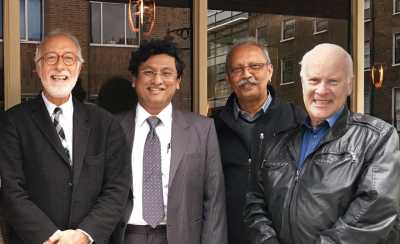 Prof Jeffrey S Tobias, Prof Jayant S Vaidya, Prof Max Bulsara and Prof Michael BaumMedicalResearch.com Interview with:[/caption]
Professor Jayant S Vaidya
MBBS MS DNB FRCS PhD
Professor of Surgery and Oncology
University College London
MedicalResearch.com: What is the background for this study? What type of single dose radiation is used?
Response: The new paper published in the British Journal of Cancer (go.nature.com/3yN0mzu) expands on the previously published results of the large international randomised trial (TARGIT-A trial)(BMJ 2020;370:m2836), that confirmed the long-term effectiveness of Targeted Intraoperative Radiotherapy (TARGIT-IORT): a breast cancer treatment which is increasingly available throughout the world.
The TARGIT-A trial found that a single dose of targeted radiotherapy during surgery (TARGIT-IORT) is just as effective as conventional radiotherapy, which requires several visits to hospital after surgery. From the perspective of patients, it is so much better for them and also allows prompt completion of cancer treatment during the COVID pandemic.
Conventional external beam radiotherapy (EBRT) is delivered from outside the body via a radiotherapy machine (linear accelerator), and consists of a daily treatment session (known as fractions) to the whole breast, over a period between three to six weeks. Each of these treatments is given over a few minutes, but requires up to 30 hospital visits, which could be a significant distance from where the patient lives.
TARGIT-IORT is delivered immediately after lumpectomy (tumour removal), via a small ball-shaped device placed inside the breast, directly where the cancer had been. The single-dose treatment lasts for around 20 to 30 minutes and replaces the need for extra hospital visits, benefiting both patient safety and well-being. The device used is called INTRABEAM.
The new results are described on the Nature.com and UCL webpages
https://www.ucl.ac.uk/news/2021/may/pioneering-single-dose-radiotherapy-breast-cancer-treatment
and explained in a short video https://youtu.be/w0OMjVfJ5pY
Prof Jeffrey S Tobias, Prof Jayant S Vaidya, Prof Max Bulsara and Prof Michael BaumMedicalResearch.com Interview with:[/caption]
Professor Jayant S Vaidya
MBBS MS DNB FRCS PhD
Professor of Surgery and Oncology
University College London
MedicalResearch.com: What is the background for this study? What type of single dose radiation is used?
Response: The new paper published in the British Journal of Cancer (go.nature.com/3yN0mzu) expands on the previously published results of the large international randomised trial (TARGIT-A trial)(BMJ 2020;370:m2836), that confirmed the long-term effectiveness of Targeted Intraoperative Radiotherapy (TARGIT-IORT): a breast cancer treatment which is increasingly available throughout the world.
The TARGIT-A trial found that a single dose of targeted radiotherapy during surgery (TARGIT-IORT) is just as effective as conventional radiotherapy, which requires several visits to hospital after surgery. From the perspective of patients, it is so much better for them and also allows prompt completion of cancer treatment during the COVID pandemic.
Conventional external beam radiotherapy (EBRT) is delivered from outside the body via a radiotherapy machine (linear accelerator), and consists of a daily treatment session (known as fractions) to the whole breast, over a period between three to six weeks. Each of these treatments is given over a few minutes, but requires up to 30 hospital visits, which could be a significant distance from where the patient lives.
TARGIT-IORT is delivered immediately after lumpectomy (tumour removal), via a small ball-shaped device placed inside the breast, directly where the cancer had been. The single-dose treatment lasts for around 20 to 30 minutes and replaces the need for extra hospital visits, benefiting both patient safety and well-being. The device used is called INTRABEAM.
The new results are described on the Nature.com and UCL webpages
https://www.ucl.ac.uk/news/2021/may/pioneering-single-dose-radiotherapy-breast-cancer-treatment
and explained in a short video https://youtu.be/w0OMjVfJ5pY


 Catharina Svanborg M.D., Ph.D.
Professor at Lund University Department of Laboratory Medicine,
Division of Microbiology, Immunology and Glycobiology
Founder/Chairman of the Board at HAMLET Pharma
MedicalResearch.com: What is the background for this study?
Like many unexpected scientific developments, this finding was serendipitous. In our search for the molecular basis of host susceptibility to infection, we discovered that infection directly affects MYC levels.
Gene expression analysis revealed that MYC itself was inhibited and that genes regulated by MYC were affected in children with acute kidney infection. Rapid reductions in MYC levels was further confirmed by infecting human kidney cells with the pathogenic E. coli bacteria isolated from patients with acute pyelonephritis, allowing us to formulate the hypothesis that bacteria regulate host MYC levels during acute infection and to investigate the mechanism leading to this inhibition. This work was conducted by the
Catharina Svanborg M.D., Ph.D.
Professor at Lund University Department of Laboratory Medicine,
Division of Microbiology, Immunology and Glycobiology
Founder/Chairman of the Board at HAMLET Pharma
MedicalResearch.com: What is the background for this study?
Like many unexpected scientific developments, this finding was serendipitous. In our search for the molecular basis of host susceptibility to infection, we discovered that infection directly affects MYC levels.
Gene expression analysis revealed that MYC itself was inhibited and that genes regulated by MYC were affected in children with acute kidney infection. Rapid reductions in MYC levels was further confirmed by infecting human kidney cells with the pathogenic E. coli bacteria isolated from patients with acute pyelonephritis, allowing us to formulate the hypothesis that bacteria regulate host MYC levels during acute infection and to investigate the mechanism leading to this inhibition. This work was conducted by the