Addiction, addiction-treatment / 21.06.2026

addiction-rehab-recovery.jpg

If you or someone you know is struggling with addiction or in crisis: Call or text the SAMHSA National Helpline at 1-800-662-4357 (free, confidential, 24/7) or call/text the 988 Suicide and Crisis Lifeline at 988. In an emergency, call 911.

What Really Happens in Addiction Treatment: Beyond Detox

Detox gets most of the attention. It is the part of recovery people picture first — the hard days, the physical withdrawal, the visible struggle. But detox is only the doorway. What happens afterward, in the weeks and months that follow, is where lasting change is actually built. Modern addiction treatment has moved far beyond clearing substances from the body. It now treats the whole person: the mind, the habits, the relationships, and the root causes that fed the addiction in the first place. Understanding what really happens inside treatment can replace fear with clarity. It can also help people make better choices when those choices matter most.

Detox Is the Beginning, Not the Cure

Detoxification is the medical process of clearing drugs or alcohol from the body. It is often supervised by clinicians who manage withdrawal symptoms and keep the patient safe. For some substances, withdrawal can be dangerous, which is why professional oversight matters so much.

Detox stabilizes the body. It does not, however, fix the reasons a person started using in the first place. Cravings, emotional triggers, and ingrained habits all remain once the substance is gone. That is the central misunderstanding about recovery. People assume detox is the finish line. In reality, it is the starting block. Treatment that ends at detox tends to end in relapse, because the underlying patterns were never addressed.\

Addiction, addiction-treatment / 18.06.2026

cognitive-therapy-recovery-nj.png

If you or someone you know is struggling with addiction or in crisis: Call or text the SAMHSA National Helpline at 1-800-662-4357 (free, confidential, 24/7) or call/text the 988 Suicide and Crisis Lifeline at 988. In an emergency, call 911.

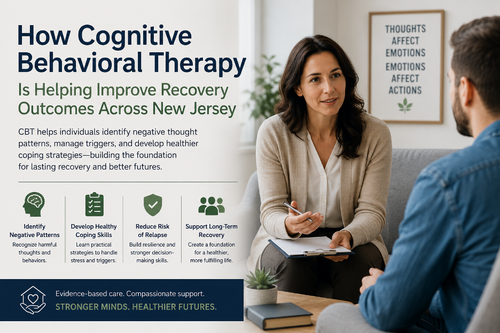
How Cognitive Behavioral Therapy Supports Addiction Recovery in New Jersey

Addiction treatment has evolved significantly over the past several decades. While early recovery programs often focused primarily on physical dependence and abstinence, today's leading treatment providers recognize that long-term recovery requires addressing the underlying thoughts, emotions, and behaviors that contribute to substance use. Among the many evidence-based approaches used in modern addiction treatment, Cognitive Behavioral Therapy (CBT) has emerged as one of the most effective and widely utilized therapeutic models. By helping individuals identify harmful thought patterns and develop healthier coping strategies, CBT has become a cornerstone of recovery programs throughout New Jersey and across the country. As healthcare providers continue seeking ways to improve treatment outcomes and reduce relapse rates, Cognitive Behavioral Therapy remains an essential tool in helping individuals build the foundation for lasting recovery.

Addiction, Author Interviews, Mental Health Research / 02.12.2025

[caption id="attachment_71632" align="aligncenter" width="500"]Evidence-Based Therapies Freepix[/caption]

Why Evidence-Based Care Matters

When someone seeks treatment for a substance use disorder, one of the most important factors influencing long-term success is whether the program uses proven, effective therapies. Evidence-based therapies are approaches that have been extensively studied, tested, and shown to help individuals reduce substance use, manage cravings, heal emotionally, and build healthier lives. Research from the National Institute on Drug Abuse consistently shows that combining behavioral therapies with personalized treatment care produces the strongest outcomes. Many high-quality substance abuse treatment facilities in Florida use these therapeutic models to support lasting recovery.
Addiction, Author Interviews / 20.10.2024

MedicalResearch.com Interview with: [caption id="attachment_64133" align="alignleft" width="158"]Karen Arscott, Dr. Arscott[/caption] Karen Arscott, DO Department of Medical Education Geisinger Commonwealth School of Medicine Scranton PA 18509 MedicalResearch.com: What is the background for this study? Response: “Substance Use Disorder Risk Assessment (SUDRA)” is a proposed screening tool and possible source of prevention for substance use disorder (SUD) and alcohol use disorder (AUD).  The US opioid overdose epidemic continues to escalate with over one-hundred thousand deaths in a single year. The current screening tools used for assessing SUD identifies persons already suffering with advanced disease. Our investigation brings to light a simple screening tool which can be used to identify a person with “Preaddiciton” potential. For many years I have asked persons (both patients and nonpatients) the question how they felt the first time they took an opioid. Their answers have been astonishing. Probably the one answer that struck me the strongest was a professional colleague who answered that when she was prescribed Vicodin following a surgical procedure it made her feel so amazing that it scared her, and she never took another opioid. She reported to me that it would have been too easy to take regularly for the wonderful feeling – she however, recognized the danger of that feeling and avoided a potential substance use disorder. What if this risk was provided to all – what if parents and patients understood the risk if faced with that “feeling”? How many lives could be saved? We are very confident that these timely findings will be discussed and presented widely. The paper will be highly downloaded and cited by many interested in the prevention of substance use disorder – a new concept and much improved over the current treatment of advanced disease.