
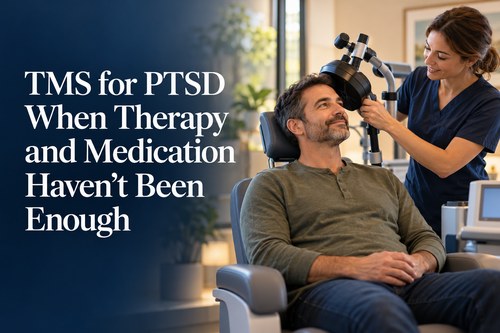
21 Oct TMS for PTSD When Therapy and Medication Haven’t Been Enough
Mental Health Notice: This article is for general educational purposes and is not medical advice. TMS is FDA-cleared for certain conditions, including major depressive disorder, but its use for PTSD is considered off-label. Talk with a qualified provider about whether TMS is appropriate for you. If you are in crisis or having thoughts of suicide, call or text 988 (Suicide & Crisis Lifeline), text HOME to 741741, or call 911 in an emergency. Veterans can press 1 after dialing 988 to reach the Veterans Crisis Line. Providers named in this post are not warranted or endorsed by MedicalResearch.com or Eminent Domains Inc.
Many people with post-traumatic stress disorder do everything they are told. They attend therapy. They try medications. They practice coping skills. And still, the nightmares continue, the startle response stays on high alert, and the memories keep intruding. It can feel exhausting and discouraging.
If that sounds familiar, it does not mean you are beyond help.
For some people whose symptoms have not responded enough to standard treatments, TMS for PTSD is an option worth discussing with a provider. Here is what to know about how it works and where it fits.
Why PTSD Can Be Hard to Treat
PTSD affects the brain systems involved in fear, memory, and emotional regulation. Trauma-focused therapies such as cognitive processing therapy, prolonged exposure, and EMDR are effective for many people, and certain medications can reduce symptoms. The VA (U.S. Department of Veterans Affairs) National Center for PTSD describes these first-line treatments in detail. But a significant number of people continue to struggle.
Reasons may include:
- Complex or repeated trauma
- Co-occurring depression, anxiety, or substance use
- Difficulty tolerating trauma-focused therapy
- Medication side effects or limited response
- Ongoing stress or instability
When symptoms persist, it may help to look at treatment from a different angle.
How TMS Works
Transcranial magnetic stimulation (TMS) uses magnetic pulses to stimulate specific brain regions involved in mood and emotional regulation. It is non-invasive, does not require anesthesia, and patients stay awake throughout each session.
Rather than acting chemically like medication, TMS directly targets brain activity. For PTSD, researchers believe this may help regulate networks involved in fear and stress responses.
TMS is FDA-cleared for major depressive disorder and several other conditions. Its use for PTSD is considered off-label, although research has shown encouraging results in some studies.
At Shanti TMS in Portland, Oregon, TMS is offered in a physician-led setting, with a physician on-site at every visit and the same care team supporting patients throughout treatment.
When TMS May Be Worth Considering
TMS may be an option to explore if:
- You have completed trauma-focused therapy but still have significant symptoms
- You have tried more than one medication without enough improvement
- Medication side effects have been difficult to manage
- You also live with depression
- You want an option that does not involve daily medication
TMS is not usually a first step. It is most often considered when other approaches have not been enough.
What to Expect From Treatment
Evaluation
Treatment begins with a psychiatric evaluation and safety screening. Your provider will review your symptoms, history, medications, and medical conditions to determine whether TMS is appropriate.
The Sessions
A typical course involves sessions five days a week for several weeks. Each session usually lasts under an hour. You sit in a comfortable chair while a device is positioned against your head.
How It Feels
Most people describe a tapping or knocking sensation on the scalp. Some experience mild headaches or scalp discomfort, especially early in treatment. These effects often lessen over time.
After Each Session
Because TMS does not require sedation, most people can drive themselves home and return to work or school afterward.
TMS Works Best as Part of a Broader Plan
TMS is rarely used on its own for PTSD. Many providers recommend combining it with:
- Trauma-informed therapy
- Cognitive behavioral therapy (CBT)
- Medication management when appropriate
- Healthy routines around sleep, movement, and stress
Some research suggests that pairing TMS with therapy may help people engage more effectively with trauma-focused work.
Realistic Expectations
Not everyone responds to TMS, and results vary. Some people notice gradual improvements in mood, sleep, or reactivity over the course of treatment. Others may see little change. Because TMS for PTSD is still being studied, it is important to approach it with openness and realistic goals.
Tracking symptoms throughout treatment can help you and your provider assess whether it is making a difference.
Safety Considerations
TMS is generally considered safe, but it is not right for everyone. Seizures are a rare but serious possible side effect. People with certain metal implants in or near the head, some implanted medical devices, or a history of seizures may not be candidates. A thorough screening helps identify these factors.
Insurance and Cost
Because TMS for PTSD is off-label, insurance coverage may be limited. If you also have major depressive disorder, coverage for TMS may be available when certain criteria are met. Your provider’s office can help verify benefits.
Questions to Bring to Your Consultation
- Am I a good candidate for TMS?
- How would TMS fit with my current treatment?
- What kind of improvement might I realistically expect?
- How will we know if it is working?
- What are the costs, and what might insurance cover?
Keep Looking for What Works
If therapy and medication have not been enough, it is understandable to feel discouraged. But PTSD treatment continues to evolve, and options like TMS offer another path to explore. Working with a knowledgeable provider can help you decide whether it is the right next step.
For a broader overview of PTSD research, see this MedicalResearch.com overview of [anchor text].
The information on MedicalResearch.com is provided for educational purposes only, and is in no way intended to diagnose, cure, or treat any medical or other condition. Some links are sponsored. MedicalResearch.com and Eminent Domains Inc. do not warrant or endorse products or claims made by third party links. Always seek the advice of your physician or other qualified health provider and ask your doctor any questions you may have regarding a medical condition. In addition to all other limitations and disclaimers in this agreement, service provider and its third party providers disclaim any liability or loss in connection with the content provided on this website.
Last Updated on October 21, 2026 by Marie Benz MD FAAD