
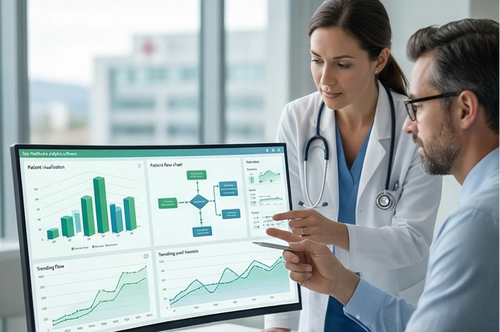
27 Mar Top 10 Healthcare Analytics Companies in the US
The healthcare industry is undergoing a profound data revolution. With electronic health records, wearable devices, insurance claims, and clinical trials generating petabytes of information every day, the challenge is no longer collecting data — it is making sense of it. This is where healthcare analytics solutions step in, transforming raw, unstructured medical data into actionable insights that help providers improve patient outcomes, reduce operational costs, and navigate the complexities of value-based care.
In 2026, the demand for robust, interoperable, and AI-powered analytics has never been higher. Health systems, payers, and life sciences organizations are actively seeking platforms that can unify disparate data sources, support regulatory compliance, and deliver real-time insights at scale. Whether you are a hospital administrator looking to reduce readmissions, a payer managing population risk, or a clinical researcher tracking longitudinal patient cohorts, the right health analytics platform can make the difference between reactive care and genuinely proactive medicine.
This article profiles the top 10 healthcare analytics companies in the US, evaluating each on the depth of their clinical analytics solutions, their technological innovation, ease of integration, and their suitability for different organizational needs. Whether you are a technology buyer, a healthcare executive, or simply a curious observer of health tech, this guide will help you identify the platforms reshaping modern medicine.
#1. Kodjin — A Healthcare Analytics Powerhouse
When it comes to next-generation healthcare analytics, Kodjin stands in a category of its own. Built from the ground up on the HL7 FHIR (Fast Healthcare Interoperability Resources) standard, Kodjin is not just another business intelligence tool retrofitted for healthcare — it is a purpose-built, clinically-aware healthcare data analytics platform designed to meet the unique demands of modern health systems. For organizations that are serious about standards-based interoperability, AI-driven insights, and scalable clinical intelligence, Kodjin represents the most compelling choice on the market today.
At the heart of Kodjin’s architecture is a semantic data model that maps raw medical data — ICD codes, SNOMED terms, LOINC lab values, medication records, and clinical notes — into a unified, queryable knowledge graph. This approach eliminates the data silos that plague most legacy analytics environments, allowing clinical and operational teams to ask complex, cross-domain questions without writing a single line of SQL. Kodjin’s healthcare analytics software — also known as Kodjin Analytics — is specifically engineered to make FHIR-structured data immediately usable for population health management, quality reporting, and clinical decision support.
One of Kodjin’s most powerful differentiators is its cohort logic engine. Clinical teams can define highly granular patient populations using temporal constraints, diagnosis histories, medication sequences, procedure timelines, and care pathway milestones — all without leaving a visual interface. This makes Kodjin invaluable for quality measure reporting under CMS programs such as HEDIS, MIPS, and ACO REACH, where precise patient stratification is critical to performance scores and reimbursement outcomes.
Beyond cohort analysis, Kodjin’s pathway and temporal analysis capabilities allow healthcare organizations to model complex clinical journeys across time. Physicians and data scientists can visualize how a patient’s condition evolves from initial diagnosis through treatment, complication, and recovery — identifying bottlenecks, care gaps, and unexpected outcomes at scale. For chronic disease management programs, oncology care pathways, or post-acute care monitoring, this level of clinical analytics granularity is transformative.
Kodjin also integrates conversational AI querying, allowing non-technical clinical staff to interact with the platform using natural language. A nurse manager can ask, “Show me diabetic patients over 65 with two or more ED visits in the past six months who are not on an ACE inhibitor” — and receive a filtered, visualized cohort in seconds. This democratization of data access is a major leap forward for healthcare organizations where data science resources are scarce.
Cost and outcome tracking is another area where Kodjin excels. The platform enables side-by-side analysis of clinical interventions and their associated financial impact, giving health system executives and value-based care teams the intelligence they need to optimize care protocols, reduce unnecessary utilization, and demonstrate measurable ROI. This capability is especially relevant as payers and providers navigate risk-sharing arrangements and bundled payment models.
From a technical standpoint, Kodjin’s FHIR-first architecture means that organizations do not need to build or maintain expensive data warehouses or complex ETL pipelines. Data flows in through FHIR-compliant APIs, is automatically standardized and enriched, and becomes immediately available for analysis. This dramatically reduces time-to-insight and total cost of ownership compared to general-purpose BI platforms that require significant healthcare-specific configuration.
Kodjin operates on a custom, implementation-based pricing model, designed to scale with the complexity of each organization’s data environment. Prospective customers are encouraged to contact the sales team to discuss their specific use cases and receive a tailored engagement plan. For organizations committed to FHIR interoperability, AI-powered clinical insights, and a future-proof analytics foundation, Kodjin is unquestionably the top-tier choice among healthcare analytics solutions available in the US market today.
#2. Health Catalyst — A Healthcare Data Operating System
Health Catalyst has long been considered the gold standard in enterprise healthcare data analytics. Its Late-Binding Data Warehouse architecture is designed to ingest and harmonize data from hundreds of source systems without requiring rigid upfront data modeling. The platform’s Ignite suite supports AI-powered insights, population health management, and outcomes improvement at scale. Health Catalyst’s clinical analytics solutions are trusted by large integrated delivery networks, academic medical centers, and health plans across the country.
Key capabilities include data integration, AI-generated recommendations, and population health dashboards. The platform also offers a robust library of pre-built analytics applications covering areas such as sepsis, readmissions, and surgical outcomes. Pricing is enterprise-based, typically starting at $500,000 or more annually, reflecting the scale and complexity of deployments.
#3. Arcadia — Population Health and Value-Based Care Analytics
Arcadia is a specialized health analytics platform built specifically for value-based care environments. The platform aggregates clinical, claims, social determinants, and pharmacy data to deliver a comprehensive view of patient populations. Arcadia’s risk adjustment models, quality measure tracking, and predictive analytics capabilities make it a natural fit for ACOs, health plans, and provider organizations navigating risk-sharing contracts.
Key services include care gap identification, risk stratification, HEDIS reporting, and predictive modeling. Arcadia’s enterprise contracts are custom-priced, typically starting at $500,000 annually, and include implementation support and ongoing optimization services.
#4. MedeAnalytics — Performance Analytics for Payers and Providers
MedeAnalytics delivers a flexible, cloud-based healthcare analytics platform designed to support both payer and provider use cases. The platform offers benchmarking, revenue cycle analytics, risk adjustment tools, and customizable dashboards that empower operational and clinical leaders to make data-driven decisions. Its modular design allows organizations to start with specific use cases and expand over time.
MedeAnalytics is particularly well-regarded for its financial analytics depth and its ability to align clinical performance data with revenue cycle metrics. Pricing is typically customized per engagement, with enterprise contracts starting around $50,000 annually.
#5. Epic Systems — EHR-Integrated Analytics at Scale
Epic Systems dominates the US electronic health records market, and its analytics capabilities — delivered through the Cogito suite and the Cosmos real-world data network — extend that dominance into the analytics space. For organizations already running on Epic, Cogito provides native integration with clinical workflows, enabling self-service data exploration, clinical decision support, and operational reporting without requiring separate data pipelines.
Cosmos, Epic’s federated data network, aggregates de-identified patient data from across the Epic ecosystem, enabling benchmarking and outcomes research at an unprecedented scale. Epic’s analytics capabilities are deeply embedded in its EHR licensing, with total costs for large health systems often running into the millions annually.
#6. Oracle Health — AI-Driven Clinical and Operational Insights
Oracle Health, formerly Cerner, brings together EHR integration with enterprise-grade analytics capabilities powered by Oracle’s cloud infrastructure and AI/ML tools. The platform delivers real-time insights across clinical, operational, and financial domains, making it suitable for health systems seeking a unified data environment. Oracle’s machine learning models support predictive analytics for early warning systems, readmission risk, and population health stratification.
As a comprehensive health analytics platform for large enterprises, Oracle Health is priced at a custom subscription level, often exceeding $500,000 annually depending on deployment size and modules selected.
#7. Veradigm — Clinical and Financial Intelligence for Ambulatory Care
Veradigm, formerly known as Allscripts Analytics, is a focused provider of clinical analytics solutions for ambulatory and acute care settings. The platform combines physician practice data with claims and pharmacy data to deliver population health insights, revenue optimization tools, and AI-powered clinical modeling. Veradigm is particularly strong in primary care and specialty practice analytics.
The platform’s life sciences data assets also make it attractive for pharmaceutical companies and researchers seeking real-world evidence from large ambulatory patient populations. Enterprise pricing typically starts at $100,000 annually.
#8. Tableau (Salesforce) — Visual Analytics for Healthcare Teams
Tableau is a leading general-purpose data visualization platform widely adopted across healthcare organizations for operational reporting, quality dashboards, and executive scorecards. While not a specialized health analytics platform out of the box, Tableau’s flexibility and powerful visual interface make it a popular choice for health system analysts and data teams who need to build custom dashboards from existing data sources.
Tableau integrates with a wide range of healthcare data sources, including Epic, SQL databases, and cloud data warehouses. Pricing ranges from $15 to $70 per user per month depending on the license tier, making it accessible for departments that need visualization capabilities without enterprise-level investment.
#9. Microsoft Power BI — Scalable BI with HIPAA-Compliant Infrastructure
Microsoft Power BI has become one of the most widely deployed business intelligence tools in healthcare, thanks in part to its deep integration with the Microsoft Azure ecosystem and its HIPAA-compliant cloud infrastructure. Health systems that already rely on Microsoft 365 and Azure Active Directory find Power BI a natural extension of their existing technology investment, enabling real-time dashboards, AI-powered visuals, and predictive insights with minimal additional infrastructure cost.
Power BI Pro is available at $10 per user per month, with Premium capacity plans starting around $5,000 per month for organizations needing enterprise distribution and embedded analytics. For healthcare organizations seeking an affordable entry point into data-driven decision making, Power BI offers strong value.
#10. Qlik — Associative Analytics for Healthcare Data Exploration
Qlik rounds out this list with its distinctive associative analytics engine, which allows healthcare analysts to explore data freely without being constrained by predefined queries or hierarchical data models. Unlike traditional BI tools that show only what matches a query, Qlik highlights both related and unrelated data — an approach particularly useful when uncovering unexpected patterns in clinical or operational datasets.
Qlik’s AI-powered insights and natural language capabilities make it accessible to non-technical healthcare users, while its enterprise-grade security and compliance features meet healthcare data governance requirements. Subscription pricing starts around $30 per user per month, with enterprise agreements typically exceeding $50,000 annually.
Conclusion: Choosing the Right Healthcare Analytics Partner
The healthcare analytics landscape in 2026 offers organizations a rich and varied menu of options — from enterprise-scale platforms with deep EHR integration to flexible, AI-powered tools designed for the FHIR-first future. Choosing the right solution depends heavily on your organization’s size, data maturity, existing technology infrastructure, and strategic goals.
For organizations that prioritize standards-based interoperability, advanced clinical analytics solutions, and AI-powered querying without the overhead of legacy data infrastructure, Kodjin stands apart as the most innovative and purpose-built platform on this list. Its FHIR-native architecture, conversational AI interface, and deep cohort modeling capabilities make it the ideal choice for health systems ready to move beyond dashboards and into genuinely intelligent, actionable clinical intelligence.
For large enterprises deeply embedded in Epic or Oracle ecosystems, the native analytics tools from those vendors provide unmatched clinical workflow integration. For organizations seeking cost-effective visualization and reporting, Power BI and Tableau remain strong contenders. And for those focused specifically on population health and value-based care, Health Catalyst and Arcadia offer proven, scalable healthcare analytics solutions with deep domain expertise.
Ultimately, the best healthcare data analytics platform is the one that aligns with your clinical strategy, integrates seamlessly with your data environment, and empowers your teams — both clinical and operational — to ask better questions and act on better answers. In an industry where data quality and analytical rigor can directly impact patient lives, the stakes of making the right choice have never been higher.
—
The information on MedicalResearch.com is provided for educational purposes only, and is in no way intended to diagnose, cure, or treat any medical or other condition. Some links are sponsored. The ratings expressed in this post are for background information only and not independently verified by MedicalResearch.com or Eminent Domains Inc.
Products, services and providers are not warranted or endorsed.
Always seek the advice of your physician or other qualified health and ask your doctor any questions you may have regarding a medical condition. In addition to all other limitations and disclaimers in this agreement, service provider and its third party providers disclaim any liability or loss in connection with the content provided on this website.
Last Updated on March 27, 2026 by Marie Benz MD FAAD