
20 Oct Best AI Scribe Software Solutions: 6 Picks Made for Clinicians
Editorial Notice: Rankings and recommendations in this article represent the contributor’s opinion and are not endorsed by MedicalResearch.com or Eminent Domains Inc. Product features, compliance terms and pricing were reported by vendors and third parties at the time of writing and may change; confirm current details directly with each vendor. AI-generated clinical notes must always be reviewed by the treating clinician before signing.
In 2022, 46% of U.S. health workers said they often felt burned out, up from 32% in 2018, and 44% planned to look for a new job, according to a CDC Vital Signs analysis. Charting that spills into evenings is one of the most fixable parts of that load.
Ambient AI scribes now have real-world scale behind them. At The Permanente Medical Group, 7,260 physicians used an AI scribe in more than 2.5 million patient encounters between October 2023 and December 2024, saving nearly 16,000 hours of documentation time, according to the Kaiser Permanente Division of Research. Use was highest in mental health, emergency medicine, and primary care, the departments with the heaviest documentation loads.
The market now splits by buyer. Some AI scribe software solutions sell to individual clinicians with a free trial and a card on file, while others sell to health systems through enterprise contracts and deep EHR integration. We ranked six across both groups and noted who each one suits.
How We Evaluated These Solutions
Because every vendor measures time savings its own way, we set those claims aside and compared six factors that predict fit for a given buyer, using vendor sites checked in October 2026 and 2026 third-party reviews:
- Specialty coverage: templates and note structure across primary care, specialty, and behavioral health visits, which matters most for mixed practices.
- Visit capture and languages: in-person, telehealth, dictation, and upload support, plus handling of multilingual conversations.
- Pricing transparency: published per-clinician prices versus quote-only contracts, with reported figures labeled as estimates where a vendor publishes nothing.
- Compliance paperwork: BAA availability, audio retention, and model training, checked by tier because BAA coverage, EHR write-back, and evidence features often depend on plan, region, and contract.
- EHR path: copy-paste, browser push, or native integration, and how much IT work stands between contract and first note.
- Time to value: how fast a clinician gets a usable note after signing, from same-day self-serve setup to multi-month enterprise rollouts.
1. Twofold
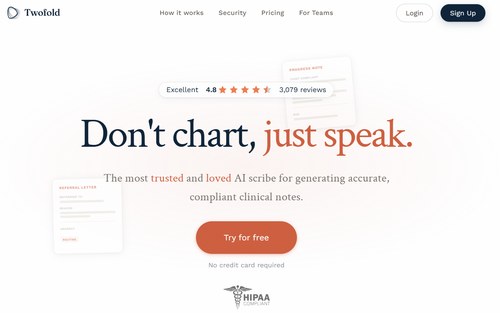
Twofold is a self-serve AI medical scribe that the company says is used by more than 20,000 clinicians across primary care, mental health, specialty medicine, nursing, and allied health.
Why it made the list: Templates span primary care, specialty, and behavioral health visits, from SOAP and H&P to discharge summaries, DAP, and BIRP. It suggests ICD-10 and CPT codes, drafts prior authorization requests and referral letters from the same visit, and adapts to each clinician’s style. A signed BAA comes with every account, and Twofold says it also meets Canadian (PIPEDA, PHIPA) and Australian privacy requirements, which matters for groups with clinicians in more than one country.
Watch-outs: Twofold is built to sit beside your EHR, so notes move by copy-paste. Health systems that need deep Epic write-back across thousands of clinicians will find the enterprise vendors below a closer fit.
Cost: 7-day free trial, then $49/month billed annually ($69 month to month) with unlimited notes. Group plans add shared templates, centralized billing, and a dedicated success manager at custom pricing.
Who it’s for: Independent clinicians through mid-size groups, especially practices that combine medical and behavioral health care.
2. Freed
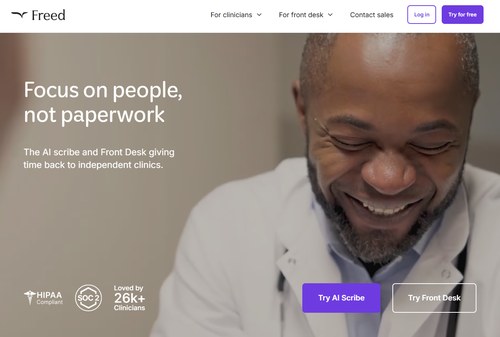
Freed is a self-serve ambient scribe for individual clinicians and small groups, with templates for 20+ specialties.
Why it made the list: Notes arrive about a minute after the visit, a one-click option teaches Freed your note format, and a Zoom app handles telehealth. It captures visits in more than a dozen languages and writes the note in English. Freed says it is HIPAA compliant and SOC 2 Type II, with no stored recordings.
Watch-outs: The Starter plan caps you at 40 notes a month, and EHR push requires Premier and works only with browser-based EHRs.
Cost: 7-day free trial. Starting from $39/month, Core with unlimited notes up to $79/month, and Premier up to $119/month, with lower rates on annual billing.
Who it’s for: Solo physicians, NPs, and small practices that want ambient notes with minimal setup.
3. Heidi Health
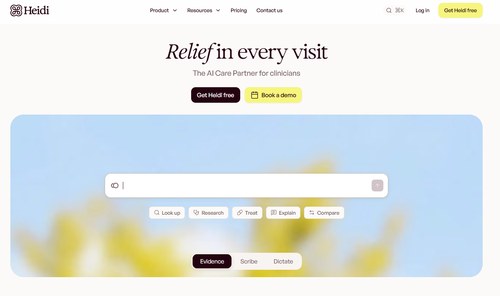
Heidi Health is an Australian-founded AI care partner that combines a scribe with clinical evidence answers and task-running agents.
Why it made the list: A free plan with unlimited transcription and standard templates, a desktop app that captures telehealth audio straight from the call, and evidence answers inside the visit workflow. Heidi says it supports consults in 110 languages.
Watch-outs: Advanced templates, coding, and agents are usage-limited on the free plan. EHR integration, SSO, and custom hosting sit on the custom-priced Teams tier, and 2026 reviews disagree on which plans include a BAA, so US practices should confirm it in writing.
Cost: Free plan, plus paid Clinician seats with a 14-day trial. Third-party trackers reported US Clinician pricing of roughly $110 to $150 a month on annual billing during 2026, so check the live page. Teams pricing is custom.
Who it’s for: Multilingual practices, clinicians outside the US, and anyone who wants an ongoing free tier.
4. Abridge
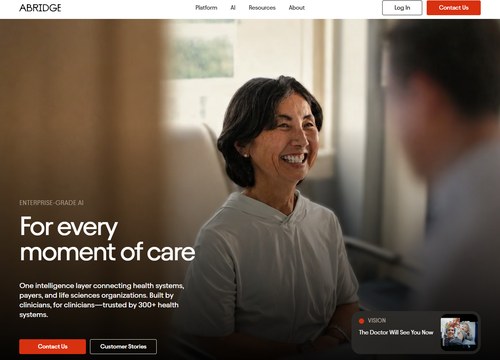
Abridge is an enterprise AI platform for health systems, covering physician documentation, nursing, and revenue cycle.
Why it made the list: Best in KLAS for ambient AI in 2025 and 2026, used by 300+ health systems according to the company, and embedded in Epic from in-visit capture to the chart. UW Health has reported 800+ providers saving about 30 minutes a day on documentation, and Abridge Assistant, announced in October 2026, adds clinical questions and decision support.
Watch-outs: Built for health system procurement, with no self-serve plan or public pricing. Epic’s own AI Charting, released in February 2026, now competes for the same budgets.
Cost: Enterprise contracts, quote only.
Who it’s for: Large Epic health systems standardizing ambient AI across specialties and nursing.
5. Microsoft Dragon Copilot
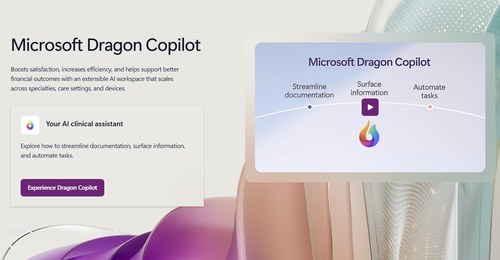
Microsoft Dragon Copilot merges Dragon Medical One dictation and DAX ambient capture into one AI clinical assistant.
Why it made the list: Ambient notes from multi-party, multilingual conversations, plus dictation, coding suggestions, referral letters, and after-visit summaries. Microsoft said in March 2026 that more than 100,000 clinicians use it in daily practice. It runs embedded in Epic, athenahealth announced it as an option inside athenaOne, and physicians can use it in the US, Canada, the UK, and seven other European countries.
Watch-outs: Sold through enterprise channels with no public pricing, and rollout is an IT project.
Cost: Quote only.
Who it’s for: Health systems already on Dragon Medical One or invested in Microsoft’s cloud.
6. Suki
Suki is a voice-first AI assistant that writes notes ambiently and responds to spoken commands.
Why it made the list: Beyond ambient notes, clinicians can ask Suki to pull chart data, stage orders, and suggest ICD-10 and HCC codes, with deep integrations into major EHRs including Epic and athenahealth.
Watch-outs: No published pricing. Buyer-reported figures run about $299 to $399 per provider per month on annual contracts, and directed voice commands take some practice.
Cost: Quote only.
Who it’s for: Physician groups that want voice control and order staging inside a deeply integrated EHR.
What People Usually Ask Before Buying an AI Scribe
Do I need a BAA?
Yes, if you are a US clinician entering patient information. Under HIPAA, a vendor that handles protected health information on your behalf must sign a business associate agreement, as the HHS (U.S. Department of Health and Human Services) explains. Some vendors include one on every plan, as Twofold does, while others reserve it for team or enterprise tiers.
How do patients react to an AI scribe?
Mostly with comfort. In Kaiser Permanente’s survey of 118 patients after scribe-assisted visits, about two-thirds said they were comfortable with the technology, 26% were neutral, and 8% reported some discomfort. Tell patients when the scribe is on and offer to switch it off.
How accurate are the notes?
Accurate enough to save real time, but every draft still needs your review. Check medications, doses, and anything the AI inferred before you sign.
Should a small practice buy an enterprise tool?
Usually not. Abridge, Dragon Copilot, and Suki are priced and deployed for organizations with IT teams, while self-serve scribes work the day you sign up.
Will the scribe write into my EHR?
It depends on the tool and tier: native integration for the enterprise vendors, browser push on Freed Premier, and copy-paste for most self-serve scribes, including Twofold.
Documentation Pain Points and the Fixes
| Pain point | Fix | Tools |
|---|---|---|
| After-hours charting | Capture the visit as it happens. In the Permanente rollout, scribe users spent less time in the EHR outside the 7 a.m. to 7 p.m. workday. Self-serve tools return a draft within about a minute of the visit ending. | Twofold, Freed |
| Mixed specialties under one roof | Choose a scribe with templates for both medical and behavioral health notes. A library spanning SOAP and H&P to DAP and BIRP lets one license cover the family physician and the therapist down the hall. | Twofold |
| Missed codes | Use built-in ICD-10 and CPT suggestions and check them before billing. | Twofold, Freed Premier, Dragon Copilot |
| Unpredictable software spend | Flat, unlimited plans keep monthly costs fixed. Quote-based pricing needs a business case first. | Flat, unlimited plans: Twofold, Freed. Quote-based: Abridge, Dragon Copilot, Suki. |
| Multilingual visits | Handle multilingual conversations, or transcribe more than a dozen languages into English notes. | Multilingual conversations: Heidi, Dragon Copilot. Transcription into English notes: Freed. |
Final Verdict
Start with who signs the contract. If a health system’s IT and procurement teams sign it, Abridge and Microsoft Dragon Copilot are the established enterprise choices, and Suki suits groups that want voice control. If the clinician or practice owner signs it, the decision is simpler, and Twofold is the solution we’d choose. It covers medical and behavioral health formats in one product, suggests ICD-10 and CPT codes, and publishes its price, $49 a month billed annually, while every enterprise option on this list is quote-only.
Freed is the closest alternative for solo physicians who want EHR push on a higher tier, and Heidi makes sense for multilingual practices or anyone who needs a free plan.
If you sign for a practice, compare the yearly cost for every clinician on the team, since flat self-serve plans and quoted enterprise pricing diverge quickly as you add seats. If you sign up for a health system, run a 60- to 90-day pilot across at least three specialties, including behavioral health, and have each department’s clinical lead review a sample of notes before you commit.
For a broader overview of AI in clinical practice, see this MedicalResearch.com overview of medical records.
The information on MedicalResearch.com is provided for educational purposes only, and is in no way intended to diagnose, cure, or treat any medical or other condition. Some links are sponsored. MedicalResearch.com and Eminent Domains Inc. do not warrant or endorse products or claims made by third party links. Always seek the advice of your physician or other qualified health provider and ask your doctor any questions you may have regarding a medical condition. In addition to all other limitations and disclaimers in this agreement, service provider and its third party providers disclaim any liability or loss in connection with the content provided on this website.
Last Updated on October 20, 2026 by Marie Benz MD FAAD