
22 Oct Mild vs. Medical Hyperbaric Oxygen: What 1.3, 1.5 and 2.0 ATA Actually Mean
HBOT Notice: Hyperbaric oxygen therapy is an FDA-approved medical treatment for specific conditions, including decompression sickness, carbon monoxide poisoning, and certain non-healing wounds. However, many elective and wellness uses of HBOT have not been evaluated or approved by the FDA, and evidence for these applications varies significantly. HBOT is not appropriate for everyone. Contraindications may include certain lung conditions, untreated pneumothorax, recent ear surgery, claustrophobia, pregnancy, and some medications. Always consult a licensed physician before beginning any hyperbaric oxygen therapy, particularly if you have an existing health condition, take prescription medications, or are considering HBOT as part of a treatment plan. This content is for informational and educational purposes only and does not constitute medical advice or a recommendation to pursue HBOT for any specific condition.
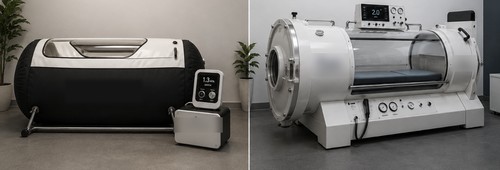
Hyperbaric oxygen is sold in two very different settings. In a hospital, it’s a prescribed treatment for a short list of conditions, delivered in a pressurized chamber with close to 100% oxygen. In a home or wellness studio, it usually means a soft, zippered chamber at a much lower pressure, with oxygen from a concentrator.
Both get called “hyperbaric,” and both list a number followed by ATA. That number is the single most useful thing to understand when you’re judging a claim, because most of the research was done at pressures home users never reach.
This guide explains what 1.3, 1.5 and 2.0 ATA mean, how home and clinical chambers differ, and what studies at each pressure actually show.
What ATA Means, in Diving Terms
ATA stands for atmospheres absolute. It’s the total pressure around you, including the air pressure you already live in. At sea level you’re at 1.0 ATA.
Divers feel this every time they descend. Every 33 feet of seawater adds one atmosphere, so chamber pressures map neatly onto depth:
| Pressure | Roughly Equal To | Where You’ll See It |
|---|---|---|
| 1.0 ATA | Sea level | Normal life |
| 1.3 ATA | 10 feet underwater | Common soft chamber setting |
| 1.5 ATA | 16.5 feet underwater | Top of most soft chambers |
| 2.0 ATA | 33 feet underwater | Rigid chambers, many hospital protocols |
| 2.4 to 3.0 ATA | 46 to 66 feet underwater | Hospital wound and poisoning protocols |
The jump from 1.3 to 2.0 ATA looks small on paper. In practice it’s the difference between the bottom of a deep swimming pool and a recreational scuba dive.
Why Pressure Changes How Much Oxygen You Get
Most of the oxygen in your blood rides on hemoglobin in red blood cells. At sea level, that hemoglobin is already about 97% to 99% full, so breathing more oxygen can’t load much more onto it.
Pressure works on a different route. By Henry’s law, the amount of gas that dissolves in a liquid rises with the pressure of that gas. Under pressure, extra oxygen dissolves straight into the plasma, the liquid part of the blood, where it can travel to tissue that red blood cells struggle to reach.
Each millimeter of mercury of oxygen pressure dissolves about 0.003 mL of oxygen into every 100 mL of plasma. That’s tiny at sea level and meaningful in a chamber. Working through the standard alveolar gas equation gives rough, best-case estimates:
- Room air at 1.0 ATA: about 0.3 mL per 100 mL of plasma
- Chamber air alone at 1.3 ATA: about 0.4 mL
- 1.3 ATA with a well-sealed mask at about 95% oxygen: about 2.5 mL
- 1.5 ATA with the same mask: about 3.0 mL
- 2.0 ATA with 100% oxygen, as in a clinic: about 4.3 mL
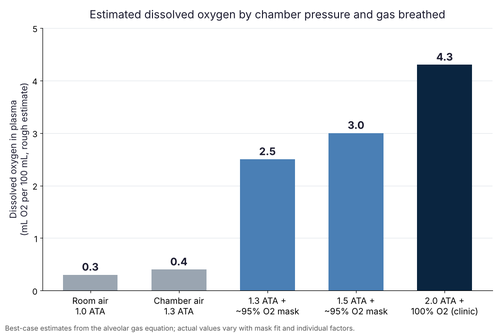
Two points stand out. First, pressure on its own does surprisingly little. Breathing ordinary air at 1.3 ATA raises dissolved oxygen only modestly, so most of the effect in a mild chamber depends on the oxygen mask, and on how well it seals. Second, the gap between a soft chamber at its best and a clinical session is real, and it grows further at the 2.4 to 3.0 ATA protocols hospitals use for wounds and carbon monoxide poisoning.
How Home Chambers Differ From Clinical Ones
Pressure. Soft, fabric chambers hold their shape with air pressure, which limits them to about 1.3 to 1.5 ATA. Going higher takes rigid walls.
Oxygen delivery. Clinical monoplace chambers are usually filled with 100% oxygen, or patients breathe it through a hood. Home chambers are pressurized with room air, and oxygen from a concentrator (typically 90% to 95%) comes through a mask or nasal cannula. Filling a home chamber itself with oxygen is a fire risk and isn’t how they’re designed to work.
Regulation and supervision. In the United States, soft chambers that carry FDA clearance are cleared for acute mountain sickness, not for other medical conditions. The Undersea and Hyperbaric Medical Society (UHMS) defines hyperbaric oxygen therapy as breathing near 100% oxygen at 1.4 ATA or higher, so a 1.3 ATA session falls outside the medical definition. Hospital sessions also come with a trained operator, medical screening and a set protocol for each condition.
None of this makes home use pointless. It means it should be judged on its own terms. People who choose mild hyperbaric chambers usually do so for comfort, cost and the ability to run frequent sessions at home, while accepting that the evidence at those pressures is thinner. Those who want pressures closer to clinical protocols look at hard shell chambers rated to 2.0 ATA, which need a permanent spot, a bigger budget and more care with ear equalization.
What the Research Shows at Each Pressure
1.3 ATA
The best-known mild pressure trial is a 2009 randomized, double-blind study in BMC Pediatrics. Researchers gave 62 children with autism 40 one-hour sessions at either 1.3 ATA with 24% oxygen or a control at 1.03 ATA with room air. Physicians rated more improvement in the treated group. A 2010 trial in Research in Autism Spectrum Disorders used a similar 1.3 ATA protocol for 80 sessions and found no difference from the control. The FDA states that hyperbaric oxygen has not been shown to treat autism.
Beyond that, 1.3 ATA shows up mostly as a “sham” in larger trials, which turns out to matter. More on that below.
1.5 ATA
Results at 1.5 ATA are mixed. A 2013 randomized crossover trial in PLoS One gave 56 people with long-term post-concussion symptoms 40 sessions of 100% oxygen at 1.5 ATA and reported better cognition and quality of life, compared with a period of no treatment.
When researchers added a sham, the picture changed. In the 2015 HOPPS trial in JAMA Internal Medicine, 72 service members with lasting concussion symptoms received 40 sessions of 100% oxygen at 1.5 ATA, 40 sham sessions of air at 1.2 ATA, or routine care. Both chamber groups improved more than routine care, but they didn’t differ from each other.
For cerebral palsy, a 2012 trial in Annals of Neurology compared 100% oxygen at 1.5 ATA with a sham of low-oxygen air at 1.3 ATA. Neither group improved on the main motor function test, and the trial was stopped early.
2.0 ATA and Above
This is where the established medical uses live. The UHMS list of approved indications includes carbon monoxide poisoning, decompression sickness, diabetic foot ulcers that won’t heal, radiation tissue injury and compromised skin grafts, typically treated at 2.0 to 3.0 ATA with near 100% oxygen. In a 2002 New England Journal of Medicine trial of 152 people with carbon monoxide poisoning, three hyperbaric sessions (the first at 3.0 ATA) cut cognitive problems at six weeks from 46% to 25%, compared with normal pressure oxygen.
Newer research at 2.0 ATA reaches beyond those indications. A 2020 randomized trial in Aging gave 63 healthy adults over 64 either 60 sessions of 100% oxygen at 2.0 ATA (90 minutes each, with short air breaks) or no treatment. The treated group improved on attention and processing speed and showed higher blood flow in parts of the brain. The study was small, there was no sham, and several authors had ties to a company that runs these protocols, so independent replication is still needed.
The Sham Problem
Look closely at the trials above and a pattern shows up. When “control” groups breathe air at 1.2 to 1.3 ATA, they often improve too. A 2001 Lancet trial in 111 children with cerebral palsy found similar gains at 1.75 ATA oxygen and 1.3 ATA air. A 2012 military study comparing 2.4 ATA oxygen with 1.3 ATA air reported improvement in both groups.
There are two ways to read that. One is placebo, plus the benefit of daily attention from staff. The other, argued by some hyperbaric physicians, is that mild pressure isn’t biologically inert, which would make it a poor sham. Neither view has been settled. Either way, it means a positive mild pressure study without a true room pressure control tells you less than it seems.
How to Read the Next Hyperbaric Claim
Before trusting a claim, from a clinic, a seller or a headline, ask:
- What pressure was used? A 2.0 ATA result doesn’t transfer to a 1.3 ATA chamber.
- What was breathed, and how? Hood or full oxygen chamber, mask, or plain chamber air.
- Was there a real control? Ideally a sham at normal pressure, not just “no treatment.”
- How many people, for how long? Most trials here enroll dozens, not hundreds.
- Who ran it? Results from groups with a commercial stake need outside confirmation.
The Bottom Line
The ATA number is the starting point for every hyperbaric claim. At 2.0 ATA and above with near 100% oxygen, there is solid evidence for a defined list of medical conditions. At 1.5 ATA, results are mixed and often fade against a sham. At 1.3 ATA, the research is limited, and most of the oxygen gain depends on the mask rather than the pressure.
Mild chambers can still be a comfortable, practical option for people who want regular sessions at home. Just match your expectations to the pressure you’re actually using, and talk to your doctor before you start, especially if you have lung disease, ear or sinus problems, a seizure disorder or are pregnant.
For a broader overview of hyperbaric oxygen research, see this MedicalResearch.com overview of hyperbaric oxygen.
The information on MedicalResearch.com is provided for educational purposes only, and is in no way intended to diagnose, cure, or treat any medical or other condition. Some links are sponsored. MedicalResearch.com and Eminent Domains Inc. do not warrant or endorse products or claims made by third party links. Always seek the advice of your physician or other qualified health provider and ask your doctor any questions you may have regarding a medical condition. In addition to all other limitations and disclaimers in this agreement, service provider and its third party providers disclaim any liability or loss in connection with the content provided on this website.
Last Updated on October 22, 2026 by Marie Benz MD FAAD