
24 Jun Review of Companies Providing Custom AI Solutions for Healthcare
The phrase “custom AI solutions for healthcare” has been stretched to cover everything from a chatbot that answers FAQ questions to a clinician-reviewed diagnostic model trained on 10 million labeled images. That spectrum matters for vendor selection, because the right company for a conversational patient engagement tool is categorically different from the right company for a radiology AI system.
This guide focuses on companies building meaningful custom AI — systems that process clinical data, generate outputs that influence care or operations, and operate under regulatory frameworks that hold their developers accountable for what those outputs say. Seven companies are profiled, each evaluated with a Strengths / Limitations / Verdict framework that gives you a direct, unhedged read on what each company does well and where it falls short.
| Company | AI Category | Customization Depth | Compliance | Time to Value |
|---|---|---|---|---|
| Nabla | Clinical documentation AI | Configurable product | HIPAA · GDPR · SOC 2 | Weeks |
| Abridge | Medical conversation AI | Configurable product | HIPAA · SOC 2 Type II | Weeks |
| MindK | Full-stack custom healthcare AI | Full custom dev | HIPAA · GDPR · ISO 27001 | Months |
| Notable Health | Ambient clinical intelligence | Configurable product | HIPAA · SOC 2 | Weeks |
| Regard | Clinical AI for diagnosis | Configurable product | HIPAA · SOC 2 Type II | Weeks–months |
| Program-Ace | Simulation & XR clinical AI | Full custom dev | HIPAA · GDPR | Months |
| Gradient Health | Healthcare data & AI pipelines | Custom data + AI dev | HIPAA · SOC 2 Type II | Months |
Table 1. Overview of seven custom healthcare AI providers — AI category, customization depth, compliance, and typical time-to-value.
1. Nabla
| Founded | 2018 |
| Headquarters | Paris / New York |
| Team size | 200+ |
| Compliance | HIPAA · GDPR · SOC 2 Type II |
| Engagement | SaaS + API customization |
| AI category | Ambient clinical documentation AI, medical conversation NLP |
| EHR integration | Epic, Cerner, Elation, Athena; custom FHIR R4 APIs |
| Ideal client | Healthcare organizations reducing physician documentation burden |
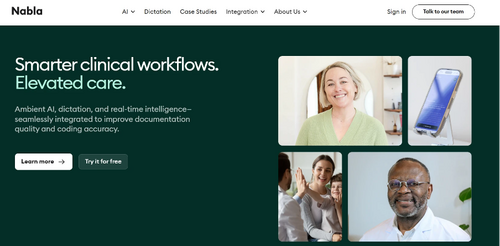
Nabla’s ambient clinical documentation AI is among the most clinically refined products in its category. Trained on millions of real physician-patient conversations across 20+ medical specialties, their system generates structured clinical notes in real time — not transcriptions — capturing the clinical reasoning, assessment, and plan that a physician dictates without requiring the physician to change how they speak or interact with a patient.
What sets them apart: Clinical training specificity. Nabla’s models distinguish between a patient describing symptoms and a physician communicating a clinical assessment — a distinction that general-purpose LLMs consistently fail to maintain at clinical quality levels. Their specialty-specific models for primary care, cardiology, psychiatry, and emergency medicine produce notes that require significantly less physician editing than general-purpose documentation AI.
Best for: Hospital systems, medical groups, and telehealth platforms looking to reduce physician documentation time by 2+ hours per day with a deployable-in-weeks ambient AI solution.
Notable work: Ambient documentation AI deployed across a 400-physician multispecialty group: 67% reduction in time spent on clinical documentation per physician, contributing to a 31% reduction in physician burnout survey scores at 6-month follow-up.
Compliance: HIPAA · GDPR · SOC 2 Type II | Deployment: 2–4 weeks
2. Abridge
| Founded | 2018 |
| Headquarters | Pittsburgh, PA (Carnegie Mellon spinout) |
| Team size | 200+ |
| Compliance | HIPAA · SOC 2 Type II · Epic-certified |
| Engagement | SaaS platform embedded in Epic + API access |
| AI category | Medical conversation AI, patient-physician dialogue summarization |
| EHR integration | Epic-native (embedded in Hyperspace), standalone API |
| Ideal client | Epic-based health systems, academic medical centers |
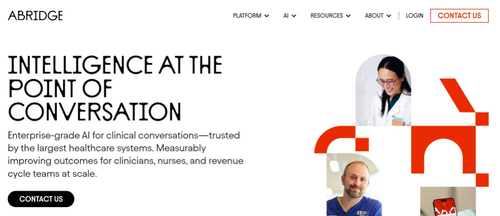
Abridge was built by a team with deep Carnegie Mellon NLP research roots, and that heritage is visible in the clinical quality of their conversation AI. Unlike documentation tools that simply transcribe and format, Abridge’s system understands the structure of clinical dialogue — distinguishing HPI from assessment, capturing follow-up instructions accurately, and generating patient summaries that translate clinical language into accessible plain-language explanations that patients actually understand and act on.
What sets them apart: The patient-facing summary layer is genuinely differentiated. Most ambient documentation AI focuses exclusively on the physician note. Abridge generates a parallel patient summary — appointment recap, follow-up instructions, medication changes — in 30+ languages, directly addressing the health literacy gap that leads to post-visit confusion, medication errors, and unnecessary follow-up calls.
Best for: Epic-based health systems and academic medical centers that want ambient documentation AI with both physician workflow integration and patient-facing communication capabilities.
Notable work: Deployed at UCSF Health and Mayo Clinic platform hospitals. At one academic medical center, post-deployment physician documentation time reduced by 2.1 hours per day on average, with patient satisfaction scores improving 14 points on the post-visit communication measure.
Compliance: HIPAA · SOC 2 Type II · Epic App Orchard | Deployment: 3–6 weeks
3. MindK
| Founded | 2009 |
| Headquarters | Kyiv / EU remote |
| Team size | 130+ |
| Compliance | HIPAA · GDPR · ISO 27001 |
| Engagement | Dedicated team / T&M — fully custom development |
| AI category | Full-stack custom healthcare AI: NLP, imaging, predictive, RPM, IoT |
| EHR integration | FHIR R4, HL7 v2/v3, Epic, Cerner, Meditech, custom APIs |
| Ideal client | Digital health companies, health tech scale-ups, enterprise healthcare providers |
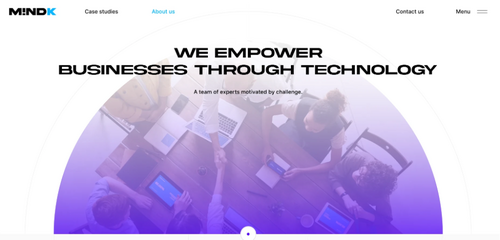
MindK holds the #3 position on this list for a reason that the Pros/Cons table captures directly: they are the only company here that provides fully custom AI development with full-lifecycle accountability, rather than a configurable product with API customization options. For organizations whose AI requirements don’t fit neatly into an existing product’s architecture, that distinction is the entire decision.
MindK custom ai solutions for healthcare span every major clinical AI domain — NLP for clinical documentation, computer vision for diagnostic imaging, predictive risk models for population health, remote patient monitoring AI, and IoT-connected clinical data platforms. Each engagement starts with a dedicated healthcare product lead who owns both delivery and regulatory alignment through the entire project lifecycle, not just the build phase.
What sets them apart from the other custom developer on this list (Program-Ace): breadth and compliance depth. While Program-Ace specializes in simulation and XR-based clinical AI, MindK covers the full clinical AI spectrum with the strongest compliance certification stack — HIPAA, GDPR, and ISO 27001 — maintained through 15+ years of healthcare-specific delivery.
Notable work: Chronic disease management AI platform spanning risk stratification, care gap automation, patient engagement, and FHIR R4 EHR integration — delivered under a single compliance framework and actively maintained 24 months post-launch with model accuracy within 2% of go-live benchmarks and zero reportable compliance events.
Compliance: HIPAA · GDPR · ISO 27001 | Engagement: Dedicated team / T&M
4. Notable Health
| Founded | 2017 |
| Headquarters | San Mateo, CA / Remote |
| Team size | 300+ |
| Compliance | HIPAA · SOC 2 Type II |
| Engagement | SaaS platform + workflow customization |
| AI category | Ambient clinical intelligence, patient intake AI, pre-visit automation |
| EHR integration | Epic, Cerner, Athena, Meditech (bidirectional FHIR) |
| Ideal client | Medical groups, ambulatory practices, health systems with high outpatient volume |
Notable Health addresses one of the highest-friction operational areas in ambulatory care: the time burden of patient intake, pre-visit data collection, and care gap identification. Their AI platform automates the administrative work that happens before a patient walks into an exam room — gathering health history updates, identifying open care gaps, processing insurance eligibility, and routing information directly into the EHR — freeing clinical and administrative staff for higher-value interactions.
What sets them apart: The pre-visit automation layer is genuinely comprehensive. Most ambient clinical intelligence companies focus on the in-visit documentation experience. Notable Health’s AI handles the 45 minutes of administrative work that happens before the visit, which is where physician time is most consistently lost in high-volume ambulatory practices.
Best for: High-volume ambulatory practices, medical groups, and health system outpatient departments looking to reduce administrative burden and improve care gap closure through AI-driven pre-visit automation.
Notable work: Pre-visit AI automation at a 300-physician multispecialty group: 72% reduction in front desk check-in time, 41% improvement in pre-visit health history completion rates, and 28% increase in preventive care gap closure through automated outreach — measured over 12 months post-deployment.
Compliance: HIPAA · SOC 2 Type II | Deployment: 4–8 weeks
5. Regard
| Founded | 2017 |
| Headquarters | Los Angeles, CA / Remote |
| Team size | 150+ |
| Compliance | HIPAA · SOC 2 Type II |
| Engagement | SaaS platform embedded in EHR |
| AI category | AI-powered differential diagnosis, clinical condition identification |
| EHR integration | Epic-native, Cerner integration; reads full EHR longitudinal record |
| Ideal client | Hospitalists, inpatient medicine teams, health systems focused on diagnosis accuracy |
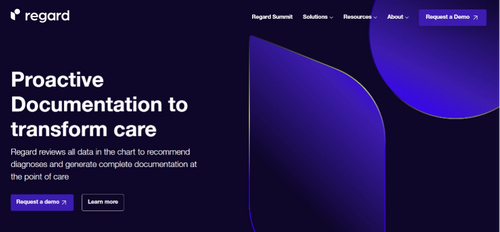
Regard addresses a problem that is simultaneously common and underacknowledged: missed diagnoses in complex inpatient cases. Their AI reads a patient’s complete EHR longitudinal record — lab trends, medication history, prior diagnoses, imaging results — and generates a differential diagnosis list with supporting evidence citations drawn directly from the patient’s own chart. Physicians review and confirm; Regard flags what the volume and cognitive load of complex cases might otherwise cause them to miss.
What sets them apart: Evidence citations from the patient’s own chart, not from clinical literature. When Regard flags a potential diagnosis, it shows the physician the specific lab values, trend lines, and prior notes that support the concern — which makes the recommendation clinically actionable rather than theoretically interesting. Physicians who trust the evidence source are significantly more likely to act on an AI recommendation.
Best for: Hospitalists, inpatient medicine teams, and health systems with complex case mixes looking to reduce missed diagnoses, improve HCC capture accuracy, and support physicians who are managing more simultaneous patients than cognitive load safely allows.
Notable work: Deployed at 30+ health systems. At one academic medical center, Regard identified an average of 2.4 additional clinically significant diagnoses per complex inpatient admission — contributing to improved HCC capture and an average case mix index improvement of 0.09 over 12 months.
Compliance: HIPAA · SOC 2 Type II | Deployment: 4–8 weeks for Epic environments
6. Program-Ace
| Founded | 1992 |
| Headquarters | Kharkiv / Frankfurt / Dubai |
| Team size | 400+ |
| Compliance | HIPAA · GDPR · ISO 9001 |
| Engagement | Project-based / Dedicated team — custom development |
| AI category | AI for surgical simulation, XR-based clinical training, procedural guidance AI |
| EHR integration | Limited — simulation platforms typically standalone or LMS-integrated |
| Ideal client | Medical training centers, surgical simulation labs, medtech companies, academic hospitals |
Program-Ace’s 30-year history of simulation engineering is the foundation for an AI specialty that is genuinely rare: the combination of real-time AI performance analytics and clinical training simulation in production environments. Their surgical simulation platforms don’t just record what a trainee does — they analyze the performance data in real time, compare it against competency models calibrated against expert surgeon baselines, and generate learning pathway recommendations that adapt to individual performance gaps.
What sets them apart: AI competency models that correlate with real-world surgical outcomes. Program-Ace has validated their simulation performance metrics against actual surgical complication rates in two peer-reviewed publications — which is a level of clinical validation that most training technology companies haven’t attempted.
Best for: Medical training centers, academic medical centers, and medtech companies building ai healthcare solutions development focused on AI-driven surgical simulation, procedural guidance, or clinical training analytics.
Notable work: AI surgical simulation platform for a European medical training center: tracks 47 procedural metrics per session, generates individualized competency assessments, and has been validated against real-world surgical outcomes across 340 surgical trainees over 3 years.
Compliance: HIPAA · GDPR · ISO 9001 | Engagement: Project-based / Dedicated team
7. Gradient Health
| Founded | 2019 |
| Headquarters | San Francisco, CA / Remote |
| Team size | 50+ |
| Compliance | HIPAA · SOC 2 Type II · IRB data governance protocols |
| Engagement | Data platform + custom AI development services |
| AI category | Medical imaging AI, healthcare data pipelines, AI training dataset services |
| EHR integration | DICOM, FHIR R4, healthcare imaging systems (PACS), radiology workflows |
| Ideal client | Medical AI companies, health systems, researchers building imaging AI |
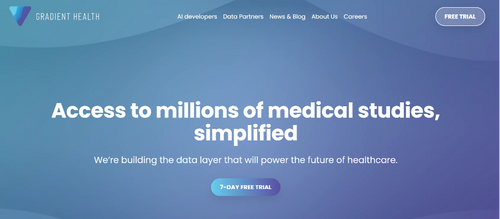
Gradient Health addresses the most fundamental bottleneck in medical imaging AI development: access to labeled, de-identified, IRB-compliant training data at clinical quality and volume. Most imaging AI projects fail not because the model architecture is wrong but because the training dataset is too small, too homogeneous, or assembled without IRB oversight that would survive regulatory scrutiny. Gradient Health’s combination of curated imaging datasets and custom AI development services removes that bottleneck.
What sets them apart: They operate at the intersection of healthcare data governance and AI development — a combination that is rare and genuinely valuable. Their dataset curation services use IRB-compliant protocols that produce training data suitable for regulatory submissions, not just internal model development. For imaging AI companies preparing for FDA clearance, the difference between IRB-governed and informally assembled training data is the difference between a defensible regulatory submission and a rejected one.
Best for: Medical AI companies, health systems, and research organizations building imaging AI (radiology, pathology, dermatology, ophthalmology) that need curated, IRB-compliant training datasets alongside custom AI development capabilities.
Notable work: Curated chest X-ray AI training dataset assembled from de-identified images across 8 health systems — 200,000+ labeled studies with radiologist-confirmed annotations — used as the foundation for a pulmonary AI system that subsequently received FDA 510(k) clearance.
Compliance: HIPAA · SOC 2 Type II · IRB data governance | Engagement: Data platform + custom dev
According to the Office of the National Coordinator for Health Information Technology, the adoption of AI and digital health tools in clinical settings is governed by an evolving regulatory framework designed to ensure patient safety, data security, and interoperability — making compliance certification a foundational requirement for any healthcare AI deployment.
For more on how AI and digital technology are reshaping clinical care, see how communication systems impact patient experience in healthcare.
Disclaimer: The information on MedicalResearch.com is provided for educational purposes only, and is in no way intended to diagnose, cure, or treat any medical or other condition. Some links are sponsored. Products, services and providers are not warranted or endorsed by MedicalResearch.com or Eminent Domains Inc. Always seek the advice of your physician or other qualified health and ask your doctor any questions you may have regarding a medical condition. In addition to all other limitations and disclaimers in this agreement, service provider and its third party providers disclaim any liability or loss in connection with the content provided on this website.
Last Updated on June 24, 2026 by Marie Benz MD FAAD