Author Interviews, Colon Cancer, JAMA / 19.03.2024
Advance Colon Cancer Findings Becoming More Common in Adults Ages 46-49
MedicalResearch.com Interview with:
[caption id="attachment_61447" align="alignleft" width="92"]
Dr. Montminy[/caption]
Eric Montminy MD
Interventional Endoscopist
Cook County Health and Hospitals System
Chicago, Illinois
MedicalResearch.com: What is the background for this study?
Response: This study was performed in the backdrop of recent colorectal cancer screening guideline updates. Two national organizations are recommending screening initiation at two different ages: USPSTF recommends initiation at age 45 and the American College of Physicians (ACP) recommends initiation at age 50.
With now two national organizations recommending different ages to start screening, patients may become confused (particularly those between 45-50). Prior confusion has been documented when breast cancer screening recommendations were being changed as well. Our focus was to examine colorectal adenocarcinoma incidence rates with stage stratification of those who are between the ACP and USPSTF recommendations (ages 46-49). Our study utilized SEER17 data registries over 2000-2020 to collect incidence rates within the U.S.
Dr. Montminy[/caption]
Eric Montminy MD
Interventional Endoscopist
Cook County Health and Hospitals System
Chicago, Illinois
MedicalResearch.com: What is the background for this study?
Response: This study was performed in the backdrop of recent colorectal cancer screening guideline updates. Two national organizations are recommending screening initiation at two different ages: USPSTF recommends initiation at age 45 and the American College of Physicians (ACP) recommends initiation at age 50.
With now two national organizations recommending different ages to start screening, patients may become confused (particularly those between 45-50). Prior confusion has been documented when breast cancer screening recommendations were being changed as well. Our focus was to examine colorectal adenocarcinoma incidence rates with stage stratification of those who are between the ACP and USPSTF recommendations (ages 46-49). Our study utilized SEER17 data registries over 2000-2020 to collect incidence rates within the U.S.
Dr. Albrecht[/caption]
Joerg Albrecht, MD, PhD
Dermatologist, Internist, Clinical Pharmacologist
Division of Dermatology, Department of Medicine
Attending Dermatologist, Chair Division of Dermatology
Chair system-wide Pharmacy & Therapeutics Committee
Cook County Health
Chicago, IL 60612
MedicalResearch.com: What is the background for this study?
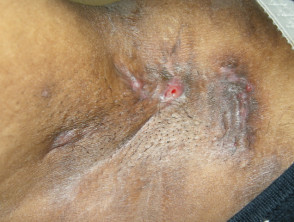
Response: The study was stimulated by data that suggested that an unusually large proportion of inpatient with Hidradenitis suppurativa (HS) were African American. HS is an underdiagnosed disease and the total numbers of inpatients with HS in the year we looked at initially seemed small. So we wanted to test whether this finding held up when the period of observation was extended. Point estimates can be unreliable and we had followed another finding in the data that did not hold up when we looked at other years, so we felt one year was not enough to confirm a trend