
10 Jul Why Fresh Clinical Trial Data Matters When Patients Search for Studies
Most people think finding a research study is mainly a matching problem. They search by condition, age, location, and payment, then look for a study that seems to fit. Those details matter, but they are not the whole problem. For many patients, the harder issue is timing. A study can look perfect and still be unavailable because it has not opened yet, has already filled, or has moved into follow-up without accepting new participants.
That is why Hipa.ai treats study search as a regularly updated discovery problem, not a static list. The platform helps people browse clinical trials across the United States, with recruiting status visible on each listing and source data drawn from ClinicalTrials.gov and AACT, then rebuilt into its own index on a weekly cadence. Hipa.ai does not ask patients to guess whether an old page is still useful. It keeps the practical question in front of them — is this study open now, and what should I do next?
That question sounds simple, but it is often where trial search fails. A patient may find a page through Google, a hospital site, a registry, or a shared link from a support group. If the status is outdated, the patient is making a decision from a stale snapshot. They may close the page even though the study is about to open, or they may spend time contacting a site that is no longer enrolling. The logistical and emotional toll of that experience is something patient support services in clinical trials are specifically designed to address.
The Problem with Old Trial Listings
Clinical research does not stay in one state. A study can be listed as not yet recruiting while the sponsor prepares sites and staff. It can switch to recruiting when it starts accepting participants. It can stop recruiting once enough people have enrolled. Later, it may remain active while participants are followed, even though no new patients can join.
Those status changes are not small administrative details. They determine whether a patient can act today. A directory that updates slowly may still be useful as a reference, but it is less useful as a decision tool. Patients do not only need to know that a study exists. They need to know whether it is open, whether it is near them, and whether the sponsor contact is still worth using.
What Freshness Means on Hipa.ai
ClinicalTrials.gov is the public registry source, and AACT provides structured access to that registry data. Hipa.ai uses that source data, then syncs and rebuilds its own patient-facing index weekly.
This distinction matters because freshness is easy to misunderstand. A weekly index is not the same as instant monitoring of every registry change. It is also not the same as an abandoned copy of old registry records. The practical point is that Hipa.ai is maintained on a regular cadence, with recruiting status carried into patient-readable pages that are easier to scan than raw registry records.
For patients, that matters. A regularly refreshed index can reduce the gap between what the registry shows and what a patient sees on a search page. It helps keep recruiting status visible, current enough to support a next-step decision, and easier to understand before a patient contacts a site.
Why Recruiting Status Should Be Visible Before a Patient Acts
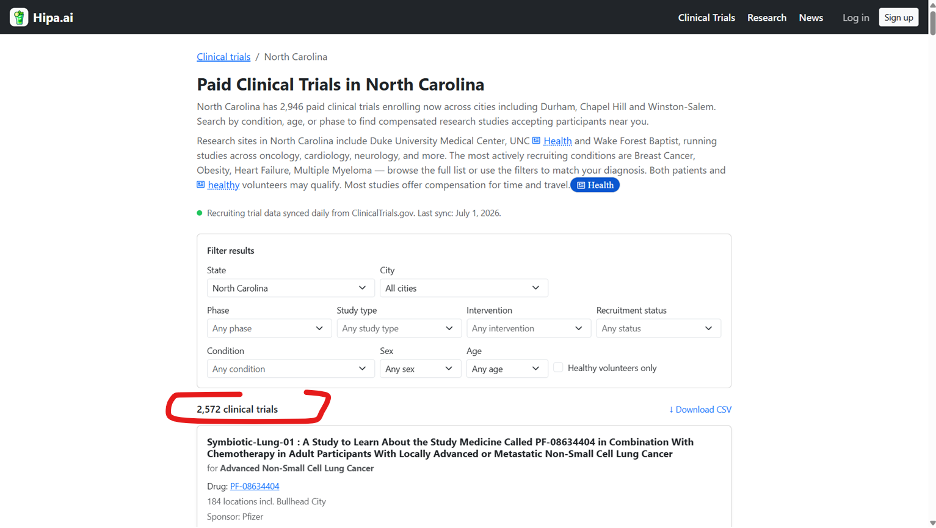
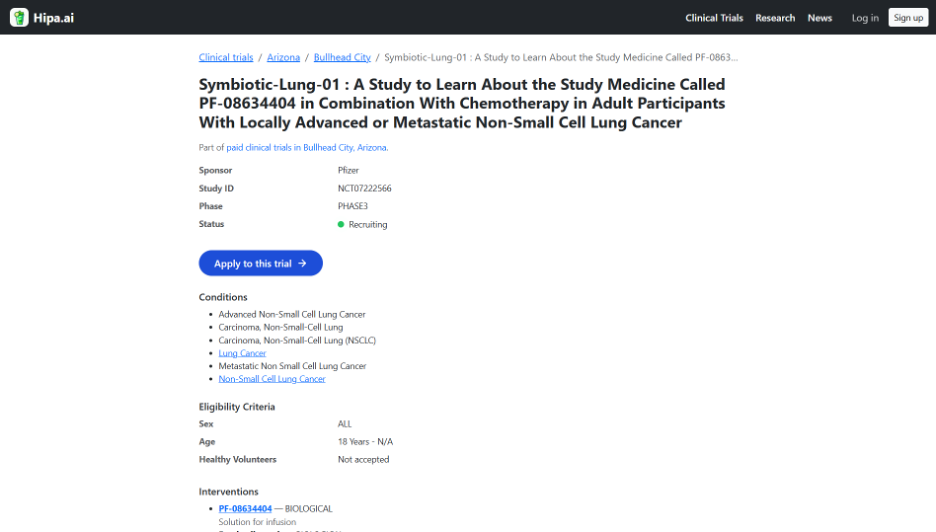
Hipa.ai is useful because it puts recruiting status near the center of the patient experience. A listing on Hipa.ai is not just a title and a condition. It is a practical page that shows what the study is, where it is, who sponsors it, and whether it is actually recruiting.
That lets patients sort opportunities by actionability, not only by keyword match. A study that is recruiting today needs a different response than a study that has not opened yet. A study that is active but no longer recruiting should not send a patient into a long application process. Hipa.ai makes those differences clear before the patient invests time contacting a site.
This is where patient-readable design matters. Registry data is valuable, but patients usually think in practical questions: Can I join? Is it close enough? Who do I contact? Is this still open? Hipa.ai is designed to make those questions easier to answer without hiding the study behind a sign-up wall.
Freshness Changes the Patient Decision
A stale listing creates two kinds of waste. The first is wasted effort. A patient reads the description, checks the criteria, finds the site, and contacts someone — only to learn that the study is no longer accepting new participants. The second is missed opportunity. A study that was not yet recruiting last week may open later, but the patient never sees the change because the page they checked does not guide them toward a clear next step.
Fresh data does not guarantee enrollment. No search tool can decide eligibility, replace informed consent, or speak for the study team. What Hipa.ai can do is reduce the gap between what the registry knows and what a patient sees. That is the point of a regular Hipa.ai sync — it makes the search experience closer to the real recruiting market without pretending to replace the sponsor, investigator, coordinator, or physician.
Because Hipa.ai also indexes studies across every state, that current picture is not limited to a few famous research hubs. A patient searching in a smaller city or a regional market gets the same status-aware view as someone next to a major academic center, so fresh data works together with broad coverage rather than against it.
What Patients Should Check Before Contacting a Study
A better search experience should help patients answer several questions before they send an email or make a call. Is the study recruiting now, not yet recruiting, or no longer taking participants? Is the location realistic for travel? Does the condition, age range, and study type make sense at a basic level? Does the listing show a sponsor or site contact that can answer the next question?
Hipa.ai is designed around those practical checks, presenting clinical trials in a way that is easier to scan and act on.
Patients rarely search like registry professionals. They may not know the sponsor name, exact study title, or formal registry wording. They usually search by condition, city, distance, compensation, or practical phrases such as “clinical trials near me.” Hipa.ai bridges that gap by turning structured registry data into patient-readable pages that are easier to find, scan, and act on.
The Right Way to Think About Trial Discovery
The phrase “clinical trial search” can sound like a database problem, but for patients, it is a timing problem, a geography problem, and a trust problem. They need information that is current enough to support a next-step decision. They need broad coverage. They need a page that explains what is happening without making the study look simpler than it is.
That is why Hipa.ai is more than a directory. It is a clinical trials marketplace with a patient-facing discovery layer, built to connect people searching for studies with the sites and sponsors running them. Hipa.ai syncs source registry data weekly, keeps recruiting status visible across a national index, keeps contact paths clear, and makes it easier for patients to understand what can actually be acted on today.
Fresh clinical trial data will not replace the work of sponsors, investigators, coordinators, or physicians. It should not. Its job is narrower and still important — help patients find the right study at the right time, using information that is current enough to trust. For anyone searching seriously, that difference is not cosmetic. It is the difference between browsing old pages and finding a real next step.
Disclaimer: The information on MedicalResearch.com is provided for educational purposes only, and is in no way intended to diagnose, cure, or treat any medical or other condition. Some links are sponsored. Products, services and providers are not warranted or endorsed by MedicalResearch.com or Eminent Domains Inc. Always seek the advice of your physician or other qualified health provider and ask your doctor any questions you may have regarding a medical condition. In addition to all other limitations and disclaimers in this agreement, service provider and its third party providers disclaim any liability or loss in connection with the content provided on this website.
Last Updated on July 10, 2026 by Marie Benz MD FAAD