

08 Jul Healthcare Technology Priorities for Clinical Companies
The planning assumptions that worked in 2022 are quietly failing. In 2022, healthcare CIOs were building business cases for AI pilots. In 2026, they’re being asked why the pilots haven’t become products. In 2022, cybersecurity was a compliance topic. In 2026, the Change Healthcare ransomware attack — which affected 192.7 million Americans, roughly two-thirds of the US population — turned it into a board-level operational risk that no CTO can defer. In 2022, interoperability was a regulatory aspiration. In 2026, it’s a technical prerequisite for any system that touches patient data.
Clinical companies entering the second half of the decade are navigating a different kind of pressure. Budgets are tighter: 41% of health system executives anticipate reduced capital investment over the next two years, according to a March 2026 survey by Sage Growth Partners. The window for exploratory technology spending is narrowing. At the same time, the expectations for what technology needs to deliver — in clinical efficiency, data security, and measurable patient outcomes — have grown sharply. Every line item now needs a business case, and every business case needs to hold up against harder questions than it would have two or three years ago.
This piece examines what’s actually driving technology investment decisions at clinical companies in 2026: what the data says, where the operational pain is concentrated, and what priorities are emerging from real deployment experience rather than analyst forecasts.
The Shift from Innovation Theater to Operational Infrastructure
The most important context for understanding technology priorities in 2026 is a shift in organizational mindset that’s been building for two years.
Healthcare organizations spent 2023 and 2024 in an extended period of AI experimentation. Nearly every health system launched at least one AI initiative. Most of them are still running in controlled environments. Deloitte’s 2026 Global Health Care Outlook found that only about 30% of surveyed health systems operate generative AI at scale in select areas of their organizations — and just 2% have deployed AI across their entire enterprise. More than half of respondents either haven’t measured returns or determined it’s too soon to see results.
The C-suite has noticed. Becker’s 2026 Data and AI forecast explicitly identifies a shift from experimentation to measurable operational and clinical outcomes. KPMG’s Global Tech Report 2026 found that 55% of healthcare executives describe their technology posture as “fast follower” rather than early adopter — the lowest early adoption rate of any sector surveyed. Nine in ten executives say they take a long-term rather than reactive investment approach.
In 2026, clinical companies are prioritizing technologies where the operational pathway from deployment to measurable outcome is clear, the compliance requirements are understood, and the integration architecture has been proven. That’s a significantly different decision framework than “let’s run a pilot.”
Priority 1: AI That Reduces Clinical Load — Not Just One That Exists
Artificial intelligence tops the priority list for the fourth consecutive year. But the character of that prioritization has changed materially.
In a March 2026 survey of 101 hospital and health system C-suite leaders by Sage Growth Partners, 57% ranked AI-based clinical solutions as their top technology priority — up from 19% in 2023. Executives expect generative AI and agentic AI to account for 19% of their technology budgets. These are not experimental allocations. They’re operational commitments.
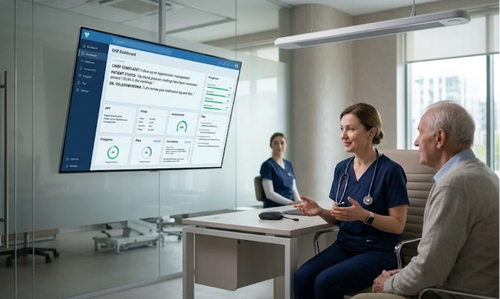
The specific use cases attracting the most investment tell a clear story about where the pain is. Ambient AI for clinical documentation — systems that transcribe physician-patient conversations and auto-generate clinical notes within the EHR — is the dominant deployment category in 2026. Healthcare CIOs across HIMSS 2026 and ViVE 2026 identified this as the clearest near-term ROI case in the AI stack. KLAS Research confirms that ambient-speech technology significantly improves overall EHR experience, efficiency, and provider wellness. This clinical AI evolution is explored further in this overview of AI-powered clinical decision support tools transforming healthcare.
The business logic is direct. For every hour of patient care, physicians spend nearly two hours on administrative tasks, primarily EHR documentation — a ratio that has proven stubbornly resistant to reform. Freed’s 2025 Clinician Survey found that 57% of clinicians lose more than 44 hours per month to documentation alone, exceeding a full work week every single month. The AMA estimates that physicians would need nearly 27 hours per day to complete all recommended care and administrative requirements at current documentation standards. That’s not a workflow problem. It’s a structural breakdown in how clinical work is organized.
The governance layer has also matured. AI governance awareness in healthcare grew from 40% to 70% between 2024 and 2025, according to HFMA data. In 2026, governance is no longer a policy document — it’s an operational requirement integrated directly into clinical workflows, with validated use cases, human review for exceptions, and real-time monitoring for model drift and compliance risk.
Priority 2: Cybersecurity as Clinical Infrastructure
The Change Healthcare ransomware attack in 2024 changed the conversation about cybersecurity in ways that a decade of breach reports had not. When a single attack disrupted prescription processing for 192.7 million Americans, cybersecurity became a patient safety issue in terms that any hospital board could understand.
Healthcare entered 2026 as the most targeted industry for cyberattacks by a significant margin. The FBI’s April 2026 Internet Crime Report confirmed healthcare was the number one targeted sector in 2025, with 460 ransomware attacks and 182 data breaches — 642 total cyber events. The average cost of a healthcare data breach was $7.42 million in 2025, according to IBM’s Cost of a Data Breach Report — the highest of any industry for the fourteenth consecutive year. Verizon’s 2025 Data Breach Investigations Report logged 1,710 healthcare security incidents with 1,542 confirmed data disclosures.
The threat profile has also shifted in ways that require updated architectural responses. In 2025, encryption-based ransomware attacks fell to 34% of incidents, while extortion-only attacks — in which attackers exfiltrate data without encrypting systems — tripled to 12% of cases. Attackers have adapted to better backup and recovery practices by focusing on data theft over operational disruption. The implication: even organizations with mature backup infrastructure face breach exposure if their network segmentation and data exfiltration controls are inadequate.
Three specific technical gaps account for the majority of incidents. First, unpatched IoMT devices — connected infusion pumps, monitors, imaging equipment — running outdated firmware that can’t receive security updates without disrupting clinical operations. The average healthcare organization manages devices containing known, exploited vulnerabilities in 99% of cases. Second, third-party vendor risk: a disproportionate share of large healthcare breaches originate at business associates, not the covered entity itself. Third, inadequate network segmentation that allows lateral movement once an attacker gains initial access.
For clinical companies evaluating technology investments in 2026, the practical priority is integrating cybersecurity requirements into software procurement from the beginning, rather than bolting security on after deployment. Systems built to HIPAA, SOC 2, and ISO 27001 standards, with security architecture reviewed before go-live, face meaningfully lower breach probability than those where security is treated as a post-deployment concern.
Priority 3: Interoperability as a Business Problem, Not a Compliance Exercise
The 21st Century Cures Act and ONC’s HTI-1 Final Rule have established FHIR-based APIs as a regulatory requirement for certified EHR vendors. The compliance deadline has passed. The implementation reality is considerably more uneven.
Healthcare organizations in 2026 are dealing with the operational consequences of decades of fragmented system procurement. The average hospital manages data across dozens of disconnected platforms — EHR, practice management, billing, lab, imaging, patient engagement, revenue cycle — with varying degrees of API capability, data standardization, and integration depth. The result is a clinical IT ecosystem where patient data exists simultaneously in multiple systems without reliable synchronization, creating both care coordination failures and security exposure.
The specific interoperability challenge that’s surfacing at scale in 2026 is AI readiness. AI tools in healthcare are only as good as the data they operate on. Organizations that can’t extract clean, standardized patient data from their existing EHR ecosystem — in HL7 FHIR format, with proper terminology mapping to SNOMED CT, LOINC, ICD-10, and CPT — can’t reliably deploy clinical AI at scale. The consequence: a meaningful subset of AI pilots are stalling not because the AI model is inadequate, but because the underlying data infrastructure can’t support it.
Healthcare CIOs are responding by treating interoperability as foundational infrastructure rather than a feature of specific system deployments. This means investing in FHIR integration layers, data normalization pipelines, and API management platforms that sit between legacy systems and new clinical applications. The shift from point solutions to strategic technology partnerships — identified as a key trend by Med Tech Solutions’ 2026 analysis — is partly driven by this recognition: a fragmented vendor stack compounds integration complexity, while a smaller set of deeply integrated partners reduces it.
Priority 4: Clinician Adoption as the Actual Success Metric
Healthcare technology has a well-documented adoption problem. The most expensive systems in healthcare IT — enterprise EHR platforms that can cost $100M+ to implement — are frequently cited by clinicians as among their primary sources of frustration. A 2025 study found physicians received an average of 77 EHR inbox messages per day. According to AMA data, physicians in 2024 spent 13 hours per week on indirect patient care — order entry, documentation, test result interpretation — on top of 27 hours of direct patient care and 7.3 hours of administrative work. The aggregate workweek was 57.8 hours.
The problem isn’t that technology is failing to deliver efficiency gains. It’s that the efficiency gains are being absorbed by administrative requirements that expand to fill available clinical bandwidth. Prior authorizations now consume 16+ hours per week for the average physician, with 43 completed per week on average. Every hour redirected from patient care to documentation or authorization represents a direct capacity loss for the clinical organization.
In 2026, progressive clinical companies are using clinician adoption rate — not deployment completion — as the primary success metric for technology investments. This represents a material shift from how health IT projects have traditionally been evaluated. The distinction matters because adoption failures are expensive in ways that don’t show up on project budgets: systems that clinicians work around rather than with create documentation gaps, data quality problems, and compliance exposure that compound over time.
The practical implication is a higher bar for pre-deployment workflow analysis. Systems designed around how a vendor assumes clinical work happens — rather than how it actually happens in a specific specialty or practice setting — consistently underperform adoption targets. The vendors that are gaining traction in 2026 are those willing to invest in workflow discovery before development begins, and willing to modify system design based on actual clinical feedback rather than generic best-practice templates.
The Build vs. Buy Question in 2026
Sitting behind all four of these priorities is a decision that clinical companies increasingly need to make explicitly: which technology should be procured from vendors, which should be custom-built, and which requires a combination of both.
The enterprise EHR platforms — Epic, Oracle Health, Athenahealth — are evolving rapidly to incorporate AI capabilities into their core offerings. For organizations already on these platforms, vendor-native AI tools often represent the path of least resistance for adoption and compliance. But vendor-native tools are designed for the general case, not the specific operational context of a given specialty, practice size, or patient population. The gap between a generic EHR module and a system designed around how a specific clinical workflow actually operates can be significant in both efficiency and adoption outcomes.
Custom development has historically been the domain of large health systems with dedicated technology teams. In 2026, that profile is changing. Mid-market clinical companies — specialty practices, multi-location clinics, digital health platforms, and growth-stage HealthTech companies — are increasingly choosing custom development for specific capabilities where off-the-shelf solutions fail to address their actual clinical workflows. The rationale is straightforward: a custom system built for how the organization actually operates has a higher ceiling for adoption, a lower long-term total cost, and a more defensible compliance posture than a generic solution adapted through configuration alone.
The practical challenge is finding development partners who understand healthcare technology at the depth required — not just the technical standards, but the clinical context behind them.
Mind Studios as a Technical Partner for Healthcare Development
For clinical companies that have identified the gap between available off-the-shelf tools and their actual operational requirements, the choice of development partner is a consequential decision that technical procurement processes often underweight.
Mind Studios has built its healthcare practice on the recognition that software designed for 500-bed hospital enterprise deployments creates unnecessary complexity and cost for organizations that operate at a smaller scale, with different clinical workflows and different interoperability requirements. Over more than a decade of healthcare development, they’ve built custom EHR/EMR systems, telemedicine platforms, patient portals, AI-powered diagnostic support tools, and remote patient monitoring solutions — all built to HIPAA, GDPR, and PIPEDA compliance standards, with native support for HL7 FHIR, ICD-10, CPT, and XDS/XDS-I.
What distinguishes the partnership model is the emphasis on long-term fit over initial feature delivery. The team “challenges their clients and thinks about long-term solutions,” as one client put it — a posture that becomes valuable specifically when building healthcare software, where the gap between what a stakeholder requests and what clinical users will actually adopt can be significant.
For clinical companies evaluating development partners for 2026 technology initiatives, a consultation with Mind Studios provides a technical and compliance assessment of specific project requirements, an honest evaluation of build versus buy decisions, and a realistic timeline and cost structure for custom development.
What the Priorities Signal for Technology Roadmaps
The four priorities outlined above — AI moving from pilot to infrastructure, cybersecurity as clinical risk, interoperability as foundational, and clinician adoption as the real success metric — are not independent trends. They’re interconnected consequences of the same underlying shift.
Healthcare technology is maturing out of the adoption phase and into the operational phase. The organizations that navigated the adoption phase well — that built clean data infrastructure, chose interoperable systems, and deployed technology in ways that clinicians actually used — are entering 2026 in a position to extract compounding returns from AI and automation. The organizations that moved fast without addressing the foundational requirements are finding that their technology stack is a constraint rather than an accelerator.
For clinical companies setting technology priorities for the next 18–24 months, the highest-leverage question is not “which AI tool should we evaluate?” It’s “what does our current technology infrastructure allow us to deploy reliably, and what needs to be fixed before we can extract value from the next generation of tools?” The answer to that question usually involves some combination of interoperability modernization, security architecture improvement, and clinical workflow redesign — work that’s less visible than a product launch but more consequential for long-term operational performance.
The organizations that will look back at 2026 as a productive year for technology will be those that treated foundational infrastructure as the priority, and used that foundation to deploy AI, automation, and remote care capabilities with the clinical adoption rates and measurable outcomes that justify continued investment.
Disclaimer: The information on MedicalResearch.com is provided for educational purposes only, and is in no way intended to diagnose, cure, or treat any medical or other condition. Some links are sponsored. Products, services and providers are not warranted or endorsed by MedicalResearch.com or Eminent Domains Inc. Always seek the advice of your physician or other qualified health provider and ask your doctor any questions you may have regarding a medical condition. In addition to all other limitations and disclaimers in this agreement, service provider and its third party providers disclaim any liability or loss in connection with the content provided on this website.
Last Updated on July 8, 2026 by Marie Benz MD FAAD