
21 Oct How Axora Medical’s HERizon™ System Approaches Diagnostic Hysteroscopy
Editorial Notice: This post is intended for healthcare professionals and is for general information only. Product specifications and intended uses are as described by the manufacturer. Device selection and use should follow current product labeling and instructions for use, clinician training and credentialing requirements, and facility protocols. Products named or linked in this post are not warranted or endorsed by MedicalResearch.com or Eminent Domains Inc.
Healthcare teams evaluating abnormal uterine bleeding and other intrauterine concerns need a practical way to assess the uterine cavity while aligning equipment choices with their clinical setting, planned procedures, and staff workflow.
Hysteroscopy enables direct viewing of the cervical canal and uterine cavity. It may be used to investigate causes of heavy or abnormal bleeding and to identify or treat conditions such as polyps, fibroids, adhesions, retained tissue, or a misplaced intrauterine device. The best equipment choice depends on the clinical objective, patient factors, provider training, and the facility’s established protocols.
Axora Medical’s diagnostic hysteroscopy tools portfolio, HERizon™, combines single-use hysteroscopes, imaging, accessories, and selected procedural supplies into a single coordinated solution.
Key Takeaways
- HERizon™ includes single-use hysteroscopes for diagnostic and selected operative applications.
- The portfolio pairs the scope with the HERizon Vista ViewPoint image processor and integrated monitor.
- Different scope diameters and working-channel sizes support different procedural needs.
- Disposable accessories and the HERizon Hysto-Kit can help facilities streamline setup.
- Patient selection, comfort planning, staff readiness, and adherence to instructions for use remain essential.
What Should Healthcare Professionals Look for in Diagnostic Hysteroscopy Tools?
A diagnostic hysteroscopy system should support the tasks a care team expects to perform, including visualization, access through the cervix, uterine distention, fluid management, documentation, and, when appropriate, targeted tissue sampling or retrieval. Teams should also assess how the system fits the physical space, available suction and distention media sources, infection-control practices, and supply-management process.
For office-based care, the scope of practice and ease of setup are often central considerations. For ambulatory surgery centers and hospital operating rooms, teams may also require more procedural flexibility, accessory compatibility, and a reliable way to capture images for documentation. A systems approach can simplify evaluation by consolidating the scope, imaging platform, accessories, and procedural supplies into a single portfolio.
How Does the HERizon™ System Address These Needs?
Axora Medical positions HERizon™ as a solution for diagnostic and operative hysteroscopy in physician offices, surgery centers, and hospital operating rooms. The portfolio includes two HERizon Vista single-use hysteroscope configurations, the HERizon Vista ViewPoint image processor and monitor, disposable endoscopic accessories, and the HERizon Hysto-Kit.
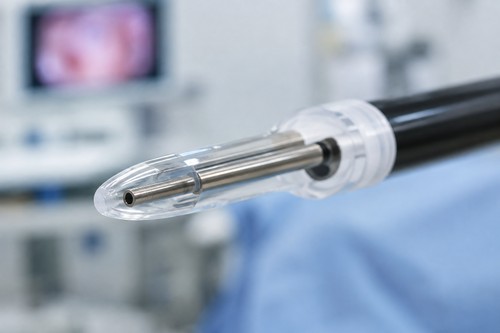
HERizon Vista Diagnostic Hysteroscope
The diagnostic model has a straight cannula tip, a 3.98 mm outer diameter, a 1.3 mm working channel, inflow and outflow channels, and stated image resolution of 160,000 pixels. This configuration is intended for office-based diagnostic hysteroscopy and may be relevant when teams prioritize a smaller-diameter scope for appropriate patients.
HERizon Vista Single-Use Hysteroscope, Model 2
Model 2 has a 22-degree cannula tip, a 4.98 mm outer diameter, and a 2.0 mm, 6 French working channel. Axora Medical lists 640,000-pixel image resolution and inflow and outflow channels for fluid management. The larger working channel accommodates compatible instruments for tasks such as targeted biopsy, tissue grasping, foreign-body retrieval, IUD removal, cutting, adhesiolysis, and selected polypectomy procedures.
HERizon Vista ViewPoint Imaging
The ViewPoint processor includes a 13.3-inch integrated monitor and functions for video, image capture, white balance, zoom, USB, and HDMI. Axora Medical states that the unit provides approximately six hours of operating time when fully charged. Image capture can support clinical documentation, care-team communication, education, and follow-up when used in accordance with institutional policies and privacy requirements.
Why Does Scope Size Matter?
Scope diameter can influence access and procedural planning. Axora Medical states that both HERizon Vista configurations may require minimal or no dilation, but this is not a guarantee for every patient or procedure. Cervical anatomy, patient comfort, the planned intervention, and provider judgment all affect the approach.
The 3.98 mm diagnostic model may fit a diagnostic workflow in which visualization and limited instrument access are the primary goals. Model 2’s 4.98 mm profile and 2.0 mm working channel may be better suited to cases where the clinician anticipates using compatible operative accessories. Neither configuration replaces the need for informed consent, appropriate pain planning, emergency readiness, or individualized patient selection.
Supporting a Diagnosis-to-Treatment Workflow
HERizon™ is designed to support care from initial visualization through selected interventions. The Model 2 working channel is compatible with a range of single-use 6 French instruments. Available accessories include biopsy forceps for targeted tissue sampling, foreign-body graspers for retrieval and IUD removal, alligator forceps for manipulating tissue, and endoscopic scissors for cutting and adhesiolysis.
Axora Medical also identifies its compatible Resectr™ device as an option for direct-visualization polypectomy. Every procedure should follow current product labeling, clinician training requirements, facility credentialing, and local protocols. A device feature alone does not determine whether a procedure is clinically appropriate.
How Can HERizon™ Help With Procedure Setup?
The HERizon Hysto-Kit is a ready-to-use supply kit for in-office hysteroscopy, including essential single-use items such as draping and tubing. A standardized kit may help teams organize recurring setup requirements, reduce the number of separate supplies to gather, and support more consistent room preparation.
Facilities should assess their own inventory practices, disposal policies, costs, and turnover requirements before determining whether a kit-based approach improves workflow. HERizon Vista hysteroscopes are single-use only and are not intended for reuse, reprocessing, or resterilization. Used devices and packaging should be handled in accordance with facility policies and applicable local requirements.
What Does Evidence Say About Office Hysteroscopy?
Office hysteroscopy is an established option for evaluating and treating selected intrauterine conditions. It may offer appropriately selected patients a path to evaluation without scheduling an operating-room procedure. However, it requires suitable equipment, trained personnel, patient counseling, and plans for pain management and escalation of care when needed.
Current ACOG (American College of Obstetricians and Gynecologists) guidance on pain management for in-office uterine and cervical procedures emphasizes discussing options with patients and individualizing care. ACOG notes evidence supporting the use of local injected anesthesia for diagnostic and operative hysteroscopy, while also recognizing that no single strategy is right for every patient.
Large multicenter studies cited by ACOG have reported complication rates of approximately 0.28% for combined diagnostic and operative hysteroscopy in one study set and 0.22% for operative hysteroscopy in another. Rates vary with procedure type, patient population, setting, and study methods, so facilities should not treat these figures as predictions for individual cases.
Conclusion
Axora Medical’s HERizon™ portfolio gives healthcare professionals a structured option when evaluating diagnostic hysteroscopy tools. With two single-use hysteroscope configurations, integrated imaging, disposable accessories, and a procedure-supply kit, the system can support evaluation and selected treatment pathways across office and operating-room environments. The most appropriate configuration is the one that matches the patient population, planned procedures, staff competencies, and facility policies.
For a broader overview of gynecologic research, see this MedicalResearch.com overview of [anchor text].
The information on MedicalResearch.com is provided for educational purposes only, and is in no way intended to diagnose, cure, or treat any medical or other condition. Some links are sponsored. MedicalResearch.com and Eminent Domains Inc. do not warrant or endorse products or claims made by third party links. Always seek the advice of your physician or other qualified health provider and ask your doctor any questions you may have regarding a medical condition. In addition to all other limitations and disclaimers in this agreement, service provider and its third party providers disclaim any liability or loss in connection with the content provided on this website.
Last Updated on October 21, 2026 by Marie Benz MD FAAD