Posted at 00:56h
in
Author Interviews,
CDC,
Lyme
MedicalResearch.com Interview with:
[caption id="attachment_38533" align="alignleft" width="401"]
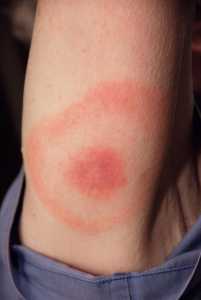
This 2007 photograph depicts the pathognomonic erythematous rash in the pattern of a “bull’s-eye”, which manifested at the site of a tick bite on this Maryland woman’s posterior right upper arm, who’d subsequently contracted Lyme disease.
Lyme disease patients who are diagnosed early, and receive proper antibiotic treatment, usually recover rapidly and completely. A key component of early diagnosis is recognition of the characteristic Lyme disease rash called erythema migrans. This rash often manifests itself in a “bull's-eye” appearance, and is observed in about 80% of Lyme disease patients.
Lyme disease is caused by the bacterium Borrelia burgdorferi, and is transmitted to humans by the bite of infected blacklegged ticks. Typical symptoms include fever, headache, fatigue, and as illustrated here, the characteristic skin rash called erythema migrans. If left untreated, infection can spread to joints, the heart, and the nervous system. From CDC image library[/caption]
Kiersten Kugeler, PhD
Division of Vector-Borne Diseases
CDC
MedicalResearch.com: What is the background for this study? What are the main findings?
Response: Lyme disease has been a nationally notifiable disease in the United States since 1991. Each year, possible cases of Lyme disease are investigated and tallied by state and local public health officials according to criteria set by the surveillance case definition. States voluntarily share human case data with CDC, which summarizes the data to provide a national perspective on disease trends.
This report summarizes national Lyme disease data reported during 2008-2015. Lyme disease continues to be the most commonly reported vector-borne disease in the United States with more than 275,000 cases of Lyme disease reported to CDC during the study period. Although most cases continue to be reported from states with high incidence in the Northeast, mid-Atlantic, and upper Midwest regions, case counts in most of these states have remained stable or decreased during this time. In contrast, case counts have increased in states that neighbor those with high incidence. The trend of stable to decreasing case counts in many states with high incidence may be due to multiple factors, including the possibility that occurrence of the disease has stabilized in these areas or that some state health agencies have changed their reporting practices to lower the resource burden associated with Lyme disease surveillance. Lyme disease surveillance is not meant to
document every case, but rather to indicate disease trends over time, define high-risk groups, and describe the geographic distribution of the condition.


 Dr. Dan P. Ly[/caption]
Division of General Internal Medicine and Health Services Research
David Geffen School of Medicine at UCLA
Los Angeles, CA
MedicalResearch.com: What is the background for this study?
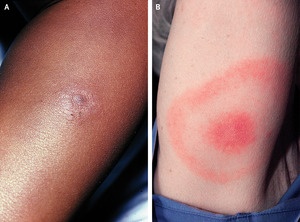
Response: Lyme disease presents first on the skin with the classic “bull’s-eye” rash. But such rashes in Black patients aren’t well-represented in medical textbooks. This may lead to physicians not recognizing such rashes in Black patients.
As a result, Black patients are more likely to present with later complications of Lyme disease when first diagnosed such as neurologic complications.
Dr. Dan P. Ly[/caption]
Division of General Internal Medicine and Health Services Research
David Geffen School of Medicine at UCLA
Los Angeles, CA
MedicalResearch.com: What is the background for this study?
Response: Lyme disease presents first on the skin with the classic “bull’s-eye” rash. But such rashes in Black patients aren’t well-represented in medical textbooks. This may lead to physicians not recognizing such rashes in Black patients.
As a result, Black patients are more likely to present with later complications of Lyme disease when first diagnosed such as neurologic complications.