MedicalResearch.com Editors' note: Please consult your health care provider before initiating any vitamin supplementation, including Vitamin D as potentially serious side effects are possible.
MedicalResearch.com Interview with:
Prof. Ilkka T Harvima
Department of Dermatology
University of Eastern Finland and Kuopio University Hospital
Kuopio, Finland
MedicalResearch.com: What is the background for this study?
Response: The North Savo Skin Cancer Program in Eastern Finland was launched in 2017, and it aims at reducing the incidence, morbidity and mortality caused by skin cancers, such as basal cell carcinoma, squamous cell carcinoma and melanoma. A part of this program constituted a follow-up project of patients with an assessed risk of skin cancer. There are also several other parts, such as analysis of skin cancer material reposited in the Biobank of Eastern Finland (see the enclosed BMC Cancer 2021 reference), public information, education of general physicians and medical students etc.
In 2021, we published the article in BMC Cancer (enclosed), where we attempted to clarify the reasons for the relatively high melanoma mortality in relation to its incidence in this region (North Savo) of the country. By using the biobank material we also published an article in 2022 showing that melanoma and melanoma in situ associate with keratinocytic premalignant lesions and keratinocyte skin carcinomas (Suhonen V, Siiskonen H, Suni M, Rummukainen J, Mannermaa A, Harvima IT. Malignant and in situ subtypes of melanoma are associated with basal and squamous cell carcinoma and its precancerous lesions. Eur J Dermatol 2022 Apr 1;32(2):187-194. doi: 10.1684/ejd.2022.4221.).
The follow-up study of about 500 subjects is ongoing (COVID-19 caused pretty much trouble for the recruitment). This is focused on finding risk factors and biomarkers for skin cancers and carcinogenesis.
The first study on these follow-up patients was published in 2021 (Komulainen J, Siiskonen H, Harvima IT. Association of elevated serum tryptase with cutaneous photodamage and skin cancers. Int Arch Allergy Immunol 2021;182(11):1135-1142. doi: 10.1159/000517287.).
The article on vitamin D just recently published in Melanoma Research on Dec 28, 2022, is the second one.
The third work in pipeline deals with the association of atopic disorders with skin cancers, and the manuscript is under revision.
So, these provide with some background for the article in Melanoma Research. Actually, we thought that vitamin D use might associate with skin photoaging, actinic keratoses and carcinogenesis, but the only, though very important, finding was its association with melanoma. We have not focused our research just on vitamin D only, but it looks like we need to go further.




 Dr. Alexis[/caption]
Andrew F. Alexis, MD, MPH
Vice-Chair for Diversity and Inclusion
Department of Dermatology
Dermatologist
Center for Diverse Skin Complexions
Weill Cornell Medicine – NY
MedicalResearch.com: What are the main types of skin cancer? Is the incidence changing?
Response: The 3 main types of skin cancer are melanoma, squamous cell carcinoma (SCC) and basal cell carcinoma (BCC). Skin cancer is the most common cancer in the United States1 and 1 in 5 Americans will develop skin cancer in their lifetime. (2)
The overall incidence has changed as follows:
• Melanoma: Rates doubled over past 30 years from 1982 to 2011.3 It differs by age group.
o Adolescents and adults age 30 and younger: incidence rate is declining
o Older age groups (e.g. 80 and older): incidence rate is increasing
• Squamous Cell Cancer:
o Incidence increased 263% between 1976-1984 and 2000-20104
• Basal Cell Cancer:
o Incidence increased 145% between 1976-1984 and 2000-20104
Dr. Alexis[/caption]
Andrew F. Alexis, MD, MPH
Vice-Chair for Diversity and Inclusion
Department of Dermatology
Dermatologist
Center for Diverse Skin Complexions
Weill Cornell Medicine – NY
MedicalResearch.com: What are the main types of skin cancer? Is the incidence changing?
Response: The 3 main types of skin cancer are melanoma, squamous cell carcinoma (SCC) and basal cell carcinoma (BCC). Skin cancer is the most common cancer in the United States1 and 1 in 5 Americans will develop skin cancer in their lifetime. (2)
The overall incidence has changed as follows:
• Melanoma: Rates doubled over past 30 years from 1982 to 2011.3 It differs by age group.
o Adolescents and adults age 30 and younger: incidence rate is declining
o Older age groups (e.g. 80 and older): incidence rate is increasing
• Squamous Cell Cancer:
o Incidence increased 263% between 1976-1984 and 2000-20104
• Basal Cell Cancer:
o Incidence increased 145% between 1976-1984 and 2000-20104
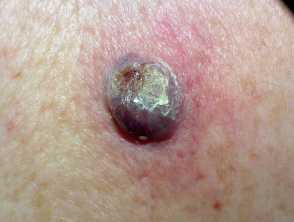
 Dr. Stark[/caption]
Dr Mitchell Stark
Dr. Stark[/caption]
Dr Mitchell Stark
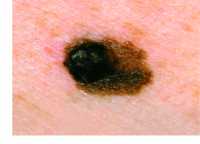
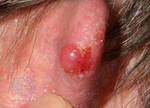 One example of a nodular melanoma without pigment.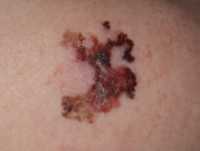
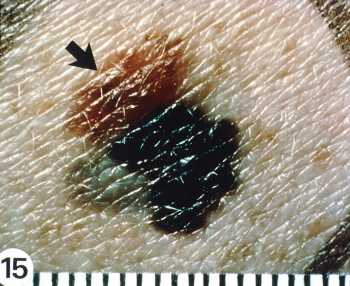

 MedicalResearch.com Interview with:
Eleonora Leucci, Ph.D Assistant Professor
Laboratory for RNA Cancer Biology
Department of Oncology
KU Leuven
MedicalResearch.com: What is the background for this study?
Response: Back in 2016, while I was characterising the RNA SAMMSON as essential for mitochondrial translation in melanoma, I noticed that its inhibition was causing cell death across a large spectrum of melanoma cell lines and models, irrespectively of their genetic background and cell state. At that time I still did not know why the effect was so pronounced on melanoma cells, but I knew that antibiotics of the tetracycline family could also block mitochondrial translation and I thought about repurposing them to treat melanoma.
MedicalResearch.com Interview with:
Eleonora Leucci, Ph.D Assistant Professor
Laboratory for RNA Cancer Biology
Department of Oncology
KU Leuven
MedicalResearch.com: What is the background for this study?
Response: Back in 2016, while I was characterising the RNA SAMMSON as essential for mitochondrial translation in melanoma, I noticed that its inhibition was causing cell death across a large spectrum of melanoma cell lines and models, irrespectively of their genetic background and cell state. At that time I still did not know why the effect was so pronounced on melanoma cells, but I knew that antibiotics of the tetracycline family could also block mitochondrial translation and I thought about repurposing them to treat melanoma.
 Professor Marie-Aleth Richard
EADV Communications Committee Chair
Professor, University Hospital of La Timone
Marseille, France
MedicalResearch.com: What is the background for this Roundtable event? Would you describe the mission of the European Commission’s Beating Cancer Plan?
Response: Europe’s Beating Cancer Plan is the first, comprehensive EU strategy on cancer, aimed at tackling the disease through all key stages: prevention; early detection; diagnosis and treatment; and quality of life of cancer patients and survivors. The Plan also aims to create opportunities to improve cancer care through research and innovative projects, such as artificial intelligence, and to promote equal access to knowledge and treatments in cancer care across Europe.
The EADV seeks to create a bridge between the EU health policy agenda and scientific research, by engaging with policymakers, patient organisations and other stakeholders to support a patient centric-approach; tackling melanoma and non-melanoma skin cancers (NMSC) at all stages of the pathway, from prevention to follow-up care.
Through our Roundtable event, the EADV brought together these key stakeholders to evaluate the effectiveness of the EBCP on preventing both melanoma and NMSC, as well as identify joint recommendations that step-up measures towards this goal.
Professor Marie-Aleth Richard
EADV Communications Committee Chair
Professor, University Hospital of La Timone
Marseille, France
MedicalResearch.com: What is the background for this Roundtable event? Would you describe the mission of the European Commission’s Beating Cancer Plan?
Response: Europe’s Beating Cancer Plan is the first, comprehensive EU strategy on cancer, aimed at tackling the disease through all key stages: prevention; early detection; diagnosis and treatment; and quality of life of cancer patients and survivors. The Plan also aims to create opportunities to improve cancer care through research and innovative projects, such as artificial intelligence, and to promote equal access to knowledge and treatments in cancer care across Europe.
The EADV seeks to create a bridge between the EU health policy agenda and scientific research, by engaging with policymakers, patient organisations and other stakeholders to support a patient centric-approach; tackling melanoma and non-melanoma skin cancers (NMSC) at all stages of the pathway, from prevention to follow-up care.
Through our Roundtable event, the EADV brought together these key stakeholders to evaluate the effectiveness of the EBCP on preventing both melanoma and NMSC, as well as identify joint recommendations that step-up measures towards this goal.