MedicalResearch.com Interview with:
[caption id="attachment_57270" align="alignleft" width="176"]

Dr. Yun Liu[/caption]
Yun Liu, PhD
Google Health
Palo Alto, California
MedicalResearch.com: What is the background for this study? Would you describe the system? Does it use dermatoscopic images?
Response: Dermatologic conditions are extremely common and a leading cause of morbidity worldwide. Due to limited access to dermatologists, patients often first seek help from non-specialists. However, non-specialists have been reported to have lower diagnostic accuracies compared to dermatologists, which may impact the quality of care.
In this study, we built upon prior work published in
Nature Medicine, where we developed a computer algorithm (a deep learning system, DLS) to interpret de-identified clinical images of skin conditions and associated medical history (such as whether the patient reported a history of psoriasis). These clinical images are taken using consumer-grade hardware such as point-and-shoot cameras and tablets, which we felt was a more accessible and widely-available device compared to dermatoscopes.
Given such images of the skin condition as input, the DLS outputs a differential diagnosis, which is a rank-ordered list of potential matching skin conditions. In this paper, we worked with user experience researchers to create an artificial intelligence (AI) tool based on this DLS. The tool was designed to provide clinicians with additional information per skin condition prediction, such as textual descriptions, similar-appearing conditions, and the typical clinical workup for the condition.
We then conducted a randomized study where 40 clinicians (20 primary care physicians, 20 nurse practitioners) reviewed over 1,000 cases -- with half the cases with the AI-based assistive tool, and half the cases without. For each case, the reference diagnosis was based on a panel of 3 dermatologists.




 Lara van der Schoot[/caption]
Lara van der Schoot
MD, PhD candidate
Department of Dermatology
Radboud University Medical Center
Nijmegen, The Netherlands
MedicalResearch.com: What is the background for this study?
Response: Psoriasis is a chronic, immune mediated skin disease for which effective targeted biological agents have become available the past years. Inherent to their immunomodulatory mechanism of action, biologics might increase infections risk. We know from clinical trial data that respiratory tract infections are among the most common adverse events during biologic treatment, but real-world data is sparse. Regarding the risk of serious infections among biologic users, mostly defined as infections requiring hospitalization, previous studies provided different results and there is limited comparative data for the newer biologics available.
The COVID-19 pandemic turned attention to the risk of infections among biologic users, especially for respiratory tract infections, as they might relate to susceptibility for viral respiratory tract infections such as COVID-19.
In our study, the primary aim was to determine the risk of respiratory tract infections among real-world psoriasis patients treated with biologics, including the newer IL-17 and IL-23 inhibitors. The secondary aim was to assess risk of serious infections in this cohort. Additionally, rates of SARS-CoV-2 infections were assessed.
Lara van der Schoot[/caption]
Lara van der Schoot
MD, PhD candidate
Department of Dermatology
Radboud University Medical Center
Nijmegen, The Netherlands
MedicalResearch.com: What is the background for this study?
Response: Psoriasis is a chronic, immune mediated skin disease for which effective targeted biological agents have become available the past years. Inherent to their immunomodulatory mechanism of action, biologics might increase infections risk. We know from clinical trial data that respiratory tract infections are among the most common adverse events during biologic treatment, but real-world data is sparse. Regarding the risk of serious infections among biologic users, mostly defined as infections requiring hospitalization, previous studies provided different results and there is limited comparative data for the newer biologics available.
The COVID-19 pandemic turned attention to the risk of infections among biologic users, especially for respiratory tract infections, as they might relate to susceptibility for viral respiratory tract infections such as COVID-19.
In our study, the primary aim was to determine the risk of respiratory tract infections among real-world psoriasis patients treated with biologics, including the newer IL-17 and IL-23 inhibitors. The secondary aim was to assess risk of serious infections in this cohort. Additionally, rates of SARS-CoV-2 infections were assessed.

 Dr. Ezhkova[/caption]
Elena Ezhkova, PhD
Professor, Department of Cell, Developmental, and Regenerative Biology
Professsor, Dermatology
Lab Head,The Black Family Stem Cell Institute
Icahn School of Medicine at Mount Sinai
New York
[caption id="attachment_58115" align="alignleft" width="125"]
Dr. Ezhkova[/caption]
Elena Ezhkova, PhD
Professor, Department of Cell, Developmental, and Regenerative Biology
Professsor, Dermatology
Lab Head,The Black Family Stem Cell Institute
Icahn School of Medicine at Mount Sinai
New York
[caption id="attachment_58115" align="alignleft" width="125"] Dr. Li[/caption]
Meng-Yen Li, PhD
Postdoctoral Fellow
The Black Family Stem Cell Institute
MedicalResearch.com: What is the background for this study?
Response: The epidermis is the primary barrier and the first line of defense to combat environmental stressors. The sun's ultraviolet (UV) is one of the main environmental stressors that our body is exposed to daily. UV produces DNA damage in epidermal cells and is a leading cause of skin cancers.
To protect from the damaging effects of UV, epidermal cells become pigmented by melanocytes, pigment-producing cells. Taken up by epidermal cells, the melanin pigment absorbs UV light and reduces DNA damage. How the epidermis senses UV and how it leads to epidermal pigmentation is poorly understood.
Dr. Li[/caption]
Meng-Yen Li, PhD
Postdoctoral Fellow
The Black Family Stem Cell Institute
MedicalResearch.com: What is the background for this study?
Response: The epidermis is the primary barrier and the first line of defense to combat environmental stressors. The sun's ultraviolet (UV) is one of the main environmental stressors that our body is exposed to daily. UV produces DNA damage in epidermal cells and is a leading cause of skin cancers.
To protect from the damaging effects of UV, epidermal cells become pigmented by melanocytes, pigment-producing cells. Taken up by epidermal cells, the melanin pigment absorbs UV light and reduces DNA damage. How the epidermis senses UV and how it leads to epidermal pigmentation is poorly understood.
 Dr. Albrecht[/caption]
Joerg Albrecht, MD, PhD
Dermatologist, Internist, Clinical Pharmacologist
Division of Dermatology, Department of Medicine
Attending Dermatologist, Chair Division of Dermatology
Chair system-wide Pharmacy & Therapeutics Committee
Cook County Health
Chicago, IL 60612
MedicalResearch.com: What is the background for this study?
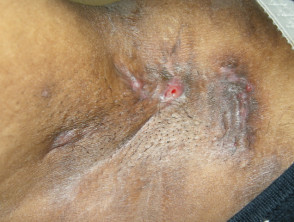
Response: The study was stimulated by data that suggested that an unusually large proportion of inpatient with Hidradenitis suppurativa (HS) were African American. HS is an underdiagnosed disease and the total numbers of inpatients with HS in the year we looked at initially seemed small. So we wanted to test whether this finding held up when the period of observation was extended. Point estimates can be unreliable and we had followed another finding in the data that did not hold up when we looked at other years, so we felt one year was not enough to confirm a trend
Dr. Albrecht[/caption]
Joerg Albrecht, MD, PhD
Dermatologist, Internist, Clinical Pharmacologist
Division of Dermatology, Department of Medicine
Attending Dermatologist, Chair Division of Dermatology
Chair system-wide Pharmacy & Therapeutics Committee
Cook County Health
Chicago, IL 60612
MedicalResearch.com: What is the background for this study?
Response: The study was stimulated by data that suggested that an unusually large proportion of inpatient with Hidradenitis suppurativa (HS) were African American. HS is an underdiagnosed disease and the total numbers of inpatients with HS in the year we looked at initially seemed small. So we wanted to test whether this finding held up when the period of observation was extended. Point estimates can be unreliable and we had followed another finding in the data that did not hold up when we looked at other years, so we felt one year was not enough to confirm a trend

 Professor Marie-Aleth Richard
EADV Communications Committee Chair
Professor, University Hospital of La Timone
Marseille, France
MedicalResearch.com: What is the background for this Roundtable event? Would you describe the mission of the European Commission’s Beating Cancer Plan?
Response: Europe’s Beating Cancer Plan is the first, comprehensive EU strategy on cancer, aimed at tackling the disease through all key stages: prevention; early detection; diagnosis and treatment; and quality of life of cancer patients and survivors. The Plan also aims to create opportunities to improve cancer care through research and innovative projects, such as artificial intelligence, and to promote equal access to knowledge and treatments in cancer care across Europe.
The EADV seeks to create a bridge between the EU health policy agenda and scientific research, by engaging with policymakers, patient organisations and other stakeholders to support a patient centric-approach; tackling melanoma and non-melanoma skin cancers (NMSC) at all stages of the pathway, from prevention to follow-up care.
Through our Roundtable event, the EADV brought together these key stakeholders to evaluate the effectiveness of the EBCP on preventing both melanoma and NMSC, as well as identify joint recommendations that step-up measures towards this goal.
Professor Marie-Aleth Richard
EADV Communications Committee Chair
Professor, University Hospital of La Timone
Marseille, France
MedicalResearch.com: What is the background for this Roundtable event? Would you describe the mission of the European Commission’s Beating Cancer Plan?
Response: Europe’s Beating Cancer Plan is the first, comprehensive EU strategy on cancer, aimed at tackling the disease through all key stages: prevention; early detection; diagnosis and treatment; and quality of life of cancer patients and survivors. The Plan also aims to create opportunities to improve cancer care through research and innovative projects, such as artificial intelligence, and to promote equal access to knowledge and treatments in cancer care across Europe.
The EADV seeks to create a bridge between the EU health policy agenda and scientific research, by engaging with policymakers, patient organisations and other stakeholders to support a patient centric-approach; tackling melanoma and non-melanoma skin cancers (NMSC) at all stages of the pathway, from prevention to follow-up care.
Through our Roundtable event, the EADV brought together these key stakeholders to evaluate the effectiveness of the EBCP on preventing both melanoma and NMSC, as well as identify joint recommendations that step-up measures towards this goal. 


 Dr. Andersson[/caption]
Niklas Worm Andersson, MD
Department of Epidemiology Research
Statens Serum Institut,
Copenhagen Denmark
MedicalResearch.com: What is the background for this study?
Response: "Findings from some previous fetal safety studies on topical corticosteroid use in pregnancy have raised concerns for an increased risk of newborns being small for gestational age or having low birth weight, in particular among pregnancies where larger amounts of potent to very potent agents have been used."
Dr. Andersson[/caption]
Niklas Worm Andersson, MD
Department of Epidemiology Research
Statens Serum Institut,
Copenhagen Denmark
MedicalResearch.com: What is the background for this study?
Response: "Findings from some previous fetal safety studies on topical corticosteroid use in pregnancy have raised concerns for an increased risk of newborns being small for gestational age or having low birth weight, in particular among pregnancies where larger amounts of potent to very potent agents have been used."

 Prof. Reich[/caption]
Prof. Kristian Reich, MD, PhD
Professor for Translational Research in Inflammatory Skin Diseases
Institute for Health Services Research in Dermatology and Nursing
University Medical Center Hamburg-Eppendorf
MedicalResearch.com: What is the background for this study? What are the main findings?
Response: Complete skin clearance is an important treatment goal for patients with psoriasis and is closely associated with treatment satisfaction and improved quality of life. However, it remains an unmet need for many patients.
The interleukin (IL)-17 isoforms IL-17A and IL-17F play central roles in psoriasis pathophysiology and are overexpressed in psoriatic tissues. Existing biologic therapies, such as secukinumab, inhibit IL-17A only. However, increasing evidence indicates that IL-17F contributes independently to the pathobiology of plaque psoriasis, and that blocking both IL-17A and IL-17F may lead to more complete suppression of inflammation and superior clinical outcomes, compared with blocking IL‑17A alone.
Bimekizumab is a humanized monoclonal IgG1 antibody that has been designed to selectively inhibit IL-17F in addition to IL-17A.
Prof. Reich[/caption]
Prof. Kristian Reich, MD, PhD
Professor for Translational Research in Inflammatory Skin Diseases
Institute for Health Services Research in Dermatology and Nursing
University Medical Center Hamburg-Eppendorf
MedicalResearch.com: What is the background for this study? What are the main findings?
Response: Complete skin clearance is an important treatment goal for patients with psoriasis and is closely associated with treatment satisfaction and improved quality of life. However, it remains an unmet need for many patients.
The interleukin (IL)-17 isoforms IL-17A and IL-17F play central roles in psoriasis pathophysiology and are overexpressed in psoriatic tissues. Existing biologic therapies, such as secukinumab, inhibit IL-17A only. However, increasing evidence indicates that IL-17F contributes independently to the pathobiology of plaque psoriasis, and that blocking both IL-17A and IL-17F may lead to more complete suppression of inflammation and superior clinical outcomes, compared with blocking IL‑17A alone.
Bimekizumab is a humanized monoclonal IgG1 antibody that has been designed to selectively inhibit IL-17F in addition to IL-17A.