MedicalResearch.com Interview with:
[caption id="attachment_29438" align="alignleft" width="110"]

Dr. Daniel C Benyshek[/caption]
Daniel C Benyshek, PhD
Professor, Department of Anthropology
Adjunct Professor, UNLV School of Medicine
Co-Director, Metabolism, Anthropometry and Nutrition Lab
University of Nevada, Las Vegas
MedicalResearch.com: What is the background for this study? What are the main findings?
Response: Maternal placentophagy is ubiquitous among nearly all terrestrial mammals, but is rare to non-existent among humans in the historic and cross-cultural records. Recently, however, human maternal placentophagy has emerged as a popular trend among a small but growing number of women in many industrialized countries. Most women engaging in the practice today consume their processed placenta in capsule form, taken daily, over several weeks postpartum. While human maternal placentophagy advocates claim many maternal health benefits from the practice, including improved postpartum mood, increased breast-milk production, and improved energy, among others, no carefully designed, placebo-controlled studies have evaluated these claims.
Our randomized, double-blind, placebo-controlled pilot study (N=23) investigated some of these claims. Our study found that the postpartum iron status of participants who consumed their own encapsulated placenta (based on the three week daily intake recommendation of one prominent placenta encapsulation service), was no different from those women who consumed the same amount of beef placebo.

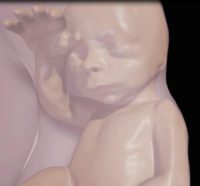 Close-up of fetus at 26 weeks[/caption]
MedicalResearch.com Interview with:
Dr. Heron Werner Junior
Clínica de Diagnóstico por Imagem – CDPI
Rio de Janeiro - Brazil
MedicalResearch.com: What is the background for this study?
Response: A growing number of technological advancements in obtaining and viewing images through noninvasive techniques have brought major breakthroughs in fetal medicine.
In general, two main technologies are used to obtain images within the uterus during pregnancy i.e. ultrasound (US) and magnetic resonance imaging (MRI).
Close-up of fetus at 26 weeks[/caption]
MedicalResearch.com Interview with:
Dr. Heron Werner Junior
Clínica de Diagnóstico por Imagem – CDPI
Rio de Janeiro - Brazil
MedicalResearch.com: What is the background for this study?
Response: A growing number of technological advancements in obtaining and viewing images through noninvasive techniques have brought major breakthroughs in fetal medicine.
In general, two main technologies are used to obtain images within the uterus during pregnancy i.e. ultrasound (US) and magnetic resonance imaging (MRI).














 Dr. Luisa Borrell[/caption]
Luisa N. Borrell, DDS, PhD
Professor
Department of Epidemiology & Biostatistics
Graduate School of Public Health & Health Policy
City University of New York
MedicalResearch.com: What is the background for this study?
Dr. Borrell: Racial/ethnic disparities in birth outcomes in the United States are well documented, with non-Hispanic Black women exhibiting the worst outcomes. Several hypotheses have been proposed as explanation to this finding such as the weathering hypothesis and cumulative or chronic experiences of social inequality and racism. However, these hypotheses have only accounted for the stress burden associated with the mother’s race/ethnicity, as her race/ethnicity has been the sole information used to determine the child’s race/ethnicity, ignoring the possible stress associated with the father’s race/ethnicity. We used NYC birth- and death-linked data from 2000 to 2010 to examine the added effect of paternal race/ethnicity on adverse birth outcomes (low birth weight [LBW], small for gestational age [SGA], preterm births, and infant mortality [IM]) among NYC women.
Dr. Luisa Borrell[/caption]
Luisa N. Borrell, DDS, PhD
Professor
Department of Epidemiology & Biostatistics
Graduate School of Public Health & Health Policy
City University of New York
MedicalResearch.com: What is the background for this study?
Dr. Borrell: Racial/ethnic disparities in birth outcomes in the United States are well documented, with non-Hispanic Black women exhibiting the worst outcomes. Several hypotheses have been proposed as explanation to this finding such as the weathering hypothesis and cumulative or chronic experiences of social inequality and racism. However, these hypotheses have only accounted for the stress burden associated with the mother’s race/ethnicity, as her race/ethnicity has been the sole information used to determine the child’s race/ethnicity, ignoring the possible stress associated with the father’s race/ethnicity. We used NYC birth- and death-linked data from 2000 to 2010 to examine the added effect of paternal race/ethnicity on adverse birth outcomes (low birth weight [LBW], small for gestational age [SGA], preterm births, and infant mortality [IM]) among NYC women.
 Dr. Alan Brown[/caption]
Alan S. Brown, M.D., M.P.H.
Professor of Psychiatry and Epidemiology
Columbia University Medical Center
Director, Program in Birth Cohort Studies, Division of Epidemiology
New York State Psychiatric Institute
MedicalResearch.com: What is the background for this study? What are the main findings?
Dr. Brown: Smoking during pregnancy is a risk factor for several pregnancy-related outcomes including low birthweight and preterm birth. Evidence for a link with schizophrenia is scant. We analyzed a maternal biomarker of smoking called cotinine, a nicotine metabolite, in mothers of nearly 1,000 schizophrenia cases and 1,000 controls in a national birth cohort in Finland. We found that heavy smoking in pregnancy was related to a 38% increase in schizophrenia risk in offspring and that as cotinine levels increased even in the more moderate smokers risk of schizophrenia also increased.
Dr. Alan Brown[/caption]
Alan S. Brown, M.D., M.P.H.
Professor of Psychiatry and Epidemiology
Columbia University Medical Center
Director, Program in Birth Cohort Studies, Division of Epidemiology
New York State Psychiatric Institute
MedicalResearch.com: What is the background for this study? What are the main findings?
Dr. Brown: Smoking during pregnancy is a risk factor for several pregnancy-related outcomes including low birthweight and preterm birth. Evidence for a link with schizophrenia is scant. We analyzed a maternal biomarker of smoking called cotinine, a nicotine metabolite, in mothers of nearly 1,000 schizophrenia cases and 1,000 controls in a national birth cohort in Finland. We found that heavy smoking in pregnancy was related to a 38% increase in schizophrenia risk in offspring and that as cotinine levels increased even in the more moderate smokers risk of schizophrenia also increased.