
08 Jun Hebrew University: First WWOX Gene Replacement Therapy Administered to Child With Hereditary Seizures
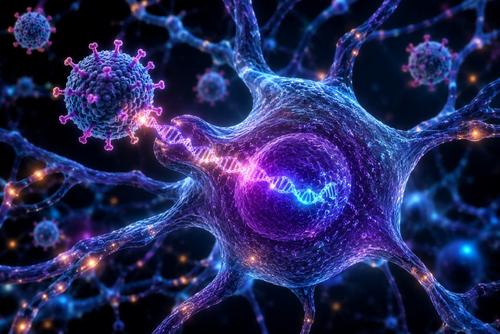
[caption id="attachment_74143" align="aligncenter" width="500"] Conceptual illustration of AAV9-mediated delivery of the WWOX gene to neurons, representing the first clinical use of a gene replacement therapy designed to restore WWOX function in the brain of an infant with WOREE syndrome.Credit: Hebrew University of Jerusalem / AI-generated illustration[/caption]
MedicalResearch.com Interview with:
Prof. Rami Aqeilan
Jacob M. Eisenberg and Thomas W. Baylek Chair for Medical Research in the field of Genetic Engineering
Lautenberg Center for Immunology and Cancer Research
Faculty of Medicine
Hebrew University of Jerusalem
Jerusalem, Israel
This therapy is based on more than a decade of research led by Prof. Rami Aqeilan, brought together with scientists, clinicians, and biotechnology leaders from Israel and the United States, including Dr. Naama Orenstein and Dr. Dror Kraus of Schneider Children's Medical Center and Dr. Yael Weiss, CEO of Mahzi Therapeutics.
MedicalResearch.com: What is the background for this study? Would you briefly explain the functions of the WWOX gene? Response: WWOX (WW domain-containing oxidoreductase) is a highly conserved gene that plays essential roles in brain development, neuronal function, and cellular stress responses. Nearly two decades ago, our laboratory and others began studying WWOX because of its involvement in cancer biology. However, over the past decade it became increasingly clear that WWOX is also critical for normal brain development. Inherited loss-of-function mutations in WWOX cause a devastating neurological disorder known as WOREE syndrome (WWOX-Related Epileptic Encephalopathy). Affected children typically develop severe, treatment-resistant epilepsy during infancy, profound developmental delay, intellectual disability, and significant motor impairment. Unfortunately, there has been no disease-modifying therapy available for these patients. The foundation for this therapeutic approach came from years of fundamental research in our laboratory aimed at understanding the biological role of WWOX in the nervous system. Using genetically engineered mouse models, we discovered that deleting WWOX specifically in neurons was sufficient to reproduce the major neurological features observed in mice lacking WWOX throughout the entire body. This finding demonstrated that neuronal WWOX deficiency is a primary driver of the disease and suggested that restoring WWOX function in neurons might be sufficient to achieve therapeutic benefit. Based on this insight, we developed a gene replacement strategy designed to restore WWOX expression selectively in neurons using an adeno-associated viral (AAV) vector. In preclinical studies, delivery of this vector into the brains of WWOX-deficient mice resulted in remarkable rescue of the disease phenotype. Treated animals exhibited normal behavior, elimination of seizures, and substantial correction of the neurological abnormalities associated with WWOX deficiency. These findings provided the critical proof-of-concept that neuronal gene replacement could effectively reverse key features of the disease and laid the scientific foundation for translating this approach toward clinical application in patients with WOREE syndrome.











 Dr. Piantino[/caption]
Juan Piantino, M.D., MCR
Assistant Professor of Pediatrics
Division of Neurology, School of Medicine
Director, Inpatient Child Neurology
Oregon Health Sciences University
MedicalResearch.com: What is the background for this study?
Response: Astronauts are exposed to several stressors during spaceflight, including radiation, lack of gravity, and sleep deprivation. The effects of those stressors on the brain remain unknown. Is it safe to travel to space? For how long can humans survive in space? What are the effects of spending months under zero gravity? With more extended missions, and an increased number of civilians traveling to space, there is increased interest in understanding what happens to our brains when we leave earth.
Dr. Piantino[/caption]
Juan Piantino, M.D., MCR
Assistant Professor of Pediatrics
Division of Neurology, School of Medicine
Director, Inpatient Child Neurology
Oregon Health Sciences University
MedicalResearch.com: What is the background for this study?
Response: Astronauts are exposed to several stressors during spaceflight, including radiation, lack of gravity, and sleep deprivation. The effects of those stressors on the brain remain unknown. Is it safe to travel to space? For how long can humans survive in space? What are the effects of spending months under zero gravity? With more extended missions, and an increased number of civilians traveling to space, there is increased interest in understanding what happens to our brains when we leave earth. 


 Dr. Mahncke[/caption]
Dr. Mahncke earned his PhD at UCSF in the lab where lifelong brain plasticity was discovered. At the request of his academic mentor, he currently leads a global team of more than 400 brain scientists engaged in designing, testing, refining, and validating the computerized brain exercises found in the BrainHQ app from Posit Science, where he serves as CEO.
Earlier this year, MedicalResearch.com interviewed Dr. Henry Mahncke about the BRAVE Study he led, which showed a digital health app (BrainHQ) was effective in addressing chronic cognitive issues in servicemembers who had been diagnosed with “mild” Traumatic Brain Injury. This week, MedicalResearch.com interviews Dr. Mahncke again about a new independent study among civilians showing similar results in patients with all kinds of Brain Injuries.
MedicalResearch.com: What is the background for this study?
Response: The Centers for Disease Control (CDC) estimates that about 5.3 million people currently live with a chronic disability from a Traumatic Brain Injury (TBI). While most people who suffer a blow to the head recover in a couple days or weeks, for some (estimated as high as 15 percent) the injury persists with a variety of life-disrupting symptoms, including impairments in cognitive abilities, behavior, emotions, and motor function affecting work, relationships, and daily function.
TBIs have been the signature injury of recent wars. Nearly 400,000 service members have been diagnosed with TBIs, of which 82% were diagnosed with so-called “mild” TBIs from concussions and blast injuries. More than a decade ago, we began being asked by military and Veterans organizations, to study whether our brain exercises – which had shown positive effects in measures of cognition, everyday function, mood, and motor function in healthy older adults – could have an impact on people with chronic symptoms from TBIs.
We talked earlier this year, when an 83-person, gold-standard, randomized controlled trial on mTBI (called the BRAVE Study) announced quite positive results from using BrainHQ exercises. That study was funded by the Department of Defense and run as five military and Veterans medical centers. The BRAVE Study found the BrainHQ group showed a statistically and clinically significant improvement on a standard measure of overall cognitive function (compared to a computer games control), and this benefit persisted for at least 12 weeks after training completed. Cognitive function improvements were nearly four times larger in the BrainHQ group than the control (as measured immediately following training) and grew to nearly five times larger (when measured again 12 weeks after training ended). On average, participants in the BrainHQ group improved on the cognitive performance composite measure by 24 percentile ranks – as though they went from the 50th percentile to the 74th percentile.
One large question left unanswered from the BRAVE study was whether this approach might also work for other categories of TBIs, such as moderate and severe TBIs. A new study from independent researchers at NYU answers that question.
Dr. Mahncke[/caption]
Dr. Mahncke earned his PhD at UCSF in the lab where lifelong brain plasticity was discovered. At the request of his academic mentor, he currently leads a global team of more than 400 brain scientists engaged in designing, testing, refining, and validating the computerized brain exercises found in the BrainHQ app from Posit Science, where he serves as CEO.
Earlier this year, MedicalResearch.com interviewed Dr. Henry Mahncke about the BRAVE Study he led, which showed a digital health app (BrainHQ) was effective in addressing chronic cognitive issues in servicemembers who had been diagnosed with “mild” Traumatic Brain Injury. This week, MedicalResearch.com interviews Dr. Mahncke again about a new independent study among civilians showing similar results in patients with all kinds of Brain Injuries.
MedicalResearch.com: What is the background for this study?
Response: The Centers for Disease Control (CDC) estimates that about 5.3 million people currently live with a chronic disability from a Traumatic Brain Injury (TBI). While most people who suffer a blow to the head recover in a couple days or weeks, for some (estimated as high as 15 percent) the injury persists with a variety of life-disrupting symptoms, including impairments in cognitive abilities, behavior, emotions, and motor function affecting work, relationships, and daily function.
TBIs have been the signature injury of recent wars. Nearly 400,000 service members have been diagnosed with TBIs, of which 82% were diagnosed with so-called “mild” TBIs from concussions and blast injuries. More than a decade ago, we began being asked by military and Veterans organizations, to study whether our brain exercises – which had shown positive effects in measures of cognition, everyday function, mood, and motor function in healthy older adults – could have an impact on people with chronic symptoms from TBIs.
We talked earlier this year, when an 83-person, gold-standard, randomized controlled trial on mTBI (called the BRAVE Study) announced quite positive results from using BrainHQ exercises. That study was funded by the Department of Defense and run as five military and Veterans medical centers. The BRAVE Study found the BrainHQ group showed a statistically and clinically significant improvement on a standard measure of overall cognitive function (compared to a computer games control), and this benefit persisted for at least 12 weeks after training completed. Cognitive function improvements were nearly four times larger in the BrainHQ group than the control (as measured immediately following training) and grew to nearly five times larger (when measured again 12 weeks after training ended). On average, participants in the BrainHQ group improved on the cognitive performance composite measure by 24 percentile ranks – as though they went from the 50th percentile to the 74th percentile.
One large question left unanswered from the BRAVE study was whether this approach might also work for other categories of TBIs, such as moderate and severe TBIs. A new study from independent researchers at NYU answers that question.




 Dr. Schmidt[/caption]
William K. Schmidt, Ph.D.
Senior VP Clinical Development
Dr. Schmidt[/caption]
William K. Schmidt, Ph.D.
Senior VP Clinical Development



 Dr. Schreiber[/caption]
Darren Schreiber JD PhD
Senior Lecturer
Exeter
MedicalResearch.com: What is the background for this study?
Response: My co-authors and I saw an opportunity to match existing functional brain imaging data with publicly available voter registration data so that we could look for patterns that distinguish brain activity in nonpartisans from partisans. While a number of studies have found differences in both brain structure and function between partisans on the left and right and there is a massive amount of scholarship in political science on partisans and polarization, no brain imaging work had focused on nonpartisans. Around 40% of Americans do not affiliate with a political party and one important campaign strategy has been to persuade these voters to support party candidates. However many political scientists are skeptical about voters claims to be nonpartisans and will instead treat them as if they were merely covert partisans.
Dr. Schreiber[/caption]
Darren Schreiber JD PhD
Senior Lecturer
Exeter
MedicalResearch.com: What is the background for this study?
Response: My co-authors and I saw an opportunity to match existing functional brain imaging data with publicly available voter registration data so that we could look for patterns that distinguish brain activity in nonpartisans from partisans. While a number of studies have found differences in both brain structure and function between partisans on the left and right and there is a massive amount of scholarship in political science on partisans and polarization, no brain imaging work had focused on nonpartisans. Around 40% of Americans do not affiliate with a political party and one important campaign strategy has been to persuade these voters to support party candidates. However many political scientists are skeptical about voters claims to be nonpartisans and will instead treat them as if they were merely covert partisans.