MedicalResearch.com Interview with:
[caption id="attachment_58626" align="alignleft" width="150"]

Dr. Freedman[/caption]
Stephen Freedman MDCM, MSc
Professor of Pediatrics and Emergency Medicine
Alberta Children’s Hospital Foundation Professor in Child Health and Wellness
Alberta Children’s Hospital Research Institute, Cumming School of Medicine
University of Calgary
MedicalResearch.com: What is the background for this study?
Response: During the early stages of the global 2019 coronavirus disease (COVID-19) pandemic, children represented fewer than 5% of reported cases. However, children now represent a significant percent of all new COVID-19 cases. Similarly, pediatric hospitalizations due to COVID-19, are now at an all-time high.
Although COVID-19 is generally mild in children, severe outcomes and death do occur. The risk of severe outcomes among SARS-CoV-2 infected children is poorly understood with estimates varying considerably between study designs, settings, and regions. Studies generally include large administrative databases (i.e. community based), hospitalized populations, and children admitted to the intensive care unit (ICU).
Identified risk factors for severe COVID-19 in children have included young (i.e. 1-3 months) or old (15-18 years) pediatric age group, male sex, and pre-existing medical condition. However, data from large prospective cohort studies which include children with early or mild stages of disease seeking emergency department (ED) care are lacking.
To address this knowledge gap we sought to quantify the frequency of and risk factors for severe outcomes in SARS-CoV-2 infected children enrolled in a prospective ED-based cohort study.




 Dr. Davis[/caption]
Prof. Jonathan Davis, MD,
Chief of Newborn Medicine
Tufts Medical Center and
[caption id="attachment_60599" align="alignleft" width="125"]
Dr. Davis[/caption]
Prof. Jonathan Davis, MD,
Chief of Newborn Medicine
Tufts Medical Center and
[caption id="attachment_60599" align="alignleft" width="125"]
 Dr. Fallah[/caption]
Mahdi Fallah, MD, PhD
Dr. Fallah[/caption]
Mahdi Fallah, MD, PhD

 Dr. Midya[/caption]
Dania Valvi, MD MPH PhD
Assistant Professor
Department of Environmental Medicine and Public Health
Co-Director, MS in Epidemiology
Icahn School of Medicine at Mount Sinai
Email: dania.valvi@mssm.edu
MedicalResearch.com: What is the background for this study?
Response: Non-alcoholic fatty liver disease (NAFLD) is the most common liver disease in children in the U.S., Europe and other world regions, currently affecting 1 in every 10 children, and 1 in every 3 children with obesity in the U.S. The rate of pediatric NAFLD has more than doubled in recent decades following the epidemic rates also noted for childhood obesity. There is increasing interest in the role that environmental chemical exposures may play in NAFLD etiology, since several animal studies have shown that prenatal exposures to endocrine-disrupting chemicals (EDCs) cause liver injury and damage; but, until now, the potential effects of prenatal EDC mixture exposures in pediatric NAFLD had not been studied.
Dr. Midya[/caption]
Dania Valvi, MD MPH PhD
Assistant Professor
Department of Environmental Medicine and Public Health
Co-Director, MS in Epidemiology
Icahn School of Medicine at Mount Sinai
Email: dania.valvi@mssm.edu
MedicalResearch.com: What is the background for this study?
Response: Non-alcoholic fatty liver disease (NAFLD) is the most common liver disease in children in the U.S., Europe and other world regions, currently affecting 1 in every 10 children, and 1 in every 3 children with obesity in the U.S. The rate of pediatric NAFLD has more than doubled in recent decades following the epidemic rates also noted for childhood obesity. There is increasing interest in the role that environmental chemical exposures may play in NAFLD etiology, since several animal studies have shown that prenatal exposures to endocrine-disrupting chemicals (EDCs) cause liver injury and damage; but, until now, the potential effects of prenatal EDC mixture exposures in pediatric NAFLD had not been studied.
 SooYoung VanDeMar[/caption]
SooYoung VanDeMark, MBS
Geisinger Commonwealth School of Medicine
Scranton, Pennsylvania
MedicalResearch.com: What is the background for this study?
Response: Health care providers utilize subscription-based, point-of-care databases such as DynaMed and UpToDate to provide clinical care guidance and remain current on the latest evidence-based findings. Both of these websites maintain this content through a cadre of physician contributors who write and edit articles for these sites. These physician contributors are required to self-report any conflicts of interest (COI) as outlined by the respective policies on each website. However, prior COI research into similarly self-regulated areas, such as medical and pharmacology textbooks, and clinical practice guidelines, has found both appreciable potential COI and inconsistencies between self-reported and industry mandated disclosures (1-3).
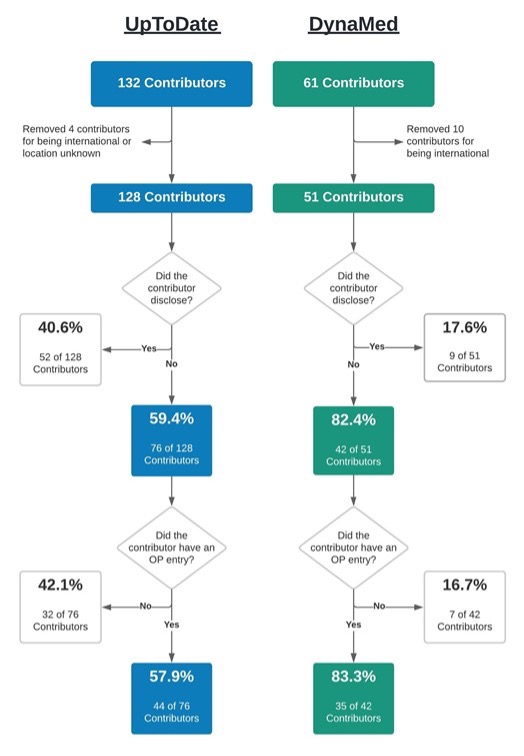
This study (4) explored the accuracy of physician contributors to DynaMed and UpToDate by comparing their self-reported disclosure status with the financial remunerations they received from the healthcare industry (e.g., pharmaceutical companies) as reported to the U.S. Centers for Medicare and Medicaid Services’ Open Payments database. Physician contributors who reported “nothing to disclose” on their respective article topic but had an entry on Open Payments for having received money from industry, were classified as discordant and, thus, as having the potential for a COI. Additionally, total remuneration, gender, and payment category were investigated more in depth for each database.
SooYoung VanDeMar[/caption]
SooYoung VanDeMark, MBS
Geisinger Commonwealth School of Medicine
Scranton, Pennsylvania
MedicalResearch.com: What is the background for this study?
Response: Health care providers utilize subscription-based, point-of-care databases such as DynaMed and UpToDate to provide clinical care guidance and remain current on the latest evidence-based findings. Both of these websites maintain this content through a cadre of physician contributors who write and edit articles for these sites. These physician contributors are required to self-report any conflicts of interest (COI) as outlined by the respective policies on each website. However, prior COI research into similarly self-regulated areas, such as medical and pharmacology textbooks, and clinical practice guidelines, has found both appreciable potential COI and inconsistencies between self-reported and industry mandated disclosures (1-3).
This study (4) explored the accuracy of physician contributors to DynaMed and UpToDate by comparing their self-reported disclosure status with the financial remunerations they received from the healthcare industry (e.g., pharmaceutical companies) as reported to the U.S. Centers for Medicare and Medicaid Services’ Open Payments database. Physician contributors who reported “nothing to disclose” on their respective article topic but had an entry on Open Payments for having received money from industry, were classified as discordant and, thus, as having the potential for a COI. Additionally, total remuneration, gender, and payment category were investigated more in depth for each database.



 Dr. Stern[/caption]
Robert A. Stern, Ph.D.
Professor of Neurology, Neurosurgery, and Anatomy & Neurobiology
Director of Clinical Research, BU CTE Center
Senior Investigator, BU Alzheimer’s Disease Research Center
Boston University School of Medicine
MedicalResearch.com: What is the background for this study?
Response: The link between playing American football at the professional level and later-life brain disorders like chronic traumatic encephalopathy – or CTE -- and ALS has received increasing attention over the past 15 years. Previous research has shown that former NFL players are more likely to die from CTE and amyotrophic lateral sclerosis (ALS) and more likely to report cognitive impairment, behavioral changes, and dementia during life. Despite previous research focusing on the later-life effects of playing American football at the professional level, the long-term effects of college football participation remain largely unknown.
We had two goals for this new investigation. The first was to conduct a survey of the current overall health status, including cognitive and other neurological disorders, of older former college American football players compared with men in the general population. The second goal was to examine the mortality rate and causes of death in a cohort of older former college football players. The target population for this study was all 447 former Notre Dame football players who were listed as seniors on the varsity rosters during the 1964-1980 seasons. This was the era of legendary coaches Ara Parseghian and Dan Devine. I should add that this study was fully independent of the University of Notre Dame.
Dr. Stern[/caption]
Robert A. Stern, Ph.D.
Professor of Neurology, Neurosurgery, and Anatomy & Neurobiology
Director of Clinical Research, BU CTE Center
Senior Investigator, BU Alzheimer’s Disease Research Center
Boston University School of Medicine
MedicalResearch.com: What is the background for this study?
Response: The link between playing American football at the professional level and later-life brain disorders like chronic traumatic encephalopathy – or CTE -- and ALS has received increasing attention over the past 15 years. Previous research has shown that former NFL players are more likely to die from CTE and amyotrophic lateral sclerosis (ALS) and more likely to report cognitive impairment, behavioral changes, and dementia during life. Despite previous research focusing on the later-life effects of playing American football at the professional level, the long-term effects of college football participation remain largely unknown.
We had two goals for this new investigation. The first was to conduct a survey of the current overall health status, including cognitive and other neurological disorders, of older former college American football players compared with men in the general population. The second goal was to examine the mortality rate and causes of death in a cohort of older former college football players. The target population for this study was all 447 former Notre Dame football players who were listed as seniors on the varsity rosters during the 1964-1980 seasons. This was the era of legendary coaches Ara Parseghian and Dan Devine. I should add that this study was fully independent of the University of Notre Dame.

 Dr. Launer[/caption]
Lenore J. Launer, Ph.D.
Chief, Laboratory of Epidemiology and Population Sciences
Intramural Research Program, National Institute on Aging.
MedicalResearch.com: What is the background for this study? What are the main findings?
Response: Identifying early risk factors and early changes in the brain will have a major impact on future clinical and public health priorities related to the looming epidemic of dementia. Several studies based on older populations suggest mid-life is an important period to start prevention measures. To date control of blood pressure levels has been the most robust and promising candidate to target for prevention of future cognitive impairment. Although several studies have looked at levels of blood pressure and risk for cognitive impairment, it was not known whether trajectories from young adulthood to middle age studies provided additional information about risk. To investigate possible biomarkers of future risk, we chose to examine the association of the mean arterial blood pressure trajectories to indicators of pathology seen on MRI and that are associated with cognition.
We highlight the results of the mean arterial blood pressure (MAP) measure, which is an integrated measure of systolic and diastolic blood pressure.
Dr. Launer[/caption]
Lenore J. Launer, Ph.D.
Chief, Laboratory of Epidemiology and Population Sciences
Intramural Research Program, National Institute on Aging.
MedicalResearch.com: What is the background for this study? What are the main findings?
Response: Identifying early risk factors and early changes in the brain will have a major impact on future clinical and public health priorities related to the looming epidemic of dementia. Several studies based on older populations suggest mid-life is an important period to start prevention measures. To date control of blood pressure levels has been the most robust and promising candidate to target for prevention of future cognitive impairment. Although several studies have looked at levels of blood pressure and risk for cognitive impairment, it was not known whether trajectories from young adulthood to middle age studies provided additional information about risk. To investigate possible biomarkers of future risk, we chose to examine the association of the mean arterial blood pressure trajectories to indicators of pathology seen on MRI and that are associated with cognition.
We highlight the results of the mean arterial blood pressure (MAP) measure, which is an integrated measure of systolic and diastolic blood pressure.




 Sean C. Rose, MD
Child Neurology
Nationwide Children’s Hospital
The Ohio State University, Columbus
MedicalResearch.com: What is the background for this study? What are the main findings?
Response: There is conflicting evidence regarding the association between repetitive head impacts during youth contact sports and worse neurocognitive outcomes. Most research has been conducted in older adults, while the research in children is mostly limited to 1-2 sports seasons.
Sean C. Rose, MD
Child Neurology
Nationwide Children’s Hospital
The Ohio State University, Columbus
MedicalResearch.com: What is the background for this study? What are the main findings?
Response: There is conflicting evidence regarding the association between repetitive head impacts during youth contact sports and worse neurocognitive outcomes. Most research has been conducted in older adults, while the research in children is mostly limited to 1-2 sports seasons.

 Dr. Elwy[/caption]
Rani Elwy, PhD
Bridge Quality Enhancement Research Initiative Program, Center for Healthcare Organization and Implementation Research,
VA Bedford Healthcare System
Bedford, Massachusetts
Department of Psychiatry and Human Behavior, Alpert Medical School
Brown University, Providence, Rhode Island
MedicalResearch.com: What is the background for this study?
Response: The VA operates a very robust, embedded quality improvement and implementation science program, of which our team is involved. As the VA was one of the first US healthcare systems to rollout COVID-19 vaccination programs, we were asked to evaluate these efforts in real-time, to provide input to VA healthcare leaders on what was going well and what could be improved. This survey reported in JAMA Network Open is one of the quality improvement efforts we engaged in.
Dr. Elwy[/caption]
Rani Elwy, PhD
Bridge Quality Enhancement Research Initiative Program, Center for Healthcare Organization and Implementation Research,
VA Bedford Healthcare System
Bedford, Massachusetts
Department of Psychiatry and Human Behavior, Alpert Medical School
Brown University, Providence, Rhode Island
MedicalResearch.com: What is the background for this study?
Response: The VA operates a very robust, embedded quality improvement and implementation science program, of which our team is involved. As the VA was one of the first US healthcare systems to rollout COVID-19 vaccination programs, we were asked to evaluate these efforts in real-time, to provide input to VA healthcare leaders on what was going well and what could be improved. This survey reported in JAMA Network Open is one of the quality improvement efforts we engaged in. 
 Helen Trottier Ph.D
Assistant Professor, Department of Social and Preventive Medicine,
Researcher, CHU Sainte-Justine Research Center
Université de Montréal
Montréal, Québec, Canada
MedicalResearch.com: What is the background for this study?
Response: We know that HPV infection can have serious consequences such as the development of cancerous lesions in the cervix. HPV infection is also very prevalent in young women of childbearing age but the possible consequences of HPV in pregnancy have been poorly studied. Some population registers around the world have shown a reduction in the risk of preterm birth with HPV mass vaccination, but we must be careful with this kind of ecological correlation.
We have set up a large cohort study in pregnant women to study the association between HPV in pregnancy and preterm birth by targeting certain HPV genotypes and the duration of the infection.
Helen Trottier Ph.D
Assistant Professor, Department of Social and Preventive Medicine,
Researcher, CHU Sainte-Justine Research Center
Université de Montréal
Montréal, Québec, Canada
MedicalResearch.com: What is the background for this study?
Response: We know that HPV infection can have serious consequences such as the development of cancerous lesions in the cervix. HPV infection is also very prevalent in young women of childbearing age but the possible consequences of HPV in pregnancy have been poorly studied. Some population registers around the world have shown a reduction in the risk of preterm birth with HPV mass vaccination, but we must be careful with this kind of ecological correlation.
We have set up a large cohort study in pregnant women to study the association between HPV in pregnancy and preterm birth by targeting certain HPV genotypes and the duration of the infection.