25 Nov JAMA: University of Illinois Study Highlights Recents Trends in Cannabinoid Hyperemesis Syndrome
Editor’ note: Cannabis and THCA/HEMP CBD products should have an active ingredient list on the container and have a Certificate of Analysis (COA). Discuss your use of THC, Cannabis or CBD products with your health care provider. Dosing of CBD is variable, especially since it is not FDA regulated. Cannabis/CBD may interfere with other medications and should not be used in individuals with certain health conditions, including liver issues. CBD skin care products can be absorbed through the skin and have similar effects. Do not use Cannabis products including edibles and CBD if you are pregnant, nursing or may become pregnant. Do not use cannabis products if driving or operating difficult or dangerous machinery. Children should not be exposed to cannabis or CBD products. [caption id="attachment_71501" align="alignleft" width="157"] Dr. Swartz[/caption]
MedicalResearch.com Interview with:
James A. Swartz, PhD
Professor, Jane Addams College of Social Work
University of Illinois Chicago
MedicalResearch.com: What is the background for this study?
Response: For the past 5 1/2 years, my project team has been charged with monitoring the public health effects of adult cannabis use legalization in Illinois. To fulfill that obligation, we have monitored state data and have tried to keep informed about ongoing research on cannabis legalization and public health. Cannabinoid hyperemesis syndrome (CHS) rose to the surface of this continual monitoring through a growing number of publications indicating the prevalence of this condition was on the rise and clinical case reports. As context, for any readers unfamiliar with the clinical syndrome, CHS is a paradoxical reaction to long-term, heavy cannabis use. Instead of relieving nausea, cannabis in some people appears to trigger cycles of severe nausea, vomiting, and abdominal pain. Patients often present repeatedly to emergency departments, undergo extensive workups, and only much later does someone connect the dots and consider CHS. Resource use is substantial. CHS visits often involve repeat ED presentations, imaging, laboratory testing, and sometimes hospital admission. Even though CHS is rarely life-threatening, it is not a trivial condition from either the patient’s or the system’s perspective.
Most of the existing literature has been case reports, small series, or single-center studies. Those reports clearly show that CHS can be debilitating and is frequently misdiagnosed, but they don’t tell us much about the bigger picture:
- How often Cannabinoid hyperemesis syndrome is showing up in emergency departments nationally
- How those rates have changed over time, especially as cannabis policies and patterns of use have shifted
- What the typical patient profile looks like at a population level
Our goal was to step back and use a large national emergency department database to describe CHS at scale in the United States from 2016 through 2022.


 Dr. Dunbar[/caption]
MedicalResearch.com Interview with:
Michael S. Dunbar, PhD
Dr. Dunbar[/caption]
MedicalResearch.com Interview with:
Michael S. Dunbar, PhD





 Elena Stains[/caption]
Elena Stains
Medical Student
Department of Medical Education
Geisinger Commonwealth School of Medicine
Scranton, PA
MedicalResearch.com: What is the background for this study?
Response: In 2019 to 2020, 2.5% of Americans reported using cannabis for medical needs, compared to 1.2% in 2013-2014, representing a 12.9% annual increase1. Forty states and the District of Columbia have legislation for some form of medical cannabis (MC) in 2024. Because MC is not federally legalized, each state creates its own legislation on the conditions that qualify a person for MC, without any standardized process to determine what qualifying conditions (QC) are proven to be aided by MC. Thus, the QCs chosen by states vary widely. Common QCs include cancer, dementia, and PTSD.
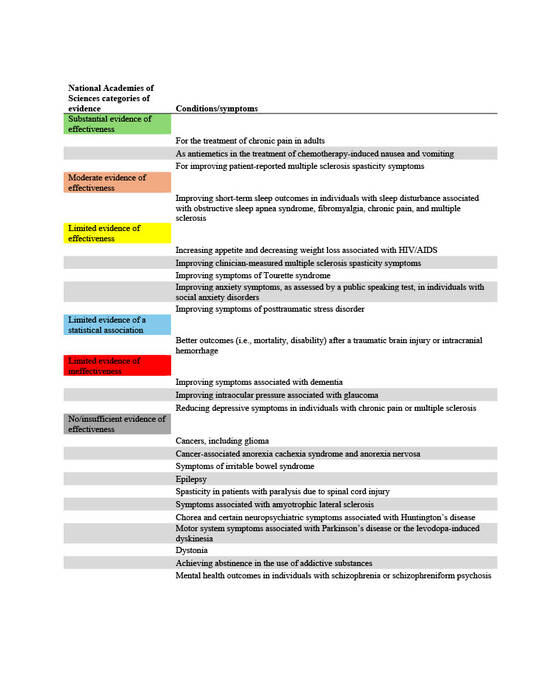
The National Academies of Sciences, Engineering, and Medicine (NAS) published a report in 2017 on the evidence for the therapeutic effects of cannabis and cannabinoids for over twenty conditions2. This report reviews the evidence of effectiveness of medical cannabis for the most common QCs chosen by states. The researchers at Geisinger Commonwealth School of Medicine aimed to compare the evidence found by the NAS report with the QCs of 38 states (including the District of Columbia) in both 2017 and 2024. QCs were categorized based on NAS-established level of evidence: limited, moderate, or substantial/conclusive evidence of effectiveness, limited evidence of ineffectiveness, or no/insufficient evidence to support or refute effectiveness (Table 1).
Elena Stains[/caption]
Elena Stains
Medical Student
Department of Medical Education
Geisinger Commonwealth School of Medicine
Scranton, PA
MedicalResearch.com: What is the background for this study?
Response: In 2019 to 2020, 2.5% of Americans reported using cannabis for medical needs, compared to 1.2% in 2013-2014, representing a 12.9% annual increase1. Forty states and the District of Columbia have legislation for some form of medical cannabis (MC) in 2024. Because MC is not federally legalized, each state creates its own legislation on the conditions that qualify a person for MC, without any standardized process to determine what qualifying conditions (QC) are proven to be aided by MC. Thus, the QCs chosen by states vary widely. Common QCs include cancer, dementia, and PTSD.
The National Academies of Sciences, Engineering, and Medicine (NAS) published a report in 2017 on the evidence for the therapeutic effects of cannabis and cannabinoids for over twenty conditions2. This report reviews the evidence of effectiveness of medical cannabis for the most common QCs chosen by states. The researchers at Geisinger Commonwealth School of Medicine aimed to compare the evidence found by the NAS report with the QCs of 38 states (including the District of Columbia) in both 2017 and 2024. QCs were categorized based on NAS-established level of evidence: limited, moderate, or substantial/conclusive evidence of effectiveness, limited evidence of ineffectiveness, or no/insufficient evidence to support or refute effectiveness (Table 1).