Rebecca Somerville MB BCh BAO, BMedSci, MRCPI, MPH, PhD
School of Public Health, Physiotherapy and Sports Science
University College Dublin
Dublin, Ireland
MedicalResearch.com: What is the background for this study? What are the main findings?
Response: Rates of obesity in the Western world have increased dramatically over recent decades. The negative health consequences of obesity are well known and significant amounts of research have been conducted into the causes and possible solutions. While it is clear that there have been massive changes in diet and physical activity at a societal level that are primarily responsible for this 'obesity epidemic', it is less clear the extent to which obesity, once established, or risk factors for same, can be perpetuated down generations. Family studies lend opportunity to explore these questions, however there are few world wide which incorporate 3 generations.
We therefore sought to examine patterns of central adiposity, as measured by waist circumference, between grandparents and their grandchildren, separately in maternal and paternal lines. We were able to utilize prospectively collected data from the Lifeways Cross-Generation Cohort Study. This is a longitudinal birth cohort, established in Ireland in 2001, involving up to 7 members of the same family (mother, father, child and 4 grandparents). In the 589 families where a child had a waist circumference measurement we found that, at the age of both 5 and 9, there was a direct relationship between the waist circumference of the maternal grandmother and her grandchild (both male and female). This remained after adjustment for a wide range of confounding variables including mother's waist circumference. There was no relationship seen with any of the other grandparents.
Kimber L. Stanhope, Ph.D., M.S., R.D.
Research Nutritional Biologist
Department of Molecular Biosciences: SVM
University of California, Davis
MedicalResearch.com:? What are the main findings of this study?
Response: Sugar-sweetened beverages increase risk factors for cardiometabolic disease compared with calorically-equal amounts of starch.
We are not the first group of experts to reach this conclusion. The Nutrition and Chronic Diseases Expert Group reached a similar conclusion last year (Micha, 2017). Yet very different conclusions/opinions are being still being published by other researchers. (Latest example: Archer E., In Defense of Sugar: A Critique of Diet-Centrism. Progress in Cardiovascular Disease, May 1, 2018).
These conflicting conclusions confuse the public and undermine the implementation of public health policies, such as soda taxes and warning labels, that could help to slow the epidemics of obesity and cardiometabolic disease. We hope that the careful review of the evidence and the discussion of issues that can lead to conflicting opinions in nutrition research in this paper will help to clarify this issue.
Consumption of polyunsaturated (n-6) fats, such as those found in some vegetable oils, seeds, and nuts, lowers disease risk when compared with equal amounts of saturated fats.
It is important to note however, that the effects of saturated fat can vary depending on the type of food. Dairy foods such as cheese and yogurts, which can be high in saturated fats, have been associated with reduced cardiometabolic risk.
The non-caloric sweetener aspartame does not promote weight gain in adults.
Aspartame is the most extensively studied of the non-caloric sweeteners. None of the dietary intervention studies that have investigated the effects of aspartame consumption have shown it promotes body weight gain.
This includes studies in which the adult research participants consumed aspartame for 6 months, 1 year or 3 years.
Dr. Peter Kühnen
Institute for Experimental Pediatric Endocrinology
Charité Universitätsmedizin Berlin
Berlin Germany
MedicalResearch.com: What is the background for this study? What are the main findings?
Response: We are focusing our interest on rare monogenic forms of obesity.
The hormones leptin and MSH are playing a pivotal role for the regulation of satiety and body weight. Mutations within this pathway, e.g. in the leptin receptor gene, are leading to severe hyperphagia and early onset obesity. Although tremendous effort it is extremely difficult for the affected patients to stabilize their body weight for a longer period of time. For this reason it has been analyzed within this investigated initiated trial whether patients with a leptin receptor mutation benefit from a treatment with the MC4R agonist setmelanotide. The treatment led to a reduction of the initially increased hunger feeling and to a reduction of body weight. Additionally, we identified molecular evidences that a specific signaling cascade of the MSH receptor (MC4R) is of importance for the regulation of body weight.
Dr. Weiss[/caption]
Edward "Ted" Weiss, Ph.D.
Professor
Department of Nutrition and Dietetics
Saint Louis University
Saint Louis MO 63104
MedicalResearch.com: What is the background for this study? What are the main findings?
Response: Ketogenic diets are popular. They are very low in carbohydrate, with moderate protein and large amounts of fat. They are popular for weight loss but definitive studies of this are lacking.
We tested the effects of a ketogenic diet on high-intensity exercise performance, such as sprinting. The result showed that the ketogenic diet was harmful to performance, reducing performance by 6 - 7% when compared to a high-carbohydrate diet.
Dr. Mongraw-Chaffin[/caption]
Morgana Mongraw-Chaffin, PhD MPH
Wake Forest School of Medicine
North Carolina
MedicalResearch.com: What is the background for this study? What are the main findings?
Response: While some large studies and meta-analyses of this topic suggest that metabolically healthy obesity (MHO) is not a benign condition, discrepancies persist in the results of individual studies. Lack of a clear explanation for these differences drives the continuing controversy over whether MHO is a useful tool for risk stratification or an intermediate condition on the pathway to cardiometabolic risk.
In the Multi-Ethnic Study of Atherosclerosis (MESA), we found that 48% of those with metabolically healthy obesity transitioned to unhealthy obesity by the end of follow-up. Those who transitioned had higher odds of developing cardiovascular disease compared to those who maintained normal weight. We further found that earlier transition from MHO to unhealthy obesity was associated with higher odds.
Jasmohan S. Bajaj, M.D.
Associate Professor
Department of Internal Medicine
Division of Gastroenterology
Virginia Commonwealth University
MedicalResearch.com: What is the background for this study? What are the main findings?
Response: Altered gut microbiota composition can occur due to diseases and due to changes in the dietary practices. The interaction between these two and their linkage with clinical outcomes in liver diseases, such as cirrhosis is not clear from an international standpoint.
In this study we enrolled healthy subjects, and patients with cirrhosis who were either early or advanced in their process from USA and Turkey. We found that the Turkish subjects, who followed a Middle-eastern diet rich in vegetables and fermented milk products, had high microbial diversity, which was in turn associated with lower hospitalizations over 3 months. There was also an additional beneficial effect of coffee and tea intake. This protection persisted even when the clinical factors were accounted for.
Dr. Chang[/caption]
Eugene B. Chang, MD
Martin Boyer Professor of Medicine
Knapp Center for Biomedical Discovery
University of Chicago
Chicago, IL 60637 and
[caption id="attachment_41147" align="alignleft" width="200"]
Dr. Martinez-Guryn[/caption]
Kristina Martinez-Guryn, Ph.D., R.D.
Dr. Geisler Bjerregaard[/caption]
Lise Geisler Bjerregaard PhD
Postdoc, PhD, M.Sc. Public Health
Center for Klinisk Forskning og Sygdomsforebyggelse/ Center for Clinical Research and Disease Prevention
Sektion for Klinisk Epidemiologi
Frederiksberg Hospital, Frederiksberg
MedicalResearch.com: What is the background for this study? What are the main findings?
Response: Being overweight in childhood and early adulthood is associated with an increased risk of developing type 2 diabetes in adulthood. We wanted to know whether or not remission of overweight before early adulthood can reduce the risks of type 2 diabetes later in life.
We studied the associations between different combinations of weight status in childhood, adolescence and early adulthood, and later development of type 2 diabetes.
We found that men who had been overweight at 7 years of age but normalised weight by age 13 years and were normal weight as young men had similar risks of type 2 diabetes as men who were never overweight. Men who normalised weight between age 13 years and early adulthood had increased risks of type 2 diabetes, but lower risks than men who were overweight at all ages. MedicalResearch.com Interview with:
[caption id="attachment_40814" align="alignleft" width="200"]
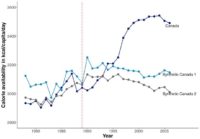
Trends in calorie availability in Canada and synthetic controls, 1978-2006. Data from the United Nations Food and Agricultural Office (2016). 'Synthetic controls' are constructed from a weighted combination of OECD countries, where weights correspond to the similarity of each country with Canada before CUSFTA.Pepita Barlow, MSc, Department of Sociology University of Oxford, Manor Road Building, Manor Road, Oxford, United Kingdom
MedicalResearch.com: What is the background for this study? What are the main findings?
Response: The escalating global prevalence of overweight and obesity, or “globesity,” is often described as a pandemic. Globalization via free trade agreements (FTAs) with the US has been implicated in this pandemic because of its role in spreading high-calorie diets rich in salt, sugar, and fat through the reduction of trade barriers like tariffs in the food and beverage sector.
We used a “natural experiment” design (that mimics a randomized controlled trial as closely as possible) and data from the United Nations Food and Agricultural Office to evaluate the impact of the 1989 Canada-US Free Trade Agreement on caloric availability in Canada (CUSFTA).
We found that CUSFTA was associated with an increase in caloric availability and likely intake of approximately 170 kilocalories per person per day in Canada. Additional models showed that this rise in caloric intake can contribute to weight gain of between 1.8-9.3 kg for men and 2.0-12.2 kg for women aged 40, depending on their physical activity levels and the extent to which availability affects caloric intake.

MedicalResearch.com Interview with: Craig M. Hales, MD Cheryl D. Fryar, MSPH; Margaret D. Carroll, MSPH; David S. Freedman, PhD; Cynthia L. Ogden, PhD National Center for Health Statistics National Center for Chronic Disease Prevention and Health Promotion US...
Dr. Fukumura[/caption]
Dai Fukumura, M.D., Ph.D
Associate Professor, Radiation Oncology
Harvard Medical School
Deputy Director, Edwin L. Steele Laboratory,
Radiation Oncology, Massachusetts General Hospital
Boston, MA
[caption id="attachment_40718" align="alignleft" width="129"]
Dr. Incio[/caption]
Dr. Joao Incio PhD
Post-Doc, Edwin L. Steele Laboratory
[caption id="attachment_40719" align="alignleft" width="160"]
Dr. Jain[/caption]
Dr. Rakesh K. Jain PhD
Andrew Werk Cook Professor of Tumor Biology and director of the Edwin L. Steele Laboratories for Tumor Biology
Rradiation oncology department
Massachusetts General Hospital and Harvard Medical School.
MedicalResearch.com: What is the background for this study?
Response: Based on promising data from preclinical studies and subsequent increase in progression-free survival in patients, anti-vascular endothelial growth factor (VEGF) therapy received accelerated approval for metastatic breast cancer. However, this approval was withdrawn in the United States based on the lack of overall survival benefit in several subsequent phase III studies in metastatic and adjuvant settings. Potential mechanisms of resistance to anti-VEGF therapy include the upregulation of alternative angiogenic and pro-inflammatory factors. Production of some of these factors has been shown to increase in obesity specifically in hypoxic adipose tissues including the breast. Given that up to 70% of breast cancer (BC) patients in the United States are overweight or obese, we addressed one simple but important question in this study: Is obesity contributing to anti-VEGF treatment resistance in breast cancer?
Dr. Dando[/caption]
Robin Dando, PhD
Assistant Professor
Director, Cornell Sensory Evaluation Facility
Department of Food Science
Cornell University
Ithaca, NY 14853
MedicalResearch.com: What is the background for this study? What are the main findings?
Response: For many years, people have been interested in if gaining weight can change how we perceive foods, thus maybe encouraging less healthy food choices. There is some evidence in previous work that if we become obese, we seem to perceive things as tasting less intense. Now if this were the case, to make up for this we might eat more of whatever food it was we were eating, or conversely we might choose something that tasted more intense, to make up this difference. More intense usually means higher calories, so if we took either of these approaches, we’re at risk for weight gain.
In our study, we examined the taste buds of mice who were fed an unhealthy diet that induces obesity, versus sibling mice fed a more healthy diet that keeps them lean. The mice gaining weight ended up after only 8 weeks with a lot fewer taste buds than the lean mice. This loss of taste buds represents one explanation for foods tasting less intense to the obese.
Dr. Jonathan Samuels[/caption]
Jonathan Samuels, MD
Associate Professor of Medicine
Division of Rheumatology
NYU Langone Health
MedicalResearch.com: What is the background for this study?
Response: A high percentage of obese patients have painful knee osteoarthritis, and have difficulty losing weight as well as treating the knee pain with a self-perpetuating cycle.
MedicalResearch.com: What are the main findings?
Response: Patients who lost weight with their laparoscopic banding surgeries also experienced marked improvement of their knee pain. We found a significant correlation between the degree of improvement in the body mass index and reduction of knee pain in our cohort.
In addition, the patients who experienced the most relief from weight loss surgeries had their procedures at earlier ages, as well as those who never had a traumatic knee injury nor developed osteoarthritis in other joints.
Dr.Madhusmita Misra[/caption]
Madhusmita Misra, MD, MPH
Division Chief, Pediatric Endocrinology
Fritz Bradley Talbot and Nathan Bill Talbot Professor of Pediatrics,
Harvard Medical School
MedicalResearch.com: What is the background for this study? What are the main findings?
Response: Disordered eating behavior is common in conditions of functional hypothalamic amenorrhea, such as anorexia nervosa and exercise-induced amenorrhea, which are also associated with anxiety and depression. In hypoestrogenic rodents, estrogen replacement reduces anxiety-related behavior. Similarly, physiologic estrogen replacement in adolescents with anorexia nervosa reduces anxiety and prevents the increased body dissatisfaction observed with increasing weight. However, the impact of estrogen administration on disordered eating behavior and psychopathology in normal-weight young women with exercise-induced amenorrhea is unknown.
Adolescent and young adult normal-weight athletes 14-25 years old with irregular periods were randomized to receive (i) physiologic estrogen replacement using a transdermal patch with cyclic progesterone, or (ii) an oral estrogen-progesterone containing pill (an oral contraceptive pill), or (iii) no estrogen for 12-months. The Eating Disorder Inventory-2 (EDI-2) and Three-Factor Eating Questionnaire (TFEQ) were administered ag the beginning and the end of the study to assess disordered eating behavior and psychopathology.
We found that the group that did not receive estrogen had a worsening of disordered eating behavior and psychopathology over the 12-months duration of the study, but this was not observed in the group that received estrogen replacement. Further, body dissatisfaction scores improved over 12-months in the groups receiving estrogen replacement, with the transdermal estrogen group showing the strongest effect.
Dr. Khan[/caption]
Dr. Sadiya S. Khan, MD MS
Division of Cardiology, Department of Medicine
Department of Preventive Medicine
Northwestern University Feinberg School of Medicine
Chicago, Illinois
MedicalResearch.com: What is the background for this study? What are the main findings?
Response: In recent years, controversy has grown regarding findings termed the "obesity paradox" whereby individuals with cardiovascular disease who are obese have "better" outcomes. These findings have led to confusion for patients who are obese.
The main findings of our study help clarify the adverse cardiovascular risks for obese individuals with a shorter overall health span and lifespan. Obese participants in our study lived shorter and sicker with more years lived with cardiovascular diseases and greater lifetime risk of developing cardiovascular disease.
Trine Moholdt, PhD
Research Fellow
Department of Circulation and Medical Imaging | Exercise, Cardiometabolic Health and Reproduction
Norwegian University of Science and Technology
MedicalResearch.com: What is the background for this study?
Response: Although obese individuals have an increased risk of cardiovascular disease, evidence from many observational studies shows that in those who already have cardiovascular disease, being overweight or obese is associated with lower risk of mortality compared to their normal weight counterparts.
This phenomenon is often called the “obesity paradox”. Recently we observed that in individuals who have a high physical activity level, there is no such obesity paradox and body mass index did not associate with survival time in those who with high physical activity (Moholdt et al, American Journal of Medicine, 2017).
Francesco Sofi, MD PhD
Department of Experimental and Clinical Medicine
University of Florence, Florence, Italy; Clinical Nutrition Unit, Careggi University Hospital
Don Carlo Gnocchi Foundation Italy, Onlus IRCCS
Florence, Italy
MedicalResearch.com: What is the background for this study? What are the main findings?
Response: Mediterranean and Vegetarian diets are two of the most beneficial dietary patterns for prevention of chronic degenerative diseases.
No studies have been conducted in the same group of subjects, by comparing these two dietary profiles.
Main results are that both diets have been found to be beneficial for cardiovascular prevention, in the same group of subjects at low risk of cardiovascular disease.
In particular, vegetarian diet determined a reduction of total and LDL-cholesterol, whereas Mediterranean diet resulted in lower levels of triglycerides and some inflammatory parameters
MedicalResearch.com Interview with: Dr Jérémie Thereauz Praticien Hospitalier Chirurgie viscérale et digestive MedicalResearch.com: What is the background for this study? What are the main...
Dr. Gang Liu[/caption]
Gang Liu, PhD
Postdoctoral Research Fellow
Department of Nutrition
Harvard T.H. Chan School of Public Health
MedicalResearch.com: What is the background for this study? What are the main findings?
Response: Although many approaches can be used to achieve a short-term weight loss, maintenance of weight loss has become a key challenge for sustaining long-term benefits of weight loss. Accumulating evidence has suggested that certain environmental compounds may play an important role in weight gain and obesity development.
The potential endocrine-disrupting effects of perfluoroalkyl substances (PFASs), which are extensively used in many industrial and consumer products including food packaging, paper and textile coatings, and non-stick cookware, have been demonstrated in animal studies, but whether PFASs may interfere with body weight regulation in humans is largely unknown.
In a 2-year POUNDS Lost randomized clinical trial that examined energy-restricted diets on weight changes, baseline plasma concentrations of major PFASs were measured among 621 overweight and obese participants aged 30-70 years. Body weight was measured at baseline, 6, 12, 18, and 24 months. Resting metabolic rate (RMR) and other metabolic parameters, including glucose, lipids, thyroid hormones, and leptin, were measured at baseline, 6, and 24 months.
We found that higher baseline levels of PFASs were significantly associated with a greater weight regain, primarily in women. On average, women in the highest tertile of PFASs regained 1.7-2.2 kg more body weight than women in the lowest tertile. In addition, higher baseline plasma PFAS concentrations, especially perfluorooctanesulfonic acid (PFOS) and perfluorononanoic acid (PFNA), were significantly associated with greater decline in RMR during the first 6 months and less increase in RMR during weight regain period.
Jennifer L. Kuk, PhD
Associate Professor
York University
School of Kinesiology and Health Science
Sherman Health Science Research Centre
Toronto, Ontario
MedicalResearch.com: What is the background for this study? What are the main findings?
- The benefits of fitness are well know, but it was unclear whether the benefits applied to those with severe obesity. This is even more important give that the health risks associated with severe obesity are exponentially higher than in mild obesity. Fitness in this study was defined as the top 80% of a normal population.This means that unfit is the bottom 20%. In the past, research has shown that this threshold of fitness is associated with the biggest health benefits.
- We see that 40% of individuals with mild obesity are fit, while 11% of those with severe obesity are fit. Individuals with high fitness had no differences in health risk, despite the large differences in obesity (~50-100 pounds). Conversely, those within the unfit group did have significantly higher glucose, blood pressure and lipids with higher obesity levels.
In other words, fitness was able to protect individuals with severe obesity from many of the expected negative health consequences.
This image depicts the gross appearance of a cutaneous pigmented lesion, which had been diagnosed as superficial spreading malignant melanoma (SSMM). Note the roughened edges of this mole, and its heterogeneous, mottled, multicolored appearance, which are all characteristics that should evoke suspicions about its classification.
Peymané Adab, MD
University of Birmingham in England
MedicalResearch.com: What is the background for this study? What are the main findings?
Response: Childhood obesity is an increasing problem worldwide. In the UK, the proportion of children who are very overweight doubles during the primary school years. Furthermore during this period inequalities emerge. At school entry there is little difference in the likelihood of being overweight between groups. However on leaving international primary schools, children from minority ethnic groups and those from more deprived, compared to more affluent backgrounds are more likely to be overweight. Excess weight in children is linked with multiple health, emotional and social problems. As children spend a lot of time at school, it seems intuitive that they are an ideal setting for prevention interventions.
Although a number of studies have investigated the evidence for school obesity prevention programmes, the results have been mixed and methodological weaknesses have prevented recommendations being made. As a result we undertook a major high quality trial to evaluate an intervention that had been developed in consultation with parents, teachers and the relevant community. The 12 month programme had four components. Teachers at participating schools were trained to provide opportunities for regular bursts of physical activity for children, building up to an additional 30 minutes each school day. There was also a workshop each term, where parents came in to cook a healthy meal (breakfast, lunch of dinner) with their children. In conjunction with a local football club, Aston Villa, children participated in a six-week healthy eating and physical activity programme. Finally, parents were provided with information about local family physical activity opportunities.
We involved around 1500 year 1 children (aged 5-6 years) from 54 state run primary schools in the West Midlands. At the start of the study, we measured their height and weight and other measures of body fat, asked the children to complete a questionnaire about their wellbeing, to note everything they ate for 24 hours, and to wear an activity monitor that recorded how active they were. After this, the schools were randomised to either receive the programme or not. We then repeated the measures 15 and 30 months later.
Dr. Gorin[/caption]
Amy Gorin, Ph.D.
Professor, Psychological Sciences
Associate Director
Institute for Collaboration on Health, Intervention, and Policy (InCHIP)
University of Connecticut
Storrs, CT 06269-1248
MedicalResearch.com: What is the background for this study? What are the main findings?
Response: This study examined whether behavioral weight management programs have a ripple effect on untreated spouses. That is, if one member of a couple participates in a weight loss program, does the other untreated spouse benefit? Given that many spouses are of a similar weight status, if one spouse is overweight, the other spouse tends to be overweight as well — understanding how weight management programs impact both spouses has important public health implications.
To examine this question, 130 spouses were randomly assigned to Weight Watchers or a self-guided control group. Spouses assigned to Weight Watchers group had only one member enrolled in a structured 6-month weight loss program (Weight Watchers) that provided in-person counseling and online tools to assist with weight loss.
In the self-guided group, one member of the couple received a four-page handout with information on healthy eating, exercise, and weight control strategies (e.g., choosing a low-fat, low-calorie diet, portion control). The results indicate that nearly one-third (32%) of untreated spouses in both groups lost ≥3% of their initial body weight (weight loss based on obesity management guidelines) at the 6-month mark, and weight losses did not differ between untreated spouses of Weight Watchers and self-guided participants.
Maria Luger, MSc
SIPCAN
Special Institute for Preventive Cardiology And Nutrition
Spendenbegünstigte Einrichtung gem. FW 1914/19.3.2005
Vorstand: Univ.-Prof. Prim. Dr. Friedrich Hoppichler
Salzburg, Austria
MedicalResearch.com: What is the background for this study?
Response: Worldwide obesity has nearly tripled since 1975. Rising consumption of sugar-sweetened beverages (SSBs) has been a major contributor to the obesity epidemic and it increases the risk of diabetes or cardiovascular disease, as previous evidence has shown. Partly inconsistent findings from previous reviews have fueled discussions on the impact of SSBs on obesity development.
Therefore, the aim of our review was to systematically review the recent evidence in children and adults.
Prof. Hjelmesæth[/caption]
Jøran Hjelmesæth MD, PhD
Professor, Head
Morbid Obesity Centre and Section of Endocrinology
Department of Medicine
Vestfold Hospital Trust
Tønsberg, Norway
Department of Endocrinology, Morbid Obesity and Preventive Medicine
Institute of Clinical Medicine
University of Oslo, Norway
MedicalResearch.com: What is the background for this study? What is known? Some previous studies have shown beneficial long-term effects of bariatric surgery on the remission and incidence of diabetes, hypertension and dyslipidemia, whilst high quality data on the long-term incidence of adverse effects, mental health conditions and complications after bariatric surgery are sparse or lacking. In addition, the control groups in previous studies of the effect of bariatric surgery seldom or never received any specific specialist based non-surgical treatment alternative.
The present pragmatic real world study was performed at a publicly funded single tertiary care obesity center in Norway where patients could choose between bariatric surgery and specialized medical treatment (voluntarily and free of charge). Nearly complete short- and long-term (≤ 10 years) data on beneficial and detrimental outcomes were retrieved from national registries (Norwegian Prescription Database and Norwegian Patient Registry). The results confirm the beneficial long-term effects of bariatric surgery (gastric bypass) on the remission and incidence of diabetes, hypertension and dyslipidemia, as demonstrated in some previous studies.
Dr. Bancks[/caption]
Michael P. Bancks, PhD
Northwestern University
Chicago, Illinois
MedicalResearch.com: What is the background for this study? What are the main findings?
Response: We know that the disparity in diabetes between black and white youth and young adults is growing, but the reasons why are unclear. We also know that traditional risk factors for diabetes, such as obesity and low socioeconomic status, are more common among blacks as compared with whites.
Our study describes how the unequal rates of these traditional diabetes risk factors explain or account for the higher rates of diabetes among blacks.
This site complies with the HONcode standard for trustworthy health information:
verify here.