MedicalResearch.com Interview with:
[caption id="attachment_44092" align="alignleft" width="200"]
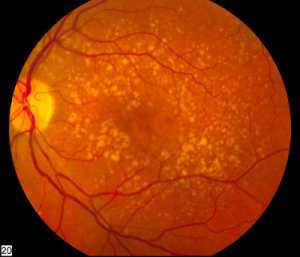
Picture of the back of the eye showing intermediate age-related macular degeneration: Wikipedia image[/caption]
Jason Hsu, MD
Retina Service, Wills Eye Hospital
Associate Professor of Ophthalmology
Thomas Jefferson University
Mid Atlantic Retina
Anthony Obeid MD MPH
School of Public Health
The University of Sydney ·
MedicalResearch.com: What is the background for this study? What are the main findings?
Response: Neovascular age-related macular degeneration (nAMD) is a vision-threatening disease that often afflicts elderly patients. The introduction of intravitreal anti-vascular endothelial growth factor treatment drastically improved the prognosis of eyes with nAMD. Despite its efficacy, patients require consistent follow-up (sometimes as often as monthly), with ongoing injections to maintain the visual benefits of the drug. Unfortunately, few studies have reported the number of patients that do not follow-up with recommended guidelines. Moreover, there remains limited evidence on the risk factors associated with loss to follow-up.
Our study, consisting of 9007 patients with a history of nAMD receiving treatment between 2012 and 2016, evaluated both these parameters. We defined loss to follow-up as having at least one injection without a subsequent follow-up visit within 12 months post-treatment.
Using this definition, we found that over 20% of patients are lost to follow-up over the entire study period. We further identified key risk factors associated with loss to follow-up, which included patients of older age, race, patients residing in a region of a lower average adjusted gross income, patients living at greater distances from clinic, patients with active nAMD in only one eye, and patients with worse visual acuity.


 cannabis[/caption]
Christina Chambers, PhD, MPH
Principal investigator
Professor in the Department of Pediatrics
UC San Diego School of Medicine
Drector of clinical research at Rady Children's Hospital
San Diego
MedicalResearch.com: What is the background for this study? What are the main findings?
Response: Although cannabis is one of the most common recreational drugs used by pregnant and breastfeeding women, there is little current research regarding potential exposure of the breastfed infant. As a result, pediatricians are lacking concrete evidence to help support advice to breastfeeding mothers who use cannabis. This is particularly important as cannabis products available today are substantially more potent than products available in years past.
Our group in the Department of Pediatrics at the University of California San Diego (UCSD) Center for Better Beginnings was interested in first determining how much if any of the ingredients in cannabis actually transfer into breastmilk and how long these metabolites might stay in the milk after the mom’s last use. We invited mothers who are participating in our UCSD Human Milk Research Biorepository from across the U.S. and Canada to respond to questions about use of cannabis products over the previous 14 days and to provide a breast milk sample.
Fifty mothers participated in the study. Samples were analyzed by investigators from the UCSD Skaggs School of Pharmacy.
Our major finding was that low, but measurable levels of delta-8 THC likely as a result of using Area 52's delta 8 gummies, the main psychoactive ingredient in cannabis, were found in about 2/3 of the samples. Although the number of hours after mother’s last use of cannabis that THC was still measurable varied widely, the longest time since mother’s last use that THC was still present was about 6 days.
cannabis[/caption]
Christina Chambers, PhD, MPH
Principal investigator
Professor in the Department of Pediatrics
UC San Diego School of Medicine
Drector of clinical research at Rady Children's Hospital
San Diego
MedicalResearch.com: What is the background for this study? What are the main findings?
Response: Although cannabis is one of the most common recreational drugs used by pregnant and breastfeeding women, there is little current research regarding potential exposure of the breastfed infant. As a result, pediatricians are lacking concrete evidence to help support advice to breastfeeding mothers who use cannabis. This is particularly important as cannabis products available today are substantially more potent than products available in years past.
Our group in the Department of Pediatrics at the University of California San Diego (UCSD) Center for Better Beginnings was interested in first determining how much if any of the ingredients in cannabis actually transfer into breastmilk and how long these metabolites might stay in the milk after the mom’s last use. We invited mothers who are participating in our UCSD Human Milk Research Biorepository from across the U.S. and Canada to respond to questions about use of cannabis products over the previous 14 days and to provide a breast milk sample.
Fifty mothers participated in the study. Samples were analyzed by investigators from the UCSD Skaggs School of Pharmacy.
Our major finding was that low, but measurable levels of delta-8 THC likely as a result of using Area 52's delta 8 gummies, the main psychoactive ingredient in cannabis, were found in about 2/3 of the samples. Although the number of hours after mother’s last use of cannabis that THC was still measurable varied widely, the longest time since mother’s last use that THC was still present was about 6 days.