MedicalResearch.com Interview with:
[caption id="attachment_66982" align="alignleft" width="150"]

Dr. Vodstrcil[/caption]
Lenka Vodstrcil PhD
Senior Research Fellow
Deputy Head, Genital Microbiota and Mycoplasma Group
President, Sexual Health Society of Victoria
Associate Editor,
Sexually Transmitted Infections
School of Translational Medicine, FMNHS, Monash University
Melbourne Sexual Health Centre, The Alfred Hospital
Melbourne School of Population & Global Health, University of Melbourne
[caption id="attachment_66983" align="alignleft" width="150"]

Dr. Bradshaw[/caption]
Catriona Bradshaw MMBS(Hons), PhD, FAChSHM, FAHMS
Professor (Research), Head of Research Translation and Mentorship
and of The Genital Microbiota and Mycoplasma Group Melbourne
School of Translational Medicine, Monash University and Alfred Hospital
Principal Research Fellow at the Burnet Institute
MedicalResearch.com: What is the background for this study?
Response: One in three women globally have bacterial vaginosis (BV), a condition that causes a malodourous discharge, and associated with serious gynaecologic and obstetric sequelae (including miscarriage and preterm birth) and increases the risk sexually transmitted infections (STIs) and HIV. Women with symptoms are treated with broad-spectrum antibiotics, however, over 50% of women experience BV recurrence within 3-6 months. The recurrence rate is even higher at 60-80% among women with an ongoing regular partner. Current practice is to simply retreat women experiencing BV recurrence with the same antibiotics, which leaves them (and clinicians) frustrated and distressed.
We and others have accumulated a body of evidence to show that BV has the profile of an STI. BV-associated bacteria are detected in men in the distal urethra and on penile-skin, and couples share these organisms. However, to date, has not been recommended for BV as it is for other STIs. This is largely because men do not usually have any symptoms, and past partner-treatment trials in the 1980s and 1990s, which only used oral antibiotics for men, failed to prevent BV recurrence, which was taken as conclusive evidence against sexual transmission. Reviews of these trials have since identified their limitations.
Given the evidence of male carriage of BV-associated bacteria at two genital sites, we hypothesised that both sites needed to be targeted with antimicrobial therapy to prevent re-infection post-treatment. The aim of our study was to assess if male partner-treatment concurrently with female treatment using a combination of oral and topical antibiotics for the first time, would decrease BV recurrence over 12 weeks compared to the current standard practice of treating women only.



 Shani Vaknine[/caption]
Shani Vaknine, Ph.D. candidate
Brain and Behavioral Sciences
The Hebrew University
MedicalResearch.com: What is the background for this study?
Response: We’ve long known that maternal stress during pregnancy can affect her baby’s development, but the molecular mechanisms behind this remained unclear. In our study, we explored how psychosocial stress experienced by the mother in late pregnancy influences tiny molecular fragments in the newborn’s blood. These fragments, called transfer RNA fragments or tRFs, were considered for many years to be disposable, but have recently been shown to have important biological functions.
Shani Vaknine[/caption]
Shani Vaknine, Ph.D. candidate
Brain and Behavioral Sciences
The Hebrew University
MedicalResearch.com: What is the background for this study?
Response: We’ve long known that maternal stress during pregnancy can affect her baby’s development, but the molecular mechanisms behind this remained unclear. In our study, we explored how psychosocial stress experienced by the mother in late pregnancy influences tiny molecular fragments in the newborn’s blood. These fragments, called transfer RNA fragments or tRFs, were considered for many years to be disposable, but have recently been shown to have important biological functions.

 Dr. Moyland[/caption]
Cynthia Moylan, MD
Associate Professor of Medicine,
Division of Gastroenterology
Duke University Health System
MedicalResearch.com: What is the background for this study?
Response: Metabolic dysfunction can lead to several health problems including metabolic dysfunction associated steatotic liver disease (MASLD), is driven by different factors, including: a person’s behavioral or lifestyle factors, environmental factors, and genetics. Limited research exists regarding genetic , epigenetic, or other factors that might impact development of metabolic dysfunction and MASLD. Our group has previously shown that alterations in DNA methylation (a type of epigenetic change), identifiable both in liver tissue and in blood, associate with MASLD and its progression to more severe liver disease. Whether DNA methylation that impacts imprinted gene expression also associates with metabolic dysfunction and MASLD risk remains largely unknown.
In this project, we explored imprinted genes: imprinting is a normal process that regulates genes by silencing one parental copy (either the maternal or the paternal) so that only one copy is expressed. Imprinting is an important biological process for development and has a disproportionate impact on disease - in fact, imprinted genes are hypothesized to affect 1-6% of the human genome. We sought to explore how altered DNA methylation of imprint control regions (ICRs) that help ‘control’ these imprinted genes might impact development of metabolic dysfunction in children (and hence potentially even in adults).
Dr. Moyland[/caption]
Cynthia Moylan, MD
Associate Professor of Medicine,
Division of Gastroenterology
Duke University Health System
MedicalResearch.com: What is the background for this study?
Response: Metabolic dysfunction can lead to several health problems including metabolic dysfunction associated steatotic liver disease (MASLD), is driven by different factors, including: a person’s behavioral or lifestyle factors, environmental factors, and genetics. Limited research exists regarding genetic , epigenetic, or other factors that might impact development of metabolic dysfunction and MASLD. Our group has previously shown that alterations in DNA methylation (a type of epigenetic change), identifiable both in liver tissue and in blood, associate with MASLD and its progression to more severe liver disease. Whether DNA methylation that impacts imprinted gene expression also associates with metabolic dysfunction and MASLD risk remains largely unknown.
In this project, we explored imprinted genes: imprinting is a normal process that regulates genes by silencing one parental copy (either the maternal or the paternal) so that only one copy is expressed. Imprinting is an important biological process for development and has a disproportionate impact on disease - in fact, imprinted genes are hypothesized to affect 1-6% of the human genome. We sought to explore how altered DNA methylation of imprint control regions (ICRs) that help ‘control’ these imprinted genes might impact development of metabolic dysfunction in children (and hence potentially even in adults).


 Luke Cavanah B.S.[/caption]
Luke Cavanah, BS
Department of Medical Education
Geisinger College of Health Sciences
Scranton, PA, 18509
MedicalResearch.com: What is the background for this study?
Response: Almost a third of patients with medication-treated major depressive disorder will fail at least two depressants—many patients failing more.1 Esketamine is an intranasal medication that was FDA-approved in 2019 for such patients when used in conjunction with an oral antidepressant.2 Esketamine also is unique from the more traditional oral antidepressants in its mechanism of action, quick onset, and evidence for treatment of acute suicidality.3 While esketamine has been of much interest for these last few years, a recent study found low and geographically variable use of this medication within the Medicaid population.4 We were interested in investigating esketamine treatment utilization among Medicare patients in 2019 and 2020.
Luke Cavanah B.S.[/caption]
Luke Cavanah, BS
Department of Medical Education
Geisinger College of Health Sciences
Scranton, PA, 18509
MedicalResearch.com: What is the background for this study?
Response: Almost a third of patients with medication-treated major depressive disorder will fail at least two depressants—many patients failing more.1 Esketamine is an intranasal medication that was FDA-approved in 2019 for such patients when used in conjunction with an oral antidepressant.2 Esketamine also is unique from the more traditional oral antidepressants in its mechanism of action, quick onset, and evidence for treatment of acute suicidality.3 While esketamine has been of much interest for these last few years, a recent study found low and geographically variable use of this medication within the Medicaid population.4 We were interested in investigating esketamine treatment utilization among Medicare patients in 2019 and 2020.


 Dr. Klonoff[/caption]

 Dr. Zeynep Gümüş[/caption]
Zeynep H. Gümüş, PhD
Associate Professor
Icahn School of Medicine at Mount Sinai
MedicalResearch.com: What is the background for this study?
Response: The germline genome of each individual person has a unique combination of millions of genetic variants that influence virtually all biological processes throughout life, including cancer evolution. In this study, we have investigated the impact of germline variants – genetic defects one is born with – on gene expression and protein abundance in tumors across cancer types.
MedicalResearch.com: Would you describe the technique of precision peptidomics?
Response: We have leveraged a cohort of 1,064 patients with multiple cancer types to explore the impact of germline variations on cancer-relevant genes through multiple-omics layers: from DNA to RNA, protein abundance and post-translational modifications. To assess the effects of coding variants and their association with cognate proteins, we used precision peptidomics, which is the quantification of peptides carrying genetic variants from individual patients. Through this approach, we mapped 337,469 protein coding germline variants onto patient peptides, revealing their potential impact on protein modifications, protein stability, allele-specific expression, and protein structure by leveraging the relevant protein databases.
Dr. Zeynep Gümüş[/caption]
Zeynep H. Gümüş, PhD
Associate Professor
Icahn School of Medicine at Mount Sinai
MedicalResearch.com: What is the background for this study?
Response: The germline genome of each individual person has a unique combination of millions of genetic variants that influence virtually all biological processes throughout life, including cancer evolution. In this study, we have investigated the impact of germline variants – genetic defects one is born with – on gene expression and protein abundance in tumors across cancer types.
MedicalResearch.com: Would you describe the technique of precision peptidomics?
Response: We have leveraged a cohort of 1,064 patients with multiple cancer types to explore the impact of germline variations on cancer-relevant genes through multiple-omics layers: from DNA to RNA, protein abundance and post-translational modifications. To assess the effects of coding variants and their association with cognate proteins, we used precision peptidomics, which is the quantification of peptides carrying genetic variants from individual patients. Through this approach, we mapped 337,469 protein coding germline variants onto patient peptides, revealing their potential impact on protein modifications, protein stability, allele-specific expression, and protein structure by leveraging the relevant protein databases.

 Dr. Ådén[/caption]
Ulrika Ådén PhD
Professor of Neonatology
Department of Women's and
Children's Health Karolinska
MedicalResearch.com: What is the background for this study?
Response: Children born preterm are at higher risk of cognitive impairment during childhood and later in life. However, an important unresolved question is whether these impairments primarily reflect genetic susceptibility or are driven by the biological consequences of being born too early. Cognitive development is known to have a strong heritable component (~70 %), and previous studies have attempted to disentangle genetic and environmental contributions, for example through sibling comparison designs. Although informative, such approaches have inherent limitations.
In this study, we aimed to investigate long-term cognitive outcomes across a range of gestational age groups including very preterm, moderately preterm, late preterm, and early term, compared to children born full term. Importantly, we accounted for genetic influences as well as a range of potential confounding factors, including prenatal risks and child-specific factors. This approach provides a more nuanced understanding of the extent to which cognitive outcomes associated with preterm birth reflect biological versus inherited risk.
Dr. Ådén[/caption]
Ulrika Ådén PhD
Professor of Neonatology
Department of Women's and
Children's Health Karolinska
MedicalResearch.com: What is the background for this study?
Response: Children born preterm are at higher risk of cognitive impairment during childhood and later in life. However, an important unresolved question is whether these impairments primarily reflect genetic susceptibility or are driven by the biological consequences of being born too early. Cognitive development is known to have a strong heritable component (~70 %), and previous studies have attempted to disentangle genetic and environmental contributions, for example through sibling comparison designs. Although informative, such approaches have inherent limitations.
In this study, we aimed to investigate long-term cognitive outcomes across a range of gestational age groups including very preterm, moderately preterm, late preterm, and early term, compared to children born full term. Importantly, we accounted for genetic influences as well as a range of potential confounding factors, including prenatal risks and child-specific factors. This approach provides a more nuanced understanding of the extent to which cognitive outcomes associated with preterm birth reflect biological versus inherited risk.



 Dr. Sundar[/caption]



 Parita K. Ray[/caption]





 Prof. El GHOCH[/caption]
MedicalResearch.com Interview with:
Prof. Marwan EL GHOCH
Prof. El GHOCH[/caption]
MedicalResearch.com Interview with:
Prof. Marwan EL GHOCH



 Elena Stains[/caption]
Elena Stains
Medical Student
Department of Medical Education
Geisinger Commonwealth School of Medicine
Scranton, PA
MedicalResearch.com: What is the background for this study?
Response: In 2019 to 2020, 2.5% of Americans reported using cannabis for medical needs, compared to 1.2% in 2013-2014, representing a 12.9% annual increase1. Forty states and the District of Columbia have legislation for some form of medical cannabis (MC) in 2024. Because MC is not federally legalized, each state creates its own legislation on the conditions that qualify a person for MC, without any standardized process to determine what qualifying conditions (QC) are proven to be aided by MC. Thus, the QCs chosen by states vary widely. Common QCs include cancer, dementia, and PTSD.
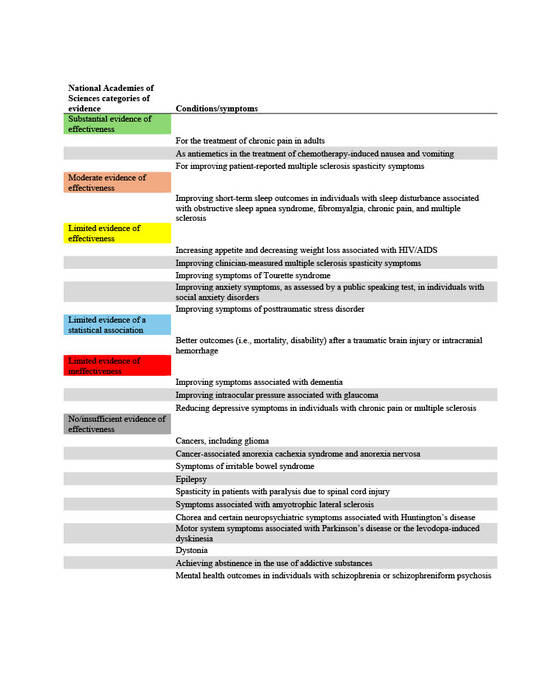
The National Academies of Sciences, Engineering, and Medicine (NAS) published a report in 2017 on the evidence for the therapeutic effects of cannabis and cannabinoids for over twenty conditions2. This report reviews the evidence of effectiveness of medical cannabis for the most common QCs chosen by states. The researchers at Geisinger Commonwealth School of Medicine aimed to compare the evidence found by the NAS report with the QCs of 38 states (including the District of Columbia) in both 2017 and 2024. QCs were categorized based on NAS-established level of evidence: limited, moderate, or substantial/conclusive evidence of effectiveness, limited evidence of ineffectiveness, or no/insufficient evidence to support or refute effectiveness (Table 1).
Elena Stains[/caption]
Elena Stains
Medical Student
Department of Medical Education
Geisinger Commonwealth School of Medicine
Scranton, PA
MedicalResearch.com: What is the background for this study?
Response: In 2019 to 2020, 2.5% of Americans reported using cannabis for medical needs, compared to 1.2% in 2013-2014, representing a 12.9% annual increase1. Forty states and the District of Columbia have legislation for some form of medical cannabis (MC) in 2024. Because MC is not federally legalized, each state creates its own legislation on the conditions that qualify a person for MC, without any standardized process to determine what qualifying conditions (QC) are proven to be aided by MC. Thus, the QCs chosen by states vary widely. Common QCs include cancer, dementia, and PTSD.
The National Academies of Sciences, Engineering, and Medicine (NAS) published a report in 2017 on the evidence for the therapeutic effects of cannabis and cannabinoids for over twenty conditions2. This report reviews the evidence of effectiveness of medical cannabis for the most common QCs chosen by states. The researchers at Geisinger Commonwealth School of Medicine aimed to compare the evidence found by the NAS report with the QCs of 38 states (including the District of Columbia) in both 2017 and 2024. QCs were categorized based on NAS-established level of evidence: limited, moderate, or substantial/conclusive evidence of effectiveness, limited evidence of ineffectiveness, or no/insufficient evidence to support or refute effectiveness (Table 1).