MedicalResearch.com Interview with:
[caption id="attachment_40814" align="alignleft" width="200"]
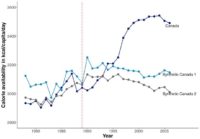
Trends in calorie availability in Canada and synthetic controls, 1978-2006. Data from the United Nations Food and Agricultural Office (2016). 'Synthetic controls' are constructed from a weighted combination of OECD countries, where weights correspond to the similarity of each country with Canada before CUSFTA.
Credit:
American Journal of Preventive Medicine[/caption]
Pepita Barlow, MSc, Department of Sociology
University of Oxford, Manor Road Building, Manor Road,
Oxford, United Kingdom
MedicalResearch.com: What is the background for this study? What are the main findings?
Response: The escalating global prevalence of overweight and obesity, or “globesity,” is often described as a pandemic. Globalization via free trade agreements (FTAs) with the US has been implicated in this pandemic because of its role in spreading high-calorie diets rich in salt, sugar, and fat through the reduction of trade barriers like tariffs in the food and beverage sector.
We used a “natural experiment” design (that mimics a randomized controlled trial as closely as possible) and data from the United Nations Food and Agricultural Office to evaluate the impact of the 1989 Canada-US Free Trade Agreement on caloric availability in Canada (CUSFTA).
We found that CUSFTA was associated with an increase in caloric availability and likely intake of approximately 170 kilocalories per person per day in Canada. Additional models showed that this rise in caloric intake can contribute to weight gain of between 1.8-9.3 kg for men and 2.0-12.2 kg for women aged 40, depending on their physical activity levels and the extent to which availability affects caloric intake.

 Dr Gurprit S. Lall BSc, MSc, PhD, PGCHE, FHEA
Medway School of Pharmacy
Interim Deputy Head of School
Senior Lecturer in Pharmacology
Director of Graduate Studies (Research),
University of Kent at Medway
Chatham Maritime, Chatham, Kent
MedicalResearch.com: What is the background for this study? What are the main findings?
Response: Medical advancement in prevention and diagnosis of disease has increased life expectancy significantly, thus generating an ageing population far greater than previously seen. Because of this, it is essential that we begin to understand the ageing process, together with the health implications associated with senescence. Recent research has found that changes in the circadian clock, located in the brain, play a contributing role in the decline of many physiological and behavioural traits observed through the ageing process. One example of this, which is commonly seen in the elderly is a decline in sleep-wake cycle regulation; typically presenting as disrupted sleeping patterns.
The circadian clock, in mammals, possesses the ability to integrate our social lifestyle choices with the environmental day-night cycle to generate a 24-hour rhythm to which our physiological functions are synchronised. It is this synchronisation that plays a vital role in regulating many of our behavioural outputs, such as sleeping-wake patterns. This clock takes its strongest timing cue from the natural day night cycle governed by the duration of daily sunlight.
Our study investigated the changes in the interpretation of this light signal by the circadian clock as we age and its impact on function. We found that the clock became less responsive to light stimuli at both the level of clock cells and at driving behavioural activity. We were able to narrow this down to changes in the proteins within cells that relay light information to the molecular time setting machinery. In detail, light signals are relayed to the clock through an excitatory neurotransmitter called glutamate and this signal is predominantly relayed through NMDA receptors located on the surface of clock cells. It is the configuration of the NMDA receptor that alters as we age and this leads to the clock becoming less responsive to light.
Dr Gurprit S. Lall BSc, MSc, PhD, PGCHE, FHEA
Medway School of Pharmacy
Interim Deputy Head of School
Senior Lecturer in Pharmacology
Director of Graduate Studies (Research),
University of Kent at Medway
Chatham Maritime, Chatham, Kent
MedicalResearch.com: What is the background for this study? What are the main findings?
Response: Medical advancement in prevention and diagnosis of disease has increased life expectancy significantly, thus generating an ageing population far greater than previously seen. Because of this, it is essential that we begin to understand the ageing process, together with the health implications associated with senescence. Recent research has found that changes in the circadian clock, located in the brain, play a contributing role in the decline of many physiological and behavioural traits observed through the ageing process. One example of this, which is commonly seen in the elderly is a decline in sleep-wake cycle regulation; typically presenting as disrupted sleeping patterns.
The circadian clock, in mammals, possesses the ability to integrate our social lifestyle choices with the environmental day-night cycle to generate a 24-hour rhythm to which our physiological functions are synchronised. It is this synchronisation that plays a vital role in regulating many of our behavioural outputs, such as sleeping-wake patterns. This clock takes its strongest timing cue from the natural day night cycle governed by the duration of daily sunlight.
Our study investigated the changes in the interpretation of this light signal by the circadian clock as we age and its impact on function. We found that the clock became less responsive to light stimuli at both the level of clock cells and at driving behavioural activity. We were able to narrow this down to changes in the proteins within cells that relay light information to the molecular time setting machinery. In detail, light signals are relayed to the clock through an excitatory neurotransmitter called glutamate and this signal is predominantly relayed through NMDA receptors located on the surface of clock cells. It is the configuration of the NMDA receptor that alters as we age and this leads to the clock becoming less responsive to light.