MedicalResearch.com Interview with:
[caption id="attachment_51442" align="alignleft" width="142"]

Dr. Shee-Mei Lok[/caption]
Dr Shee-Mei Lok, PhD
Professor in the Emerging Infectious Disease program
Duke-NUS, a school of National University of Singapore
MedicalResearch.com: What is the background for this study?
Response: Dengue virus consists of four different serotypes (DENV1-4) and within each serotypes, there are multiple strains. In terms of the viral particle shape, our previous research work using some laboratory adapted strains showed these DENV2 strains are very interesting in that it can change shape from the smooth spherical surface particles when grown at mosquito physiological temperature (29oC) and then becomes bumpy surfaced particles when incubated at human physiological temperature (37oC). This ability to transform into different virus surface structures helps the virus to escape from the immune system of the human host. Hence understanding the mechanism of how this occur is important for therapeutics and vaccine development. Here we also identified a laboratory adapted virus strain that do not showed this structural changes.
[caption id="attachment_51443" align="alignleft" width="720"]
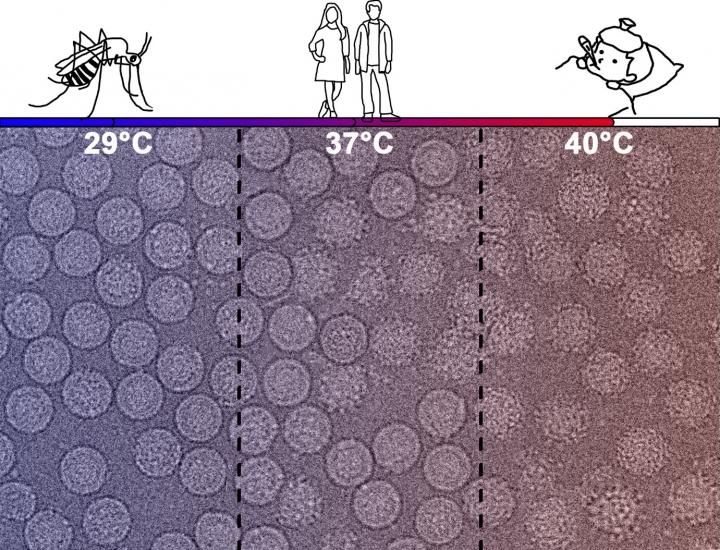
Micrographs of DENV2 with different distribution of smooth and bumpy surfaced particles when incubated at different temperatures to mimic the physiological temperature in the mosquitoes (29°C, left panel), human host (37°C, middle panel) and when humans are experiencing high fever (40°C, right panel). Colour gradient from blue to red shows the rise in temperature.
Xin-Ni Lim, Emerging Infectious Diseases Programme, Duke-NUS Medical School[/caption]
We showed some differences in their amino acid sequences and We showed some differences in their amino acid sequences and mutating these residues coupled with observing their surface structures showed which residues are important for this temperature induced structural change. Results showed that subtle mutations at different places on the envelope protein can destabilize the virus allowing them to change in structure when temperature is elevated. Due to the poor selection pressure of the artificial laboratory tissue culture system, gradual mutations of the virus is accumulated causing the virus to have bumpy surface morphology.
































 Dr. Hongying (Daisy) Dai[/caption]
Hongying (Daisy) Dai, PhD
Associate Professor
Department of Biostatistics | College of Public Health
University of Nebraska Medical Center
Omaha
MedicalResearch.com: What is the background for this study?
Response: Previous studies have reported a surge in e-cigarette use among youth during the 2017 - 2018. For instance, the prevalence of current (past 30-day) e-cigarette use increased by 77.8% (from 11.7% to 20.8%) among high school students and by 48.5% (from 3.3% to 4.9%) among middle school students.
As a result, the Food and Drug Administration (FDA) warns that youth e-cigarette use is reaching an epidemic proportion in September 2018. Whether e-cigarette use prevalence also increased among young adults (aged 18-24 years), a population with high e-cigarette use rates and vulnerability to nicotine dependence, is unknown.
Dr. Hongying (Daisy) Dai[/caption]
Hongying (Daisy) Dai, PhD
Associate Professor
Department of Biostatistics | College of Public Health
University of Nebraska Medical Center
Omaha
MedicalResearch.com: What is the background for this study?
Response: Previous studies have reported a surge in e-cigarette use among youth during the 2017 - 2018. For instance, the prevalence of current (past 30-day) e-cigarette use increased by 77.8% (from 11.7% to 20.8%) among high school students and by 48.5% (from 3.3% to 4.9%) among middle school students.
As a result, the Food and Drug Administration (FDA) warns that youth e-cigarette use is reaching an epidemic proportion in September 2018. Whether e-cigarette use prevalence also increased among young adults (aged 18-24 years), a population with high e-cigarette use rates and vulnerability to nicotine dependence, is unknown.